Former Lord Selkirk Regional Comprehensive Secondary School and University of Winnipeg athlete Annika Goodbrandson has arrived in Japan, where she will represent Canada at the 2025 Deaflympics as a member of the national women’s volleyball team.

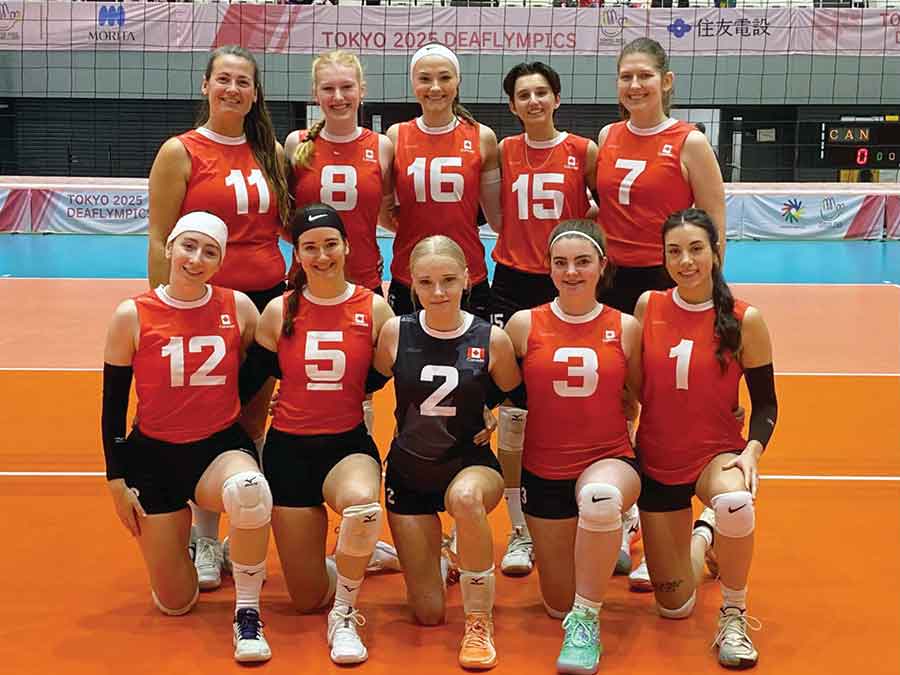
Members of Canada’s national women’s Deaflympics volleyball team gather ahead of competition in Tokyo, where Selkirk’s Annika Goodbrandson (back row, centre) joins the roster as the lone Manitoban. The 2025 Games mark Goodbrandson’s first international appearance in volleyball and the 100th anniversary of the Deaflympics
The Comp graduate, who played basketball for the UWinnipeg Wesmen before entering the University of Manitoba’s Faculty of Education, is the only Manitoban on the Canadian women’s roster. For Goodbrandson, who is profoundly Deaf, the opportunity marks both a personal milestone and an important moment for visibility within the Deaf and Hard of Hearing athletic community.
“I am honoured to represent not only Canada, but also Manitoba — and more importantly, young girls like myself from Selkirk and surrounding communities,” she said. “I’m proud that I can set an example for young female athletes, whether they’re in volleyball or in multisport like I was.”
Goodbrandson learned of her selection shortly after graduating from the U of W, when she decided to step away from her basketball career to pursue international competition in volleyball. The transition reunited her with teammates who, she said, quickly welcomed her back.
“I immediately felt part of the team again,” she said. “Multiple teammates reached out expressing their excitement to play together.”
Her father, Dean Goodbrandson, said Annika’s drive was evident from childhood.
“As a young athlete, Annika was very active and motivated,” he said. “She was a very visual learner and had to overemphasize paying attention to coaches’ instructions, which made her an even better athlete. She never let her hearing deficit slow her down one bit.”
Growing up, Goodbrandson was often the only Deaf athlete on her teams. Teammates and coaches helped ensure she was included through gestures, visual cues and adapted communication. Support from the Central Speech and Hearing Clinic also helped her navigate hearing equipment throughout her athletic development.
Her accomplishments reflect that determination. At the Selkirk Comp, she excelled in water polo, cross-country, track, volleyball and basketball, earning the Manitoba High School Athletic Association’s Scholar-Athlete Award in Grade 12. She later became a U Sports Academic All-Canadian.
Leaving for Tokyo brought a mix of excitement and gratitude, she said.
“It was very exciting to meet up with teammates along the way. It reminded me how great our team support is,” she said. “Despite our different communication styles — ASL, spoken language, or both — everyone is inclusive and helps one another.”
Communication on the national team is almost entirely visual. Players rely on ASL, foot stomps to gain attention, gestures, and training sessions without hearing devices to simulate match conditions. The team also works with an interpreter, Vicki, who supports communication at practices and events.
Training as a national squad presents challenges, as players travel from across the country to gather every few months. To stay prepared, Goodbrandson maintains her own fitness schedule and trained at home through the summer.
Her support system, she said, has been essential. She credits her parents, brother, partner Spencer — a volleyball player himself — and both families for encouraging her through major decisions, including stepping away from basketball.
“My parents have been my biggest supporters since the day of my diagnosis,” she said. “And Spencer pushed me to pursue this opportunity when I wasn’t fully sure. He was the extra encouragement I needed.”
As the Deaflympics begin, Goodbrandson hopes her young team focuses on growth.
“With many of us competing for the first time, I really want us to learn together from the experience,” she said. “We’re playing against some former and current pro players, and we have a big age range on our team — from 16 to 44. As a young group, we have the potential to grow into a more competitive team by the next Deaflympics.”
And while the competition is central, she’s also embracing the experience.
“I’m most excited for the culture, the food, and bonding as a team,” she said.
Her father, watching from home, said seeing her wear the maple leaf is “simply amazing.”
“It makes us proud of her, her team, and the fact she’s part of the 100th anniversary of the Deaf Games,” he said.