A hundred years ago this month, a young Mennonite physician began his practice in Winkler.
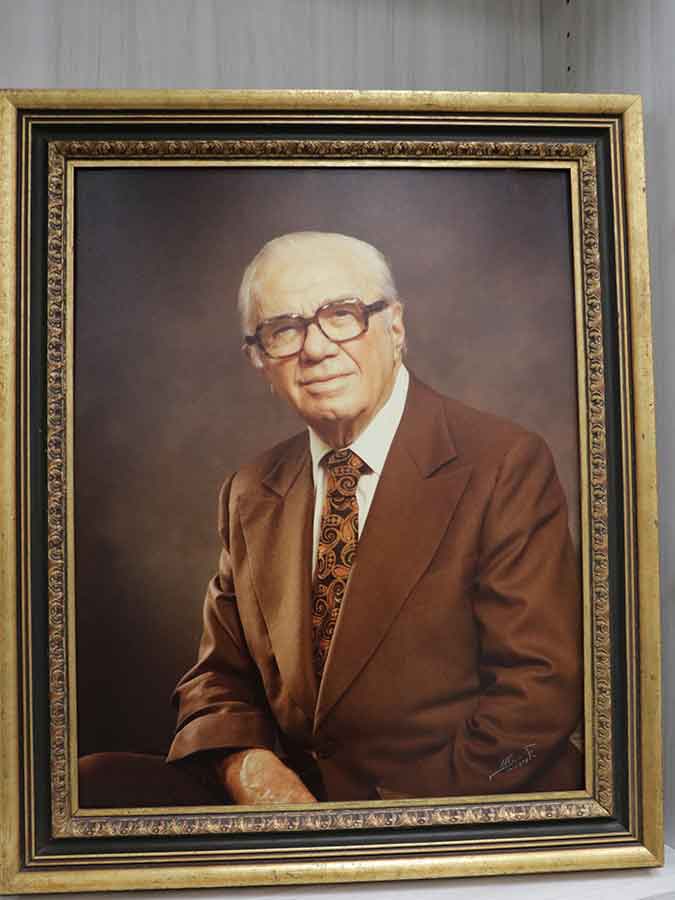
Dr. Cornelius W. Wiebe would go on to transform the medical landscape in the community, spearheading the construction of and later expansions to Winkler’s first hospital, tirelessly advocating for improvements and education in both public and personal health, and delivering over 6,000 babies before his retirement in 1978 after 53 years as a beloved small-town doctor.
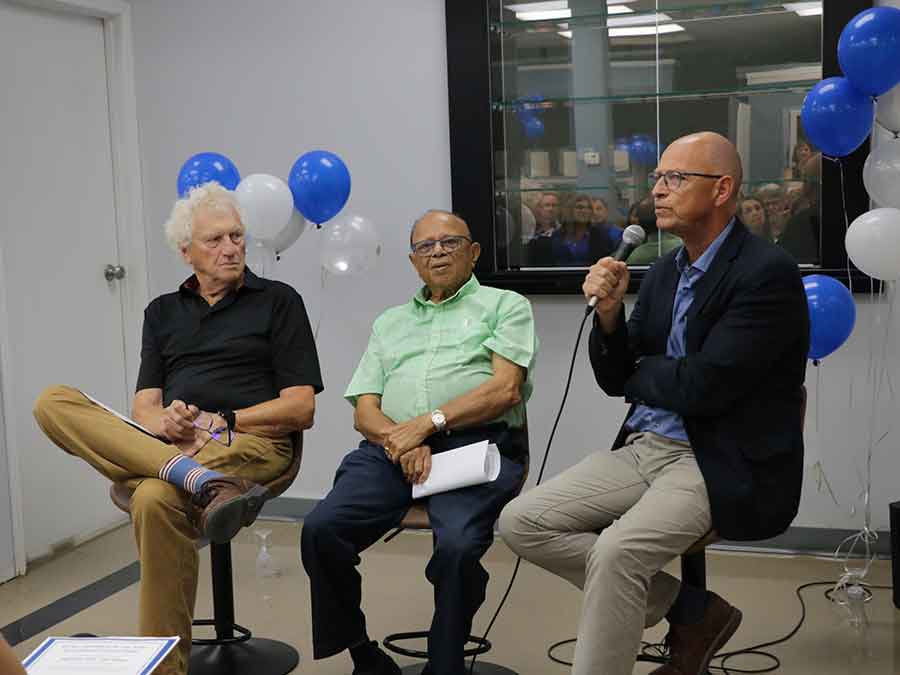
From left: Drs. Don Klassen, V.C. Chandy, and Cornelius Woelk shared memories of Dr. C.W. Wiebe at the ceremony honouring the 100th anniversary of his practice
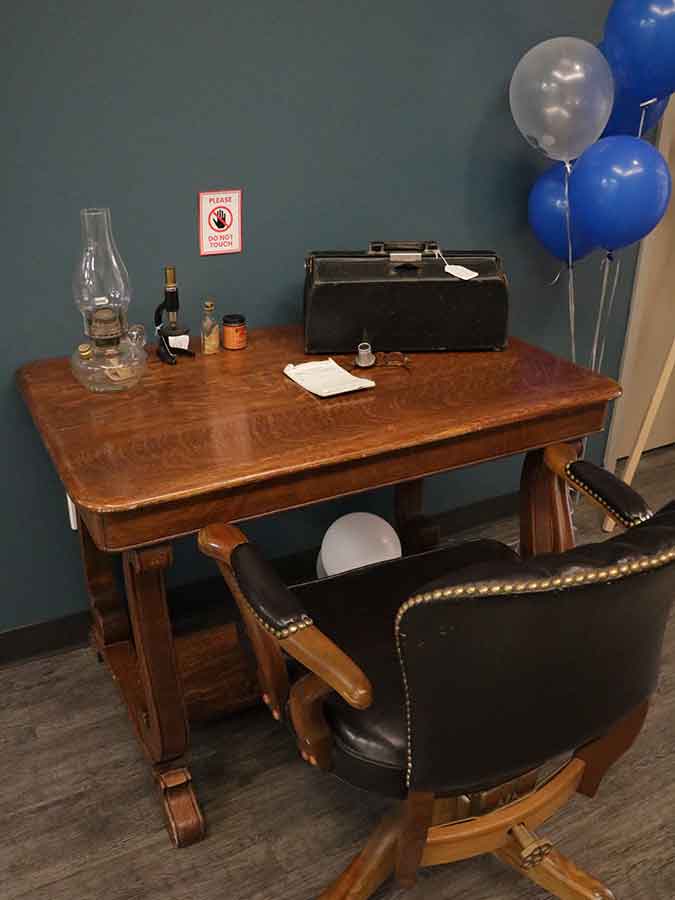
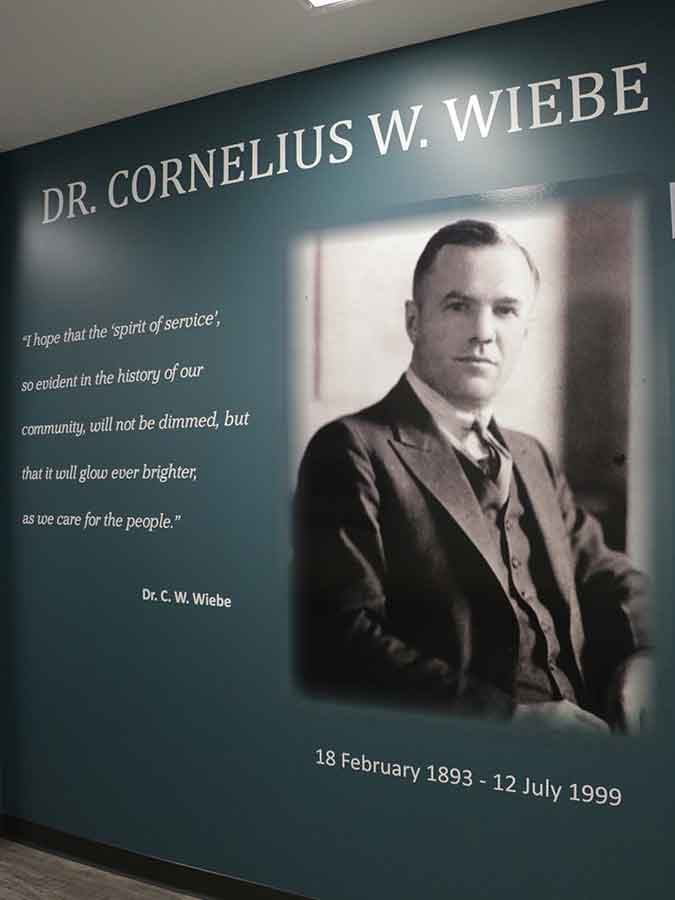
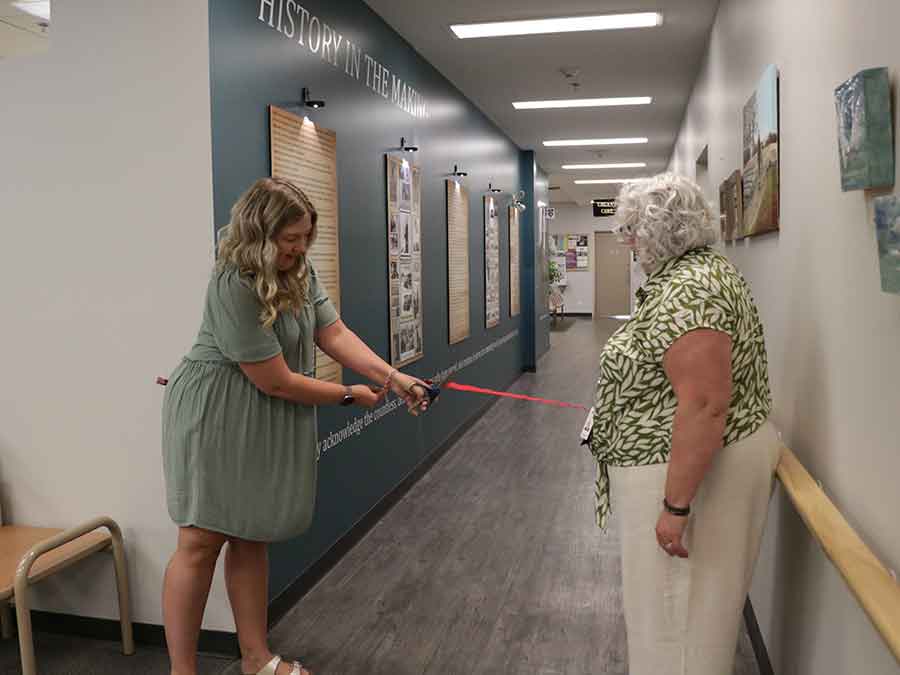
Last week, the medical centre in downtown Winkler that bears Wiebe’s name celebrated the ongoing impact he had with the unveiling of a tribute wall detailing the highlights of a lifetime of service.
“It’s an opportunity to honour the legacy of the man whose dedication to caring has helped really shape the community, and whose work formed the foundation of what our physicians and healthcare professionals today really rest upon in providing healthcare today,” said Karen-Denise Cyr, executive director of the C.W. Wiebe Medical Centre.
In his remarks, Mayor Henry Siemens reflected on the enduring legacy of Dr. Wiebe.
“There are maybe a handful of people who were truly involved and truly critical to creating Winkler as it is today. Dr. Wiebe was one of them,” he said. “His care, his concern, his passion for community allowed Winkler to grow the way that it has, because without good health care, no community could grow … Winkler today would not be possible without Dr. Wiebe and this clinic.”
Siemens asked the assembled crowd to raise their hands if they were a “Dr. Wiebe baby.” Those that did represented multiple generations, making it clear just “how many years he served to be able to deliver babies over all those years and to help this community become what it is.”
Dr. Nichelle Desilets, president of Doctors Manitoba, shared how Wiebe once headed up the Manitoba Medical Association, which later became Doctors Manitoba.
“Dr. Wiebe was a tremendously accomplished physician, public health advocate, and champion of community health. A true inspiration to all of us who work in Manitoba’s rural family medicine community.
“What strikes me as most inspiring is how he cared for his community on a daily basis,” Desilets said. “He knew that seemingly small acts of kindness made big, life-changing differences, whether he was rushing to a patient’s home to deliver triplets because they couldn’t get to the hospital or accepting food as payment for services because his patients could not afford care.
“And I must say, as someone who is passionate about providing maternity care to patients close to their home, to deliver 100 babies a year without a hospital in the middle of the Depression is quite a feat, to say the least.
“He continually pushed for better education and facilities for colleagues and patients, unwavering in his duty to provide the highest level of care to those who needed him,” continued Desilets. “It’s evident that Dr. Wiebe’s legacy of service, generosity and hard work lives on in this medical community.”
Three longtime members of that medical community—Dr. Don Klassen, Dr. V.C. Jacob, and Dr. Cornelius Woelk—stepped up next to share their memories of working with Dr. Wiebe.
Woelk began his practice in Winkler after Wiebe had already officially retired—but that didn’t mean the elder physician wasn’t still a familiar face at the medical clinic. Woelk recalled running into him one day in the hallway.
“He pulled out a magazine, a medical journal, and said, ‘I want you to read this article … and then I want you to come to my place for tea.’”
The article detailed making use of a patients’ immune system to battle cancer, today known as immunotherapy—something that was still a few years away from becoming a standard treatment practise.
Woelk recalled thinking it was an idea that was on the edge at the time, but he found the resulting conversation with Wiebe to be enlightening.
“Given what he was reading, he had a real sense of curiosity, and he was thinking about the future, he was open to change.”
Klassen’s time as a physician in Winkler overlapped with Dr. Wiebe’s by three months. It was a privilege to work with him, he shared, and he has tried to honour Wiebe’s legacy in the years since.
“I have been kind of one of the guys who carried the ball that Dr. Wiebe handed off to us and have tried to move it along,” Klassen said. “I take that as a real privilege.”
Klassen reflected on Dr. Wiebe’s commitment to improving pre- and post-natal care for mothers.
“He noted that infection—sepsis—and bleeding were two of the major causes of maternal mortality … he thought he would do something about that,” he said. “There was no hospital; he did his own deliveries. So he got the idea that some pre-natal care was really quite a good idea. Finding the ladies who had high blood pressure and the other things that needed to be tended to before they delivered and had seizures in the post-partum period, those were important to him.”
Wiebe also led the charge in getting people vaccinated against preventable diseases as more and more vaccines became available in the mid-20th century.
“He saw people who died of tetanus and diphtheria, and then the whole polio epidemic of the early ‘50s,” Klassen said. “So he saw all of those infections and said, ‘I want to see if I can do something about that.’ And he did.”
As the public health officer for Winkler, Dr. Wiebe laboured tirelessly to convince area residents to get immunized, working with local educators to get the word out about the benefits of vaccines.
Jacob, who began his own practice in Winkler in the 1960s, credited Dr. Wiebe with bringing quality medical care closer to home for generations of Winklerites.
“Dr. Wiebe was progressive, energetic, and practical,” he said. “He was pursuing his goals that benefited the local community.”
He recalled the time that Wiebe, knowing the Winkler hospital needed more beds, took his case to the government, convincing officials to expand the community’s health district area to include more of the surrounding area and make a larger hospital a reality.
He was also instrumental in the construction of the Valley Rehab Centre (today known as Gateway Resources) for people with intellectual disabilities, Jacob shared, “reflecting his deep commitment to the well-being of all people.
“Dr. Wiebe was not just a physician—he was a builder with great vision,” Jacob said. “His legacy leaves all the institutions he helped to build, the lives he touched, and the enduring sense of community spirit he inspired.”
A labour of love
The tribute wall was a labour of love for clinic staff, who poured through historical documents for the details of Wiebe’s life.
The book Cornelius W. Wiebe: A Beloved Physician by Mavis Reimer formed the foundation of much of that research, shared Cyr, and speakers at the event last week were presented with copies of that book signed by Dr. Wiebe himself in thanks.
Also lending a helping hand were volunteers with the Winkler Heritage Society, which provided a number of artifacts from Dr. Wiebe’s life for the clinic to display, Al Thorleifson, curator of the Pembina Manitou Archive, who reviewed the timeline storyboards for accuracy, and Image Promotions, who installed the display.
After cutting the ribbon on the tribute wall alongside Dr. Tanja Borchers, clinic president, Cyr reflected on how Dr. Wiebe’s legacy lives on in the medical centre today.
“It was a passion project to celebrate him, but also to be a reflection on how much healthcare is important to the community even today,” she said of the display. “We’re really proud about not just that legacy, but also the work that we are doing today and what’s to come.”
The clinic currently has around 40 physicians on staff. Seven new doctors are slated to join the practice this fall.
“We’re always recruiting,” Cyr said, adding that she believes they’re getting to a point where they’re “starting to turn the tide … and carve away at the list of people who are currently without a family physician in this area.
“We know that the physicians who are coming to us in the next few weeks and months are extremely hardworking, really eager to provide as much care as possible,” she said, sharing hopes that they’ll finally be able to expand the Urgent Care hours into the evenings someday soon.
Plans are also in the works for additional renovations and upgrades to the clinic building, which in recent years has expanded into multiple newly available spaces in the ALG Professional Centre. Further details of that project are expected to be released soon.


