National Emergency Preparedness Week May 4-10 asks Canadians to be ready to respond
The Municipality of Bifrost-Riverton is keeping an eye on possible climate-related disasters and other emergency situations in the lead up to Canada’s Emergency Preparedness Week, which runs May 4-10.
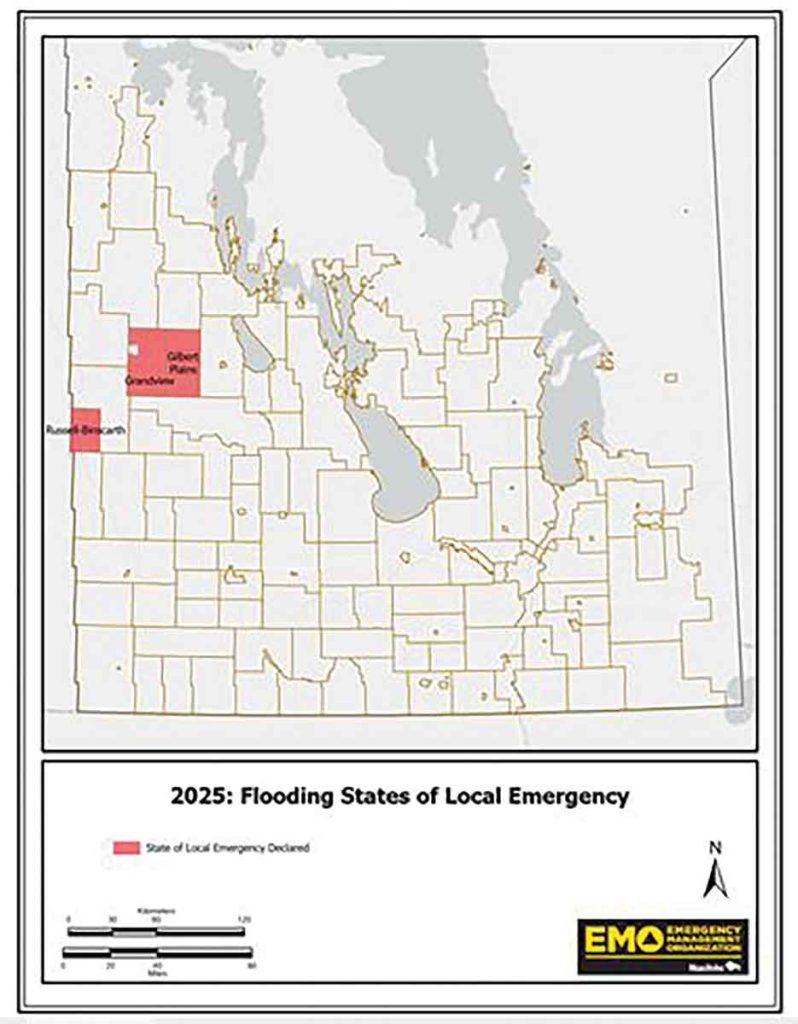
Manitoba EMO’s flood update of April 16 shows no flooding emergencies in the Interlake. Grandview, Gilbert Plains and Russell-Binscarth in western Manitoba have declared flooding states of local emergency
Emergency Preparedness Week is a national awareness initiative that’s coordinated by Public Safety Canada. It encourages local governments and emergency management personnel to promote the importance of being prepared and serves as a reminder to Canadians to learn how to protect themselves and their homes during emergencies.
This year’s theme is “Be Prepared. Know Your Risks.” It encourages people to become familiar with risks in their particular region, which could include droughts, extreme heat or cold, floods, landslides, tornadoes or wildfires, learn how to make an emergency plan and what to include in a 72-hour emergency kit.
Manitoba has its own Emergency Management Organization (EMO), which falls under the umbrella of the provincial government’s transportation and infrastructure department. EMO coordinates responses to emergencies and disasters on behalf of the government, working with municipalities and other local authorities and emergency management partners.
For their part, municipalities typically have their own municipal emergency coordinator (MEC), who works with councils and other organizations when a disaster strikes.
Warren Toderan is the MEC for the Municipality of Bifrost-Riverton, the Town of Arborg and the Rural Municipality of Fisher. MECs are volunteers but are paid for training and during emergencies.
Toderan said all three municipalities have emergency plans that are updated each year, and approved by Manitoba EMO through legislation.
With respect to Bifrost-Riverton in particular, Toderan said there have been three emergencies – flooding, a power outage and a snowstorm that shut the area down for an extended period – since he became MEC in 2019.
“Our emergency plan identifies any potential emergencies and has steps for us to deal with them if they occur,” said Toderan. “Other potential emergencies are tornadoes, wildfires and chemical spills.”
At present, there is risk of an emergency but they’re prepared for one.
“Emergencies are at most times, very unpredictable and can occur at a moment’s notice. We are prepared as best we can if one occurs.”
Manitoba EMO provides public updates on flooding at this time of the year. Its April 16 Situation Update shows no significant flooding risk at this time in the Interlake, and no flood alerts, provincial road closures or evacuations in effect.
“Over the past week, spring melt has begun resulting in a variety of impacts across Western Manitoba including ice jamming, road closures and the activation of the Portage Diversion,” states the update. “Manitoba Transportation and Infrastructure (MTI) staff continue to inspect and monitor drains, infrastructure and bridges. As snowpack remains intact, staff continue to monitor the Parkland and North regions closely.”
Toderan said each of the three municipalities under his aegis have identified in their emergency plans “reception centres” and a “secondary site” where the public can go in the event of a serious emergency.
“As an example, the Town of Arborg would use the Recreation Centre Hall in Arborg. Each emergency plan has identified an Incident Command Centre (IOC),” he said.
In addition to each municipality having an emergency plan, Toderan said they have trained staff and volunteers and they’ve completed training exercises – mock table top and functional exercises – so that they know what to do during emergencies.
The RM of Gimli also has a dedicated MEC, who is working on a plan to use the Gimli Recreation Centre as a public shelter.
“The Emergency Coordinator is creating a plan to bring forward for setting up an emergency centre in support of public safety,” said the RM’s interim assistant chief administrative officer Christine Payne.
In addition to enhancing public awareness of emergencies, national Emergency Preparedness Week will include an Alert Ready National Public Alerting System message.
Manitoba is participating in the test, which is scheduled for Wednesday, May 7 at 1:55 p.m. The test will occur on television, radio and compatible wireless devices. Test alerts help the public become aware of what an emergency looks and sound like so that they can be ready in the event of a real emergency.
Manitoba’s EMO website has a variety of resources for the public. They include a guide to emergencies and disasters, hazards in Manitoba, funding support for emergencies and disasters, and what emergency supplies to have on hand, including water, non-perishable food, manual can opener, toilet paper and cash.
The federal government’s Public Safety Canada website also has information on hazards and guides for Canadians so that they can be prepare for and know what to do in an emergency.