Bugs are no strangers to Manitoba — especially for farmers and agronomists who deal with them every growing season. Helping those producers understand which insects pose a risk and which are beneficial is the job of John Gavloski, provincial entomologist with Manitoba Agriculture, based in Carman.
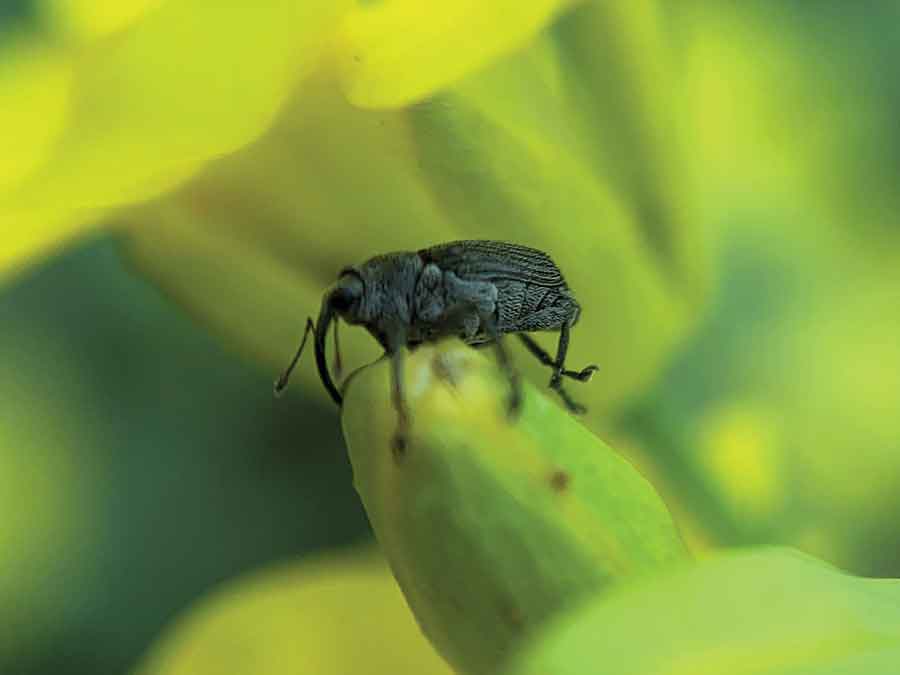
Cabbage seedpod weevils are a growing concern for canola fields. Pictured is a cabbage seedpod weevil found in a canola crop near Carman
“A huge part of my job is educating farmers and agronomists about insects,” Gavloski said. “I spend a lot of time fielding questions, collecting insect data and producing relevant information about insects that may harm or benefit crops.”
While Gavloski always knew he wanted to work with animals, his interest in entomology took off during university after enrolling in an entomology class taught by what he described as a “very enthusiastic instructor.” One course quickly turned into two, which eventually led to a summer job in the field — and a career that has now spanned nearly three decades.
This week, Gavloski is sharing his expertise at Ag Days in Brandon, where he is delivering two presentations focused on insect concerns in Manitoba crops.
The first presentation addressed insects commonly found in canola crops. A major focus was the cabbage seedpod weevil, an insect that had not previously raised alarm in the province.
“I have been tracking the cabbage seedpod weevil since its arrival in Manitoba in 2017, and the levels were never reaching problem status,” he said. “But last year, the population completely exploded. Now it’s my job to inform farmers how to scout for it, how many is too many and what steps they can take to control it.”
He also emphasized the diversity of weevils. Worldwide, there are more than eight times as many species of weevils as there are birds, with some weevils being beneficial to agriculture.
His second presentation highlighted several insects that were abundant across a variety of crops in Manitoba in 2025. Gavloski discussed three different weevils, how to correctly identify them and effective strategies for managing them. Flea beetles in canola, grasshoppers and beetles that feed on stored grain were also covered.
The session concluded with a “Crop Talk,” allowing attendees to ask questions, similar to the weekly Crop Talks he serves as a panellist on during the summer.
“I want to make sure farmers and agronomists are getting the information they need,” Gavloski said. “I try to address most of the questions they have. I want what’s best for them, and Crop Talks help with that process.”
During the growing season, Gavloski also distributes weekly insect survey results through the Manitoba Crop Pest Updates newsletter. Anyone interested in subscribing can email crops@gov.mb.ca with the subject line “Subscribe to Insect Report.”
Despite his focus on pests, Gavloski emphasized that not all insects are harmful. Many play important roles in agriculture, including pollination, decomposition and natural pest control.
“To put it simply, if you don’t have the good guys, the bad guys will quickly take over,” he said. “The constant battle is ensuring populations don’t get out of hand. It’s about knowing how to manage insects, and that’s where I can help.”
According to Gavloski, farmers and agronomists are generally appreciative of his work, often sharing positive feedback about receiving early warnings on emerging insect issues and having opportunities to ask questions.
When it comes to crop vulnerability in Manitoba, Gavloski identified sunflowers and canola as being particularly susceptible to insect damage. Several insects feed exclusively on sunflowers, and some can be quite damaging to sunflowers grown for seed consumption.
Canola faces its own challenges, especially from flea beetles. When early crop growth is delayed, flea beetles can feed heavily on seedlings, creating what Gavloski described as a “real problem” for producers.
More information on insects and agriculture — including past seasonal reports and insect identification guides — can be found at www.gov.mb.ca/agriculture/crops/insects/.
Gavloski noted pest populations can fluctuate dramatically from year to year, depending on factors such as weather conditions and the presence of natural enemies like predators, diseases and parasitoids.
Over his career, he has seen a noticeable increase in the number of pest species in Manitoba, adding to the number that must be monitored. Some introduced insects arrive through natural movement, but many are human-assisted. For insects of concern on crops and trees, many arrive in the province through vehicle transportation or the movement of firewood — something that is strongly discouraged nationwide.
“Bugs are awfully good hitchhikers,” he said. “Always be conscious if you are transporting plants or soil into the province, and make sure the insects we don’t have — and don’t want — stay out.”
Looking ahead, Gavloski expects to add more invasive species to his watch list over the next few years and is already monitoring several insects that have yet to arrive in Manitoba.
While insect populations are changing, the technology used to track them in provincial surveys has remained relatively stable. Although newer, more automated traps and synthetic lures are available that can capture a wider range of insects, Gavloski still finds simpler, traditional trapping methods cheaper, easier to deploy and at times more accurate than complex mechanical systems.
For backyard gardeners, Gavloski offered one key piece of advice: use insecticides only as a last resort. When practical, physically removing insects is often easier and cheaper, and overuse of chemicals can lead to resistance.
“All you need is a few individuals with genetics that allow them to survive the insecticide,” he explained. “Those survivors reproduce, spread their traits, and eventually the chemicals no longer work.”