Liberal bill will make literacy assessment mandatory across province this fall
The Evergreen School Division has gone the extra mile to provide support to students who are struggling with reading, says the leader of the Manitoba Liberal Party.
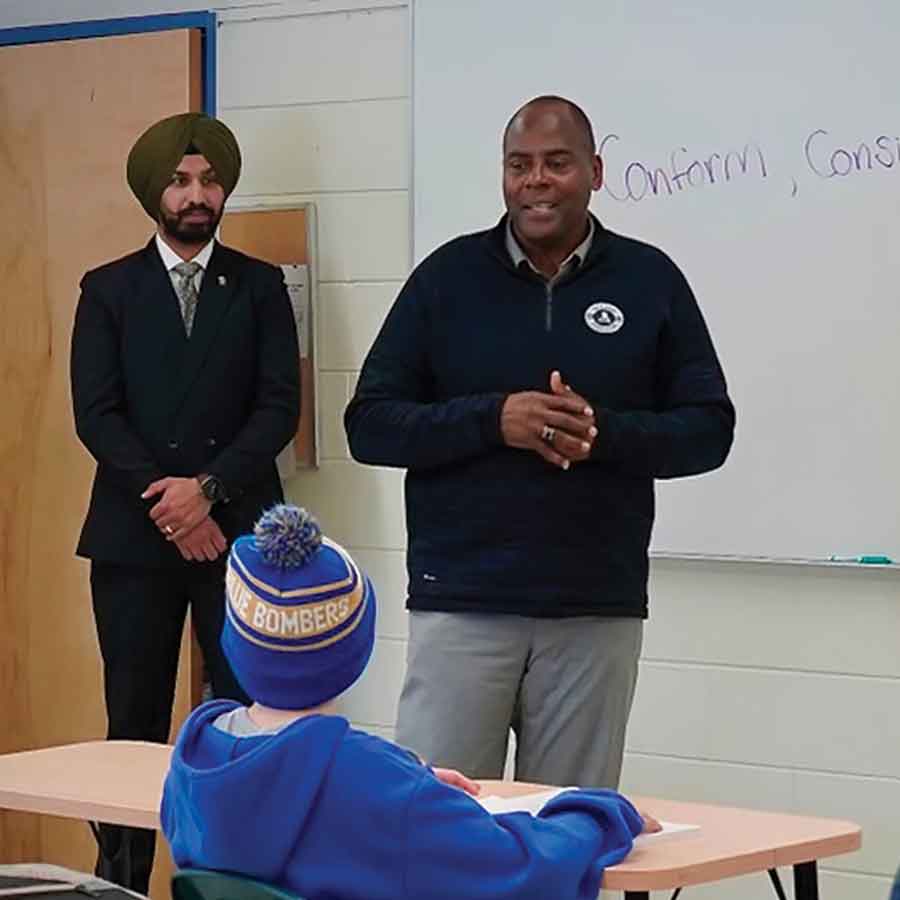
Willard Reaves spoke with students about his own experience with reading challenges when he was a child and the invaluable help he received from his Grade 3 teacher
And its literacy intervention program could be used as a model for other school divisions across the province.
Willard Reaves, a retired Winnipeg Blue Bombers football player who became leader of the Liberal party in 2025, paid a visit to Gimli’s three schools last week to get a first-hand look at the division’s literacy program.
Reaves visited Sigurbjorg Stefansson Early School, Dr. George Johnson Middle School and Gimli High School where he observed the intervention program and spoke with students, then met with Supt. Scott Hill.
“The Evergreen School Division’s program gives students an opportunity to learn when they’re behind a little bit on their reading. The division goes the extra mile to make sure they’re included. The schools work with the students,” said Reaves last Wednesday. “I’m blown away by how this school division is really taking care of our future generations.”
Mandatory literacy testing will be implemented this fall in every division across the province, but ESD is already ahead of the pack, having identified a few years ago a need for assessing students who are struggling to read and providing them with extra reading support. And Reaves said that proactive approach in which no student is left behind is truly admirable.
“Right now, schools around Manitoba are doing pretty much their own thing, and the Evergreen School Division decided to do something hands-on that’s working. They see the science and they know what they have to do,” said Reaves. “The one thing that was so impressive to me was looking at the children with the smiles on their faces. The kids who need that extracurricular intervention to help them catch up are getting that help.”
Reaves said his interest in seeing all students in the province have access to equitable education has nothing to do with politics but with his own personal experience as a child growing up in the United States in the 1960s and 1970s.
That was a low period in American educational history in which there was great disparity between the educational resources provided to black schools and those provided to white schools. And there was resistance to attempts to integrate schools. Lack of equitable educational resources affected students’ school performance, and that helped fuel misleading tropes about racial intelligence and justify continuing segregation.
But Reaves had a teacher who was dedicated to advancing literacy.
“I went to Kinsey Elementary School in Flagstaff, Arizona … and I had a teacher named Mrs. Harris. She was my third grade teacher. She discovered that I was having issues with reading when I was in kindergarten and first grade, and she stuck with me even though I wasn’t in her class for grades 4, 5, 6 and 7. I went to summer school. I had to stay inside sometimes during recess to do extra reading and phonics. Had it not been for Mrs. Harris, I don’t know where I would have been at that particular time,” said Reaves.
“As a black child growing up in the ’60s, there was a lot of disparity in education. Mrs. Harris was a white teacher, and the principal, Eric Curtis, was white, but they didn’t stop helping; they continued to help. They made a difference in my life. That’s why I’m out here to see ESD’s remedial program for myself. And I can tell you I am in awe.”
Students’ literacy performance across Canada has been on a downward trajectory for some time.
The Organisation for Economic Cooperation and Development (OECD) administers a testing program called PISA (Programme for International Student Assessment), which measures 15-year-old’s ability in reading, math and science. The results are used to inform educational policies and practices among the 90 or so countries participating in the assessment.
The currently available PISA results for Canada (2022) showed the average performance of 15-year-old students in reading was trending downwards compared to 2018. That was in line with an “unprecedented drop” in the performance of students across participating countries.
Evergreen School Division posts on its website a “Continuous Improvement Report” that notes educational progress and challenges. Its 2025 report shows 77.68 per cent of Grade 3 students are reading at grade level, but in their provincial reading assessment, only 60.2 per cent of Grade 3 students were “meeting expectations” in that assessment’s sub-competencies. And only 53.2 per cent of Grade 8 students were meeting expectations under the provincial reading assessment.
Given a decline in literacy performance across Manitoba, MLA Cindy Lamoureux (Liberal, Tyndall Park) introduced a private member’s bill, The Public Schools Amendment Act (Universal Screening for Learning Disabilities) in the previous legislative session that will make testing mandatory, twice a year, for children in kindergarten to Grade 4, and ensure resources are allocated to students who need extra help. The bill was ultimately supported by the NDP government and the PC party and is scheduled to take effect later this year.
ESD Supt. Scott Hill said the division has already embarked on an intervention program and has been hosting visits from a number of other provincial school divisions that want to see ESD’s approach to “structured literacy” and its use of universal screening assessments for the purpose of offering early reading interventions.
“We adopted many of these practices a few years ago, and many other divisions are just at the beginning of implementing these approaches in keeping with recent legislation regarding universal screeners, as well as the Manitoba Human Rights Commission’s report [titled] Supporting the Right to Read in Manitoba,” said Hill.
The report acknowledges that ESD is ahead of the curve.
“In 2022/23, Evergreen School Division implemented a comprehensive approach to literacy instruction, premised on the principles of direct and explicit evidence-based instruction in the skills that will lead to effective word recognition and language comprehension. In 2024, Evergreen School Division was honoured with a Dyslexia Canada award for their comprehensive approach to literacy instruction,” states the report (p. 67).
Hill said the division was happy to have a visit from Willard Reaves and Dr. Jon Gerrard (former MP, MLA and leader of the Manitoba Liberal Party) and show them ESD’s reading intervention program.
“They expressed interest in learning more about our approach to literacy instruction and intervention and, more broadly, our teaching approaches that aim to include and engage all students,” said Hill. “Mr. Reaves shared his experience as a child. He struggled to learn to read until a teacher in Grade 3 finally provided the additional support, including systematic phonics instruction, that he needed to get on track.”
Hill said the ESD board of trustees is committed to evidence-based approaches to literacy instruction and intervention, and in keeping with the Human Rights Commission’s direction.
“This has meant providing support in the form of dedicated teacher time in each school to implement interventions, investing in teacher professional learning and intensive training for new teachers, as well as up-to-date evidence-based materials, curricular resources and books that are the right ‘fit’ for our approach to reading instruction,” he said.
“Lower class sizes and single-grade classrooms are additional investments in early learning that contribute to our efforts to secure the best conditions for teaching and learning, especially for literacy instruction. Teaching students how to read is the most important thing we do — it’s foundational to all other scholastic learning, but more importantly, it’s a critical factor in making sure that students are put in good stead to becoming healthy, successful contributing citizens.”