Civil defence refers to the use of organized non-military efforts to prepare for attacks and similar disastrous events. It re-emerged after 1949, when the Soviet Union detonated its first atomic bomb. If the Second World War proved the value of civilian readiness, the Cold War institutionalized it.
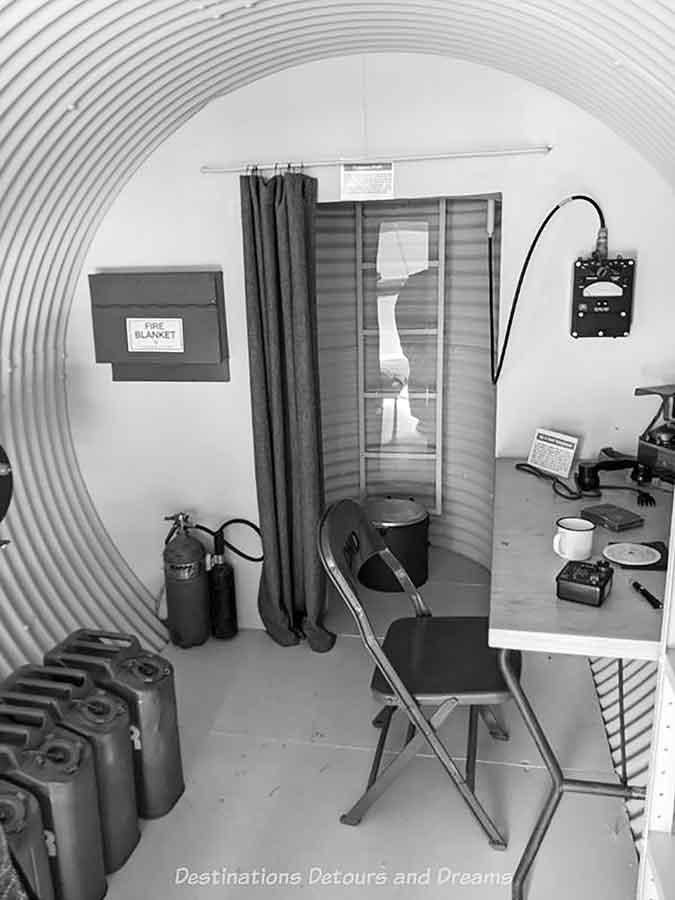
The Town of Miami has restored and recreated a 1950s fallout monitoring post, now open to the public for tours
By the 1950s, the threat of nuclear conflict with the Soviet Union pushed Western governments into full defence planning — and Canada followed suit. This would become the most comprehensive era of domestic preparedness in our history. Responding to the perceived threat of enemy attack, pamphlets, municipal survival plans and mock attack exercises were created to help minimize danger.
The federal government increasingly emphasized responsibility for survival through civil defence organizations, preparations and public participation. On May 8, 1952, Carman decided to form a committee to concern itself with that matter and the lessening of the effects of enemy action in the case of attack.
Kline Cochran, civil defence co-ordinator for the Town of Carman, spoke to the Chamber of Commerce describing the effects of an atomic bomb explosion.
“Explosion of a nominal bomb would completely paralyze a city like Winnipeg. Devastation would be complete within a half mile of ground zero. A mile away damage would be severe; moderate damage would occur up to 1½ miles from the explosion and light damage would be caused to two miles.”
“We must be prepared for national survival if NATO’s thin shield should crumble,” Mayor Harris stated. “Carman is headquarters for one of nine mutual aid areas surrounding the city. We would be called upon to receive as many as 36,000 evacuees in a short time, should the need for evacuation of Winnipeg arise.”
Following the realization of widespread radioactive fallout from the H-bomb in 1954, focus shifted from evacuation to survival and shelter. This was a time when Canadians were taught to expect the worst and prepare for it.
In schools, children practiced duck-and-cover drills and air-raid sirens were installed and tested in many cities and towns. Public service ads in newspapers, on TV and radio taught families how to build home shelters, purify water and survive fallout.
The government began building a nationwide Nuclear Detonation and Fallout Reporting System (NDFRS) to measure the pattern and intensity of an explosion. A network of 2,000 small fallout posts — 200 in Manitoba — was constructed. There were three types:
A — a cinderblock structure inside buildings
B — a metal structure underground
C — above-ground shelters on stilts in permafrost areas
Trained volunteers, including RCMP members and postmasters, would detect radiation and transmit data to centres across the country. From there, the information was sent to the emergency headquarters Diefenbunker in Ottawa.
One of those B posts was discovered at the Moose Lake Provincial Park entrance. It consisted of a 10-foot vertical metal tunnel that led down to a horizontal corrugated-metal 8 × 14 cylinder. It housed radiation monitoring equipment, storage, food and water for two weeks, and two beds. In 2023, it was dug up and moved to Miami.
“This thing is a real Cold War artifact, basically a giant culvert. It’s the only one of its kind restored in this way in Manitoba — maybe Canada,” said Gilles Messier, who found the decommissioned post and was the driving force behind the project. Visit or contact the Miami Railway Station Museum, which hosts tours of this must-see!
Shrapnel: Miami’s post would have been operated by the CNR agent and was buried west of the station. It was decommissioned in the early 1970s.
The four-storey Diefenbunker was the largest and could keep 565 people “comfortable” for one month. It too is available to tour in Carp, Ont.
Building a personal shelter involves significant cost (ranging from $10,000 to $100,000+) and requires permits, with potential issues from local water tables and soil conditions. Companies now offer pre-built underground bunkers, often made from shipping containers, designed for modern survival needs.
The primary responsibility for civil defence was eventually transferred to EMO.