During the 1950s and 1960s, prefabricated homes, also known as Ready-To-Move (RTM) houses, experienced renewed popularity as an effective solution to the post-Second World War housing shortage. Numerous companies began manufacturing and promoting these homes as cost-effective alternatives to conventional housing, with Carman supporting several entities that became industry pioneers.
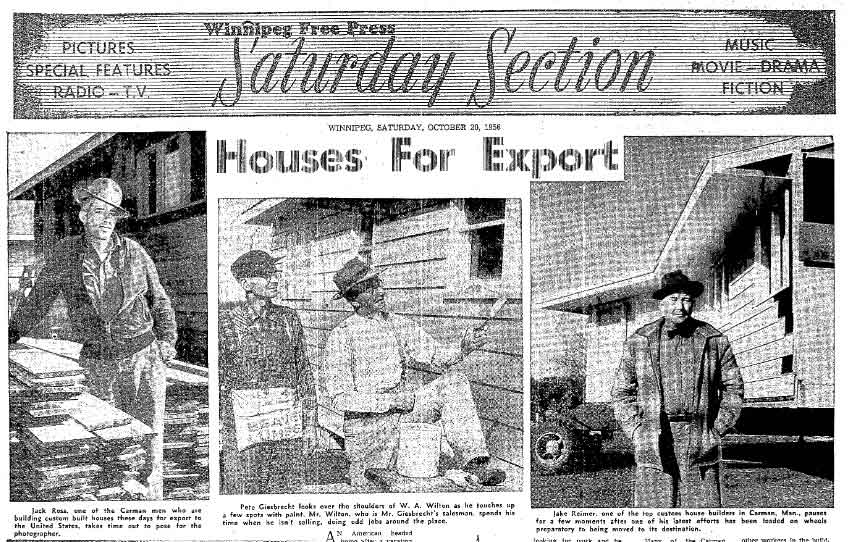
This article was from 1956 emphasizing Carman’s housing industry
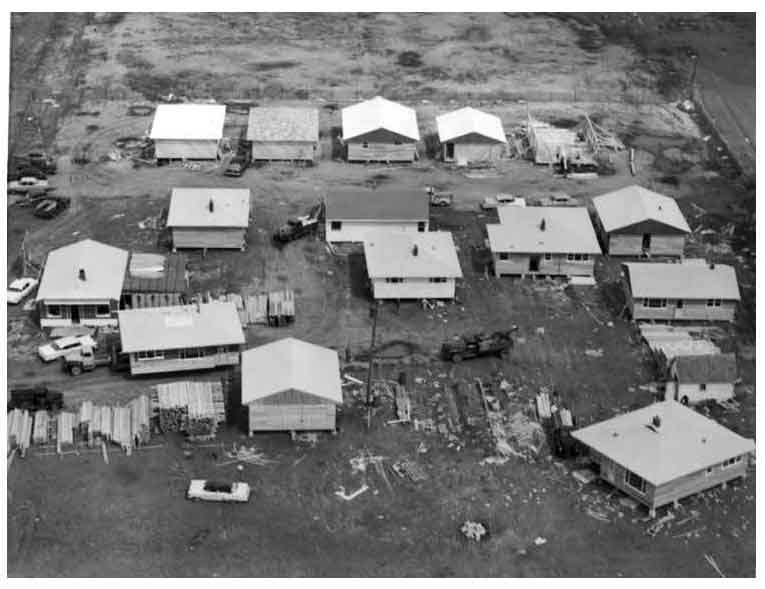
The RTM sector in Carman began modestly in 1951 but expanded rapidly; by 1957, five contractors were actively involved to varying extents. Frank Giesbrecht led the initiative, followed by Jack Ross, Jake Reimer, Tom Watson and Pete Giesbrecht’s Town and Country. In total, 90 homes were relocated in 1957 alone — Ross accounted for 31 of these sales — with a combined value of $550,000 (equivalent to approximately $5.8 million today).
Building multiple houses concurrently on a single site allowed contractors to extend substantial savings to buyers. Once constructed at the contractor’s facilities, the homes were transported directly to prepared foundations across Canada and, notably, into the United States.
Several factors made this business model especially attractive to the American market: Manitoba’s average wage of $1 per hour was significantly lower than the U.S. average of $2.50, there was a skilled labour shortage in the United States, and proximity to lumber yards in Carman further reduced costs. Consequently, it was often more economical for U.S. buyers to have their homes built in Carman and shipped south.
The price range for these homes varied between $3,000 and $16,000 (about $185,000 today), depending on the size and chosen amenities such as flooring and paint. Clients reported savings of up to $2,000 (approximately $17,000 today) through this approach. Contractors took pride in the durability of their construction, as evidenced by minimal repair requirements following relocation managed by Harms the Movers.
Local businesses excelled in attracting American investment to Carman. Despite the significant economic impact — providing employment for more than 60 individuals and supporting related trades — the local importance of the RTM industry was often overlooked due to its gradual expansion.
Sidings: In 1956, Jake Reimer delivered what he referred to as “the grandpappy of them all” to Inkster, North Dakota. This residence spanned 2,000 square feet, weighed 50 tons, measured 60 by 58 feet in an L-shape, required transport in two sections and necessitated the temporary removal of road signs along the 170-mile route. The project cost $22,000 (approximately $254,000 today).
Sidings: A notable year for new construction occurred in 1960, with projects totaling $662,000 in value (about $7.3 million today). This included commercial buildings (Co-op store, Bill Pethybridge, Cam Johnston, Elias Lumber, Pat’s B/A and R & S Drive Inn), school initiatives, residential developments (on 1st Street SE and 3rd Street SE) and renovations (Safeway’s expansion, McMillan’s Red & White and Sanders Drugs). The RTM industry continued to flourish throughout the 1970s and has remained active to the present day.
Sidings: Research for this article revealed a Headingley-based RTM company whose owner discovered an Oct. 20, 1956 edition of the Free Press featuring Carman’s industry leaders — Jack Ross, Jake Reimer and Pete Giesbrecht — on the front page. The newspaper was found during recent renovations in the ceiling of the owner’s grandfather’s home.
Sidings: In 2025, the Carman-Dufferin-Grey Planning District issued $14,030,121 in residential permits, an increase from $9,827,622 in 2024. Of this total, $10,474,800 was attributed to new home construction. Commercial, industrial and farm permits reached $41,272,665, compared with $11,012,410 the previous year.


