The Morden air cadet squadron had esteemed visitors recently, and the commanding officer saw it as an honour that very much reflects the success of the program here.
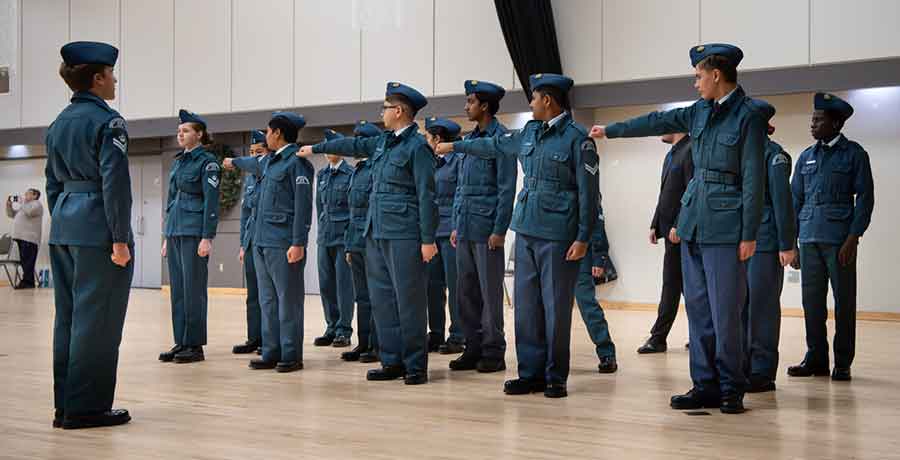
The local air cadet program has 61 members from all across the Pembina Valley
On Dec. 1, the Morden squadron welcomed Lieutenant-Colonel Jennie Deutscher, CD, Commanding Officer, and Chief Warrant Officer James Sandall, CD, representing the Regional cadet Support Unit for the northwest, which takes in Manitoba, Saskatchewan, Alberta, and the Yukon.
“This was a huge honour for our squadron and a very rare occurrence,” said commanding officer Roxanne Maynard, who also received an award that night for her years of service in the Canadian Armed Forces.
“The cadets worked hard on their drill and getting their uniforms up to snuff and to be looking their best and behaving their best for the lieutenant colonel,” Maynard shared. “It was a great evening, and the cadets did great. It was cadets leading cadets, and they were able to show that on that evening.”
The air cadet program usually includes a commanding officer’s parade, but this one was obviously a bit special.
“It’s very rare that we get a visit from a commander like that,” said Maynard. “In my career, the only time I had a lieutenant colonel come down to a squadron was when there was a change of command … and I’ve been part of the military now and involved with this for 13 years, so it’s something special.”
Maynard reflected on the success of the Morden squadron, which is now at 61 cadets—a number that she sees as really noteworthy.
“That’s getting quite big … for a rural squadron, that’s quite large,” said Maynard, who noted the program is open to youth from age 12 to 18.
“They come from all over the place. Some come from Winkler, some come from St. Joseph and St. Jean. We have some come from Carman and even some from the western part of the province as well,” she said. “They come from quite a large circle.”
Maynard offered her thoughts on what might draw youth to become an air cadet.
“I think a lot of it is being a group, working together as a group,” she said. “When they come to cadets, they’re wearing the uniforms. They all look the same. They’re not necessarily at the same level, but they’re all able to come here and learn things together … learn things about teamwork and have the camaraderie with other cadets.
“We also try to do community service, and we have different optional training,” she noted, citing the example of learning marksmanship. “We’re also looking into the possibility of building a band again.
“They just love it. By the time they age out of the program they’re used to organizing activities and providing supervision,” said Maynard. “They’re basically ready to go adults and to go into the world and make the world a better place.”
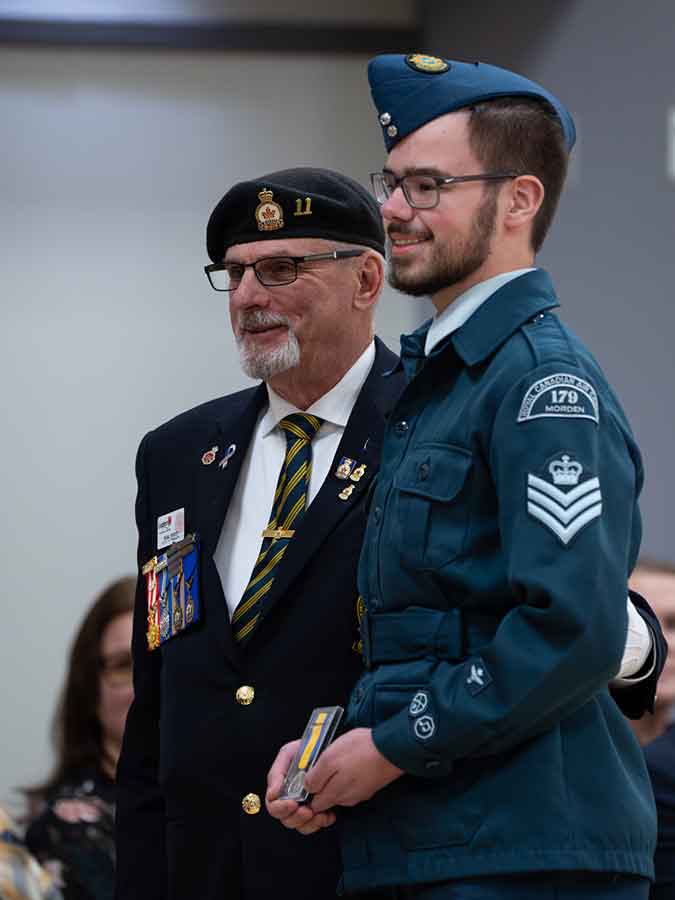
Brady Wolfe, who has been in the air cadets for five years, received a medal of excellence at the ceremony.
“It was pretty exciting, pretty special,” he said, noting what attracted him to the program “was that I wanted to fly a plane.”
He noted he also appreciates the camaraderie of the program.
“Now I like it all … all the stuff that I have learned,” he said. “I’m an introvert, so I’m always in the corner … it’s bringing me out.”
Fellow cadet Lennon Klassen received a Commander’s Coin at the ceremony in recognition of her keen involvement in the program.
“It’s my first year in the cadet program. I started this last September,” she shared. “Last year my school took a field trip to the aviation museum. After that experience, I knew I wanted a career in aviation.
“Air cadets is one path toward that goal. I really like the community service aspect and being able to help others.”


