Canada’s lobster and crab industry got a break earlier this month from almost a year of Chinese tariffs of 25 per cent after Prime Minister Mark Carney was able to strike a deal with Chinese president Xi Jinping.
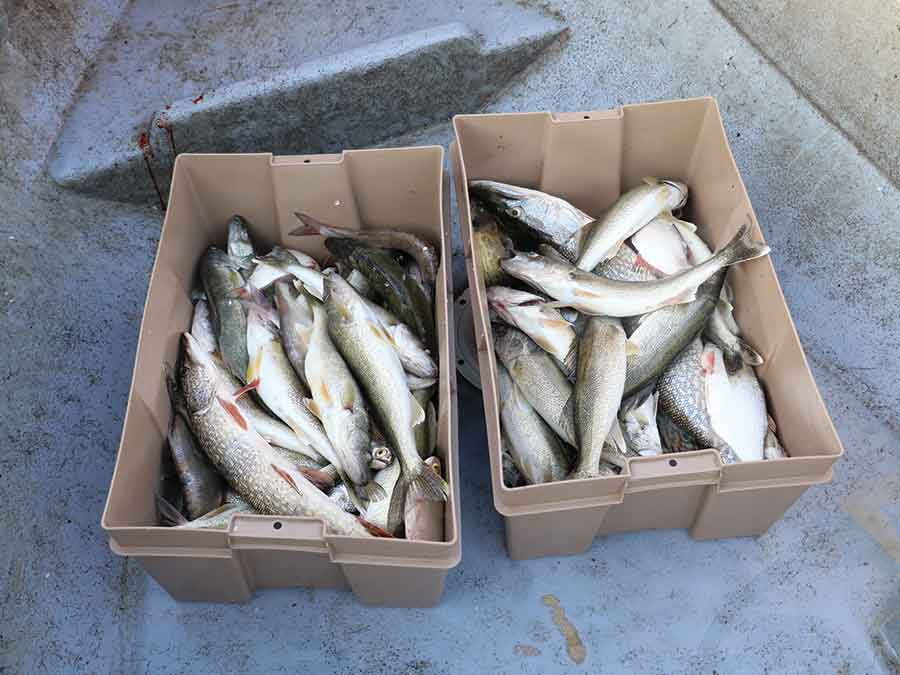
Wild-caught Lake Winnipeg fish such as pickerel, whitefish and pike is shown
China lifted its tariff on the two ocean species — the largest Canadian exports by value to China — on March 1 in exchange for limited access to Canada’s electric vehicle market. The deal appeared to leave other sea species in tariff limbo.
It also seemingly failed to consider Canada’s freshwater fisheries, which produce thousands of tonnes of wild-caught fish each year. That generates about $135 million in annual sales, according to federal fisheries and oceans’ 2023 data.
Lake Winnipeg commercial fisher and analyst Bill Buckels said Canada’s wild-caught inland fisheries are being ignored by the federal government as global trade relationships fragment and tariffs are increasingly used to protect domestic production.
Both the federal and provincial governments should be doing all they can to “explore new markets” for Canada’s forgotten wild-caught inland fisheries, he said.
“It seems that Global Affairs Canada doesn’t care about inland fishers. Everything’s about lobster and crab and the east coast and the west coast,” said Buckels. “Even here in Manitoba, it seems it’s all about pork and canola producers. It’s never about other food producers like commercial fishers.”
He calls Lake Winnipeg the “hub” of the inland fishery in Western Canada. The lake is the largest wild-caught freshwater fishery in the West, roughly equal to Lake Erie’s wild-caught fishery, with American production excluded.
With the uncertainty surrounding CUSMA negotiations this year, Buckels said Canadian political leaders and trade representatives need to explore new markets for “all” Canadian fish. The wild-caught freshwater industry is heavily reliant on sales to America.
“American tariffs have so far not had an impact on us because there is currently no tariff on the fish we export to the United States. But that could change,” said Buckels. “And we’ve lost other markets; our freshwater fish exports are still banned from the Russian market.”
Russia imposed an embargo on Canadian fish and seafood products in 2014 after Russia annexed Crimea in southern Ukraine. Canada had placed economic sanctions on Russia in response to its invasion.
Buckels said the federal government’s Freshwater Fish Marketing Corporation knew at that time it “should have found a market for all fish, but it, in fact, failed to find a market for all fish.”
FFMC used to be the sole purchaser of Manitoba wild-caught fish before the provincial Conservative government abolished the monopoly in 2017 and created an open market.
In 2024 and 2025, FFMC saw losses of $7.2 million and $7.6 million respectively, according to the corporation’s 2025 annual report. It put those losses down to open-market competition rather than to the start of the new tariff regime.
How possible new tariffs could affect the future revenue of FFMC, other Manitoba fish buyers and the commercial fishers themselves is yet to be seen. For now, Buckels said Manitoba’s fishery is primarily affected by market access. China is effectively closed to Manitoba fish.
“Manitoba’s commercial fishery is under pressure because we have a limited market. I’d like to know what the federal government has to say about that. For all fish, I want to see access to as many markets as possible,” said Buckels. “And I want to see support for those markets — especially by our provincial government since commercial fishing is very important to our Indigenous communities.”
He added he’s not aware of any trade advocacy efforts the provincial fisheries department has carried out on behalf of the Manitoba commercial fishery.
“The province hasn’t demonstrated any interest in advancing the interests of the Manitoba commercial fishery. This demonstrates the province’s attitude towards the inland commercial fishery, how unimportant they think it is,” he said. “We have a viable commercial fishery here. We’re a food business the same as any farmer. The provincial government needs to advocate for new freshwater fish markets in Europe and our continuing access to the American market. And we need to have a provincial trade delegation to China.”
The Express asked the Manitoba department of fisheries what sort of advocacy efforts it has made with regard to the tariff regime. It didn’t provide an answer.
The Fisheries Council of Canada (FCC) says it is the “united voice for Canada’s wild-capture fisheries industry,” and with regard to the 25 per cent tariff China implemented in March 2025, the FCC had warned of a “catastrophic” impact on and “existential threat” to fishing operations across the country.
In January of this year, the council welcomed the lifting of the Chinese tariff on crab and lobster but asked the federal government for “further clarity” on other seafood species. FCC made no mention of wild-caught (wild-capture) freshwater species.
Lake Winnipeg, Lake Manitoba, Lake Erie, Lake Ontario and Great Slave Lake, to mention a few, are considered wild-caught fisheries.
The Express reached out to the fisheries council, asking where the council sees other market opportunities for Canadian freshwater fish and seafood, and what it expects with regard to fish when CUSMA negotiations get underway, among other questions. It didn’t respond.
Global Affairs Canada didn’t respond to questions about the lifting of the Chinese tariffs on only lobster and crab and the impact on the commercial fishing industry since the tariffs were applied in 2025.
The federal department of fisheries and oceans said the Freshwater Fish Marketing Corporation does not have sales in China; therefore, its sales revenues have not been affected by Chinese tariffs.


