You’ve Been Dispatched: A Flight Nurse’s Memoir – Stories from the Front Lines
When an emergency takes place, we are lucky in Manitoba to have highly capable first responders at the ready to keep us safe and get us where we need to go. Sometimes, in the most dire of situations, people need to get to a hospital very quickly, and the first responders who are part of air ambulance teams are a crucial part of saving their lives. A former resident of St. Andrews as well as former flight nurse, Corine Oxer, recently wrote a book sharing the stories of her time working with our air ambulance service in Manitoba. You’ve Been Dispatched tells stories from Oxer’s first time in a helicopter to the time she participated in what they call a hover exit, and much more.
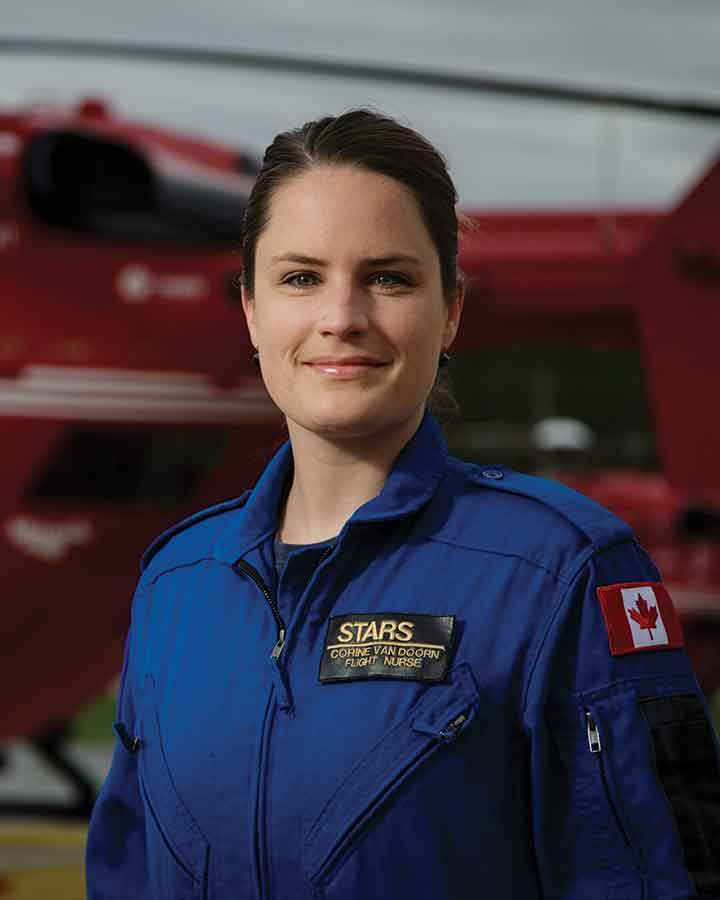
Corine Oxer is the author of You’ve Been Dispatched
“The book is a collection of stories, of things that I have experienced, and that I’ve done when I worked as a flight nurse for STARS in Manitoba mainly, and that was seven years of my career,” said Oxer.
She explained that though she no longer works as a flight nurse, when people find out about that part of her career, they have a lot of questions about things like what kind of calls require an air ambulance, what exactly flight nurses do, or how do you do that job in the cold, so, she decided to share some stories of her experiences over the years.
As a disclaimer, Oxer has anonymized the stories to protect the privacy of her air ambulance coworkers as well as the patients involved.
“Everything has been anonymized. So sometimes I’ve changed ages. I’ve changed gender. I never mentioned a specific location because these things can be pretty specific, not necessarily high profile, but recognizable,” she explained.
Oxer started her career with STARS in Alberta, where she met her husband. He is from Selkirk, and when her dream job as a flight nurse had an opening in Manitoba, they went for it. She lived in St. Andrews and worked out of the air ambulance base in Winnipeg.
“Lots of people might have seen the big red, loud helicopter on some occasions, (but) hopefully never needed it. But STARS, the Winnipeg base, is one of six bases of the organization of STARS in three provinces. And from Winnipeg, STARS responds to two types of calls. They can be scene calls, so anything that happens outside healthcare facilities. So, you’re thinking automatically of the big car crashes, but it can also be people that went through a medical event at home, things like that. The other part of the of the calls are the inter-facility calls. That means, for example, STARS would fly to the Selkirk hospital, pick up a patient there who is not at the right place and needs facilities that are only provided in the city. That could be a patient that cannot be safely transported at that point by ambulance, meaning that patient needs a little bit more than the back of an ambulance can offer, or needs a little bit more speed than the back of an ambulance can offer,” explained Oxer.
As for the first responders doing this work, the air ambulance team consists of two pilots, a paramedic, and a nurse. As well as an on-call transport physician, who, though they aren’t in the helicopter with the team, is still an integral part of the work, providing their knowledge and skills.
Oxer also wanted to say how important the very first responders on the scene, the paramedics, firefighters and police officers, are to what the air ambulance does because without them, the air ambulance team would not be able to do the work that they do.
“(Without) our ground paramedics getting the patient to us or being on scene first, we wouldn’t be there. If it wasn’t for the fire department securing the scene and making sure the rig doesn’t roll, or whatever happens to be, we wouldn’t be able to go in. If it wasn’t for (the) police blocking off the road, we wouldn’t be able to land. There are so many partners in this in this chain, and this gives people an insight into our little chain. But, through these stories, I’ve also tried to make it really clear and really evident how important the role of all the other partners are,” said Oxer.
As for her book, without giving too much away, the stories are a little bit exciting but also very enlightening.
“There are stories about big crashes, there are stories about people that are quite severely injured. There are stories about people that don’t survive. But then, there’s a chapter called ‘It’s Not All Misery.’ There are stories that are sometimes hilarious. There is one about a truck that overturned, and the patient turned out to be fine, but then there was a massive smell and a stench. It turned out to be a truck with pig guts, pretty much. It had overturned, but it’s 3 in the morning. It’s dark. We don’t see it,” she said.
Oxer said that you don’t have to read every story or even read them in order, as each is complete on its own. This means that this is a great book to pick up and put down when needed.
She hopes that people who grab the book get their questions about air ambulance work answered.
“I think there’s a lot of questions, or people are wondering about what they see on the surface and what goes on behind those doors. And I hope they get those questions answered,” said Oxer.
If you’d like to pick up a copy of You’ve Been Dispatched, you can purchase Oxer’s book at www.amazon.ca.


