Liberal MLA Cindy Lamoureux (Tyndall Park) is charting a course to ensure Manitobans living with autism spectrum disorder and their families receive the care and services they need over the course of their lives.
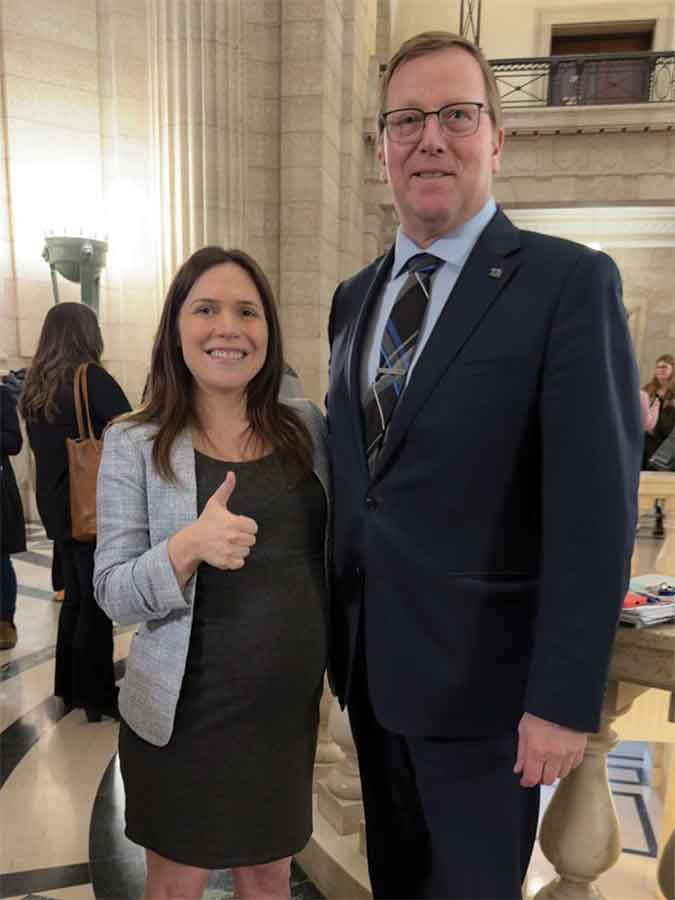
Liberal MLA Cindy Lamoureux (Tyndall Park) with MLA Derek Johnson (Interlake-Gimli), one of three PCs who supported Lamoureux’s autism strategy bill
Lamoureux introduced Bill 232, The Autism Strategy Act, in the Manitoba legislature last month. It would require the provincial government to implement a long-term, co-ordinated strategy to provide support for children and adults living with autism, and will include support for families and caregivers, and provisions for employment and housing, research, data collection and regular reporting.
The number of Manitobans diagnosed with autism spectrum disorder has “significantly” increased over the past decade.
“The needs of those diagnosed are diverse and evolve over the course of one’s life. There needs to be accessible supports and services for people with autism and their families and caregivers in all areas of our province,” said Lamoureux, speaking in the legislature on March 17. “Currently, in Manitoba, there is no long-term co-ordinated strategy to provide the ongoing supports and services needed. Through consultation, I have learned there needs to be an integrated provincial strategy that would encompass several components.”
The Express reached out to Lamoureux, but she unavailable for comment.
In addition to a lack of integrated strategy, Lamoureux said there are delays in diagnosing autism. Children on waiting lists for preschool assessments, for instance, are “aging out” before they can be assessed and access therapeutic services.
And employment and housing supports would allow people with autism to achieve “purpose, meaning and independence,” she added.
In creating the bill, Lamoureux said she had spent months consulting with her constituents, members of Parents of Autistic Children Everywhere (PACE), a Winnipeg-based grassroots support organization, pediatricians, The St. Amant Centre, the Cerebral Palsy Association of Manitoba, Indigenous advocates and other service providers, as well as the Nova Scotia government, which will be releasing an autism action plan.
Through consultation, she said she learned that some parents have had to quit their jobs or use up their holiday and sick time to stay home with their children, or have had to leave work early so that “someone can always be with the child.”
Over the past decade, Lamoureux said Manitoba has been “silent” on creating a province-wide plan to improve access to vital supports and services for autism, and is “starting to lag behind” other Canadian jurisdictions.
“In 2023, the House of Commons unanimously passed the Federal Framework on Autism Spectrum Disorder. This mandates the Minister of Health to create a national framework to improve access to supports, research and services. Nova Scotia will be releasing an autism action plan very soon based off the government’s commitment. This derived from an NDP MLA, Lisa Lachance, and her private member’s bill in 2023. BC is currently discussing rolling out services and assessing differently, and Ontario, Prince Edward Island, Quebec and Saskatchewan are all doing something through autism strategies, plans, committees and ongoing work,” said Lamoureux. “This brings us to Manitoba, where, unfortunately, over the last decade, there has been silence.”
Interlake-Gimli MLA Derek Johnson was one of the official opposition Progressive Conservative members to stand in support of Lamoureux’s bill.
Johnson said he supports bill because it would require the government to improve the screening and diagnosis of autism spectrum disorder and support autism research as part of Manitoba’s health-care system.
It would help identify the gaps in programs and services and focus government funding where it’s lacking.
“How can you focus resources on something when you don’t where the holes are?” Said Johnson. “This bill would have the government create a strategy to identify those issues in our health-care system and also identify supports and the services needed by people with autism and their families and caregivers.”
The bill, if passed, would require annual reporting plus a review every five years, he added. That would address accountability and provide a mechanism by which the strategy could be updated where needed.
“I feel it will truly make a difference for Manitoba families that are struggling to ensure their children reach their full potential,” said Johnson. “There are data that show the sooner you identify autism, the earlier you can them get those interventions and increase their IQ gains. We always want anybody with a disability to reach their utmost potential. We can support therapies for children and adults to help them deal with the challenges presented with autism.”
Johnson said no funding was attached to Lamoureux’s bill as only government cabinet ministers are allowed to introduce legislation that “forces the government to spend money.”
His party also supports families’ choice of therapy program, including applied behavourial analysis and Autism Outreach, but some of those programs should be available as “part of our health-care system.”
Bill 232 received first and second reading in the house last month, but it has yet to be called to committee, where it could be amended, and third and final reading.
The PCs said in a March 19 Facebook post that the Kinew government initially voted “no” to the bill before changing course after “public backlash.”
Johnson said three members of the official opposition Conservatives stood in support of Lamoureux’s bill to force it to a recorded vote, but it’s up to the government to now “call it” to the committee stage. If the government fails to call it to committee, it could die.
“Being the lone Liberal in the legislature means [Cindy] needed other legislative members to support the bill,” said Johnson. “So I stood up and supported it and helped force it to a recorded vote to ensure it got voted on. The NDP voted for it, but we’ll see if they call it to committee.”
The provincial government has programs in place that support Manitobans living with autism, including funding of $21.5 million this year in autism-specific supports and services.
It also provides funding for services, operations and capital projects at the Winnipeg-based St. Amant Centre.
St. Amant’s CEO Ben Adaman said in an April 7 news release on the centre’s website that the province’s 2026 budget incudes a new $5-million commitment that will allow St. Amant to support more autistic Manitobans and their families.
“That is the biggest new investment in capacity in at least 15 years,” said Adaman. “Details are still being worked out, but the government has expressed strong confidence that St. Amant will put those new resources where they are most needed. We are determined to support people to achieve the goals that matter to them.”