With flood risk rising in parts of the Interlake and ongoing pressures from input costs, labour shortages and unpredictable weather, a new Manitoba study is looking to farmers themselves for answers on what supports mental wellness in agriculture.
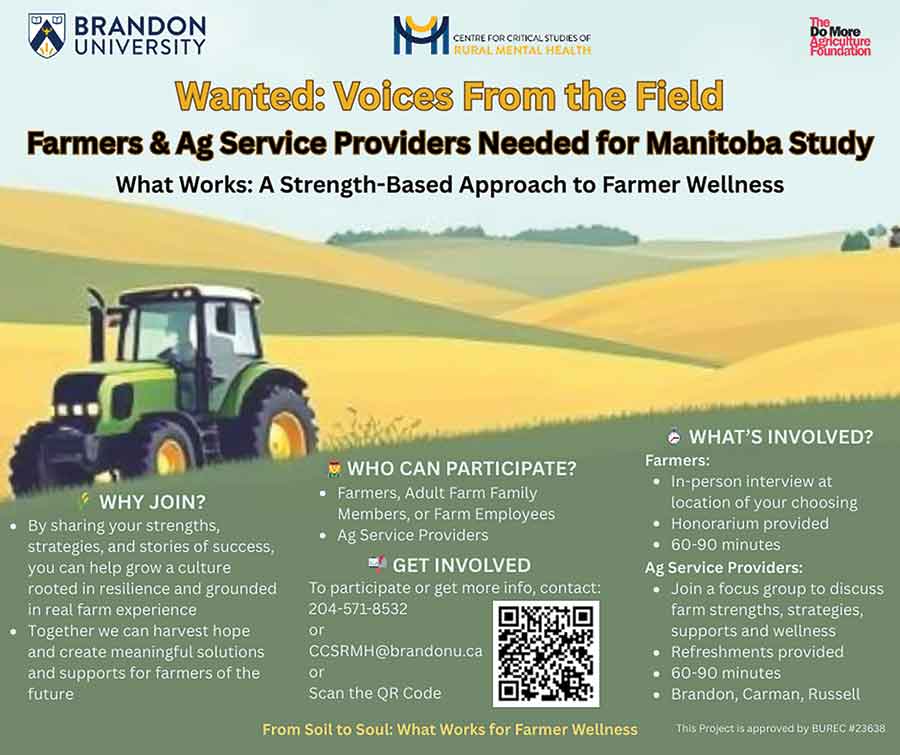
Researchers with the Centre for Critical Studies of Rural Mental Health at Brandon University are inviting farmers and agricultural service providers across the region to take part in interviews and focus groups aimed at identifying what is already working in farm communities.
The project takes a strengths-based approach — focusing not only on challenges but on the tools, supports and strategies producers are already using to manage stress and maintain well-being.
“This research is about listening to farmers and ag service providers and learning from what’s already working,” said Tracy Young, research facilitator with the Centre. “Hearing directly from farmers and those who support them is key to shaping meaningful approaches to wellness.”
Young said the study grew out of her experience working directly with producers and farm families.
“Over the last number of years in my work as a mental health clinician in agriculture, I’ve become increasingly familiar with the industry hardships and the risks to mental health for farmers and farm families,” she said. “At the same time, I’ve also seen the importance of reminding people of their purpose — their connection to the land, the animals and the work they do.
“We hear so much about the downside. Why not take a closer look at the good — the positive, the strengths in farming — and what works to keep the industry growing and thriving?”
Farm families continue to navigate long hours, financial uncertainty and the increasing complexity of modern agriculture, all of which can take a toll on mental health. In regions like the Interlake, those pressures are often compounded by weather-related concerns such as flooding and delayed seasons.
Young said the study is not ignoring those realities but instead aims to highlight resilience within the industry.
“We’re not intending to overlook the pressures farmers are facing,” she said. “We want to gather the voices of strength and hope and help raise them up so the industry can be reminded of the promise that agriculture still holds.”
In practical terms, the strengths-based approach means focusing on what is already helping farmers cope and succeed.
“We want to know what’s working for you — what brought you strength, what gave you purpose, how you keep going and who supports you,” Young said. “From there, we can build on those ideas and develop tools that are truly relevant to the industry.”
The study will collect stories from both farmers and agricultural service providers, with the goal of identifying supports that can be expanded and shared more widely.
Those insights will be compiled into narratives that highlight resilience in agriculture and used to develop tools and resources for producers in Manitoba and beyond, in partnership with the Do More Agriculture Foundation.
Young said participation from farmers across rural Manitoba is critical to the success of the project.
“Everyone’s voice is important. Everyone has a story to tell that could help someone else,” she said. “Agriculture can be isolating at times, and if this study can help share that strength across the miles, that alone is a reason to take part.”
Farmers, farm employees, family members and agricultural service providers are all encouraged to participate.
Participants are being asked to share their experiences, wellness strategies and perspectives on what supports mental health within the agriculture sector.
More information about the study and how to participate is available online at youngt@brandonu.ca or by contacting Tracy Young, principal investigator for the project, at 204-571-8532.