As if they weren’t already struggling to afford food, Canadian consumers are in for another food price hike that predicts a family of four having to pay almost $1,000 more for food in 2026.

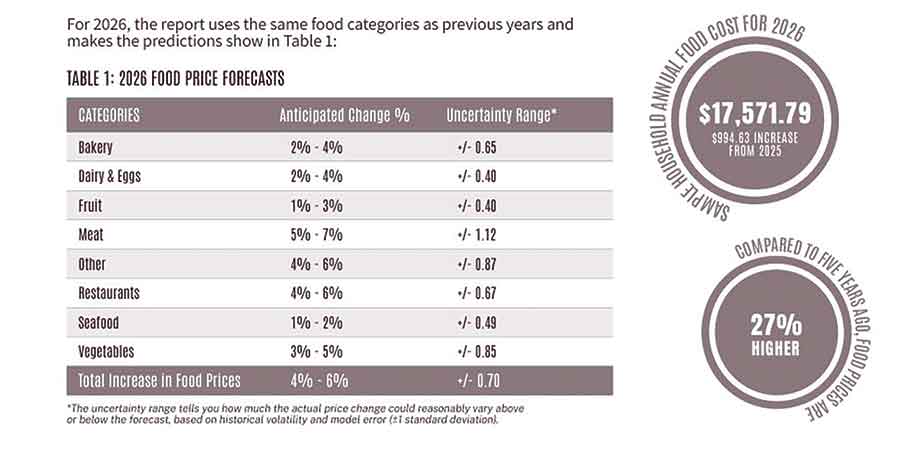
A family of four is expected to pay $994.63 more for food in 2026 compared to last year
The 16th annual Food Price Report from Canadian researchers is painting a bleak picture of food costs.
Led by Dr. Sylvain Charlebois from Dalhousie University, a forecasting team and several academics from universities across the country, the report titled “From tariffs to tables: tracking the forces behind Canada’s 2026 food prices” expects overall food prices to increase by four to six per cent in 2026.
The report estimates that a family of four, consisting of a man (aged 31-50), a woman (aged 31-50), a boy (aged 14-18) and a girl (aged 9-13), could spend up to a maximum of $17,571.79, an increase of up to $994.63 over last year.
“Food affordability remains a top concern for Canadian consumers. A quarter of Canadian households are considered food insecure and nearly 2.2 million people visited food banks in Canada on a monthly basis this year,” states the report. “Although inflation was relatively steady in 2025, food prices are still 27% higher than they were five years ago, and consumers are feeling the strain of these higher prices at the grocery store. Nearly 85% of Canadians reported that their household food expenses have increased in the past 12 months. Moving into 2026, this is unlikely to change.”
Last year, the researchers predicted a family of four having to spend up to a maximum total of $16,833.67 on food. The report’s prediction was pretty close. Based on “observed changes” in 2025, a family of four spent 16,577.16, a difference of $256.51.
Consumers won’t be getting a break on the cost of basic food items in 2026.
The researchers are anticipating price increases across major food categories such as bakery (2-4 per cent increase), dairy and eggs (2-4 per cent), vegetables (3-5 per cent), fruit (1-3 per cent) and seafood (1-2 per cent). Meat prices are expected to spike by 5-7 per cent. Restaurant food is anticipated to cost 4-6 per cent more.
To derive their estimates, researchers used a number of factors that can impact Canadian food prices including the effects of the climate crisis on food production, U.S. president Donald Trump’s tariffs and trade disputes, shifts in the food manufacturing and retail landscape, labour markets, policy changes and the Canadian dollar outlook.
“This year, all eyes were on the ongoing trade dispute with the United States. The inflationary impacts of tariffs and counter-tariffs will continue to be felt next year as trade tensions reshape the economic landscape. The dispute has created uncertainty in the market, as well as supply chain disruptions and declining demand for Canadian exports,” states the report. “With that said, Canada is actively strengthening relationships with other international trading partners to build resilience and global competitiveness. Canada’s removal of almost all counter-tariffs on U.S. imports should also help ease upward inflationary pressures on goods.”
The federal Liberal government’s GST/HST tax break on most food items for all Canadians from mid-December 2024 to mid-February 2025 was “staggering” in terms of its effect on food inflation, dropping to -0.6 per cent in January, the first time food inflation had been in negative territory since 2017, states the report.
Depending on what part of the country they live in, Canadians could be paying below or above the national average of food price increases. Last year, Manitoba and Ontario paid more for food but showed “average” changes. British Columbia, Saskatchewan and the three maritime provinces paid above the national average. Alberta, Quebec and Newfoundland and Labrador paid below the national average increase in the cost of food.
The forecast for 2026 shows Manitoba and B.C. falling below the national average of food price increases.
“Some provinces are projected to shift direction compared to 2025. For example, British Columbia and Manitoba are expected to fall below the national average in 2026 after performing above or at average levels in 2025. In contrast, Ontario and Quebec are forecasted to see above-average food price increases next year,” states the report. “The estimates offer important guidance for policymakers and consumers by highlighting emerging regional pressures and potential affordability challenges across the country.”
Despite some Canadians facing less severe food price increases, American tariffs will continue to impact inflation and global markets, and it’s “unlikely” food prices will notably decreases anytime soon.
“For the food industry, tariffs have meant increased costs and price volatility for businesses, which ultimately get passed down to Canadian consumers at the store,” states the report. “While the isolated impact of the tariffs on food prices is difficult to gauge, the tariffs and counter-tariffs have increased grocery costs.”