The Express made a mistake last week with regard to the date that Lake Winnipeg commercial fisher Robert T. Kristjanson, who’s in his 90s, retired from the Freshwater Fish Marketing Corporation (FFMC) board.
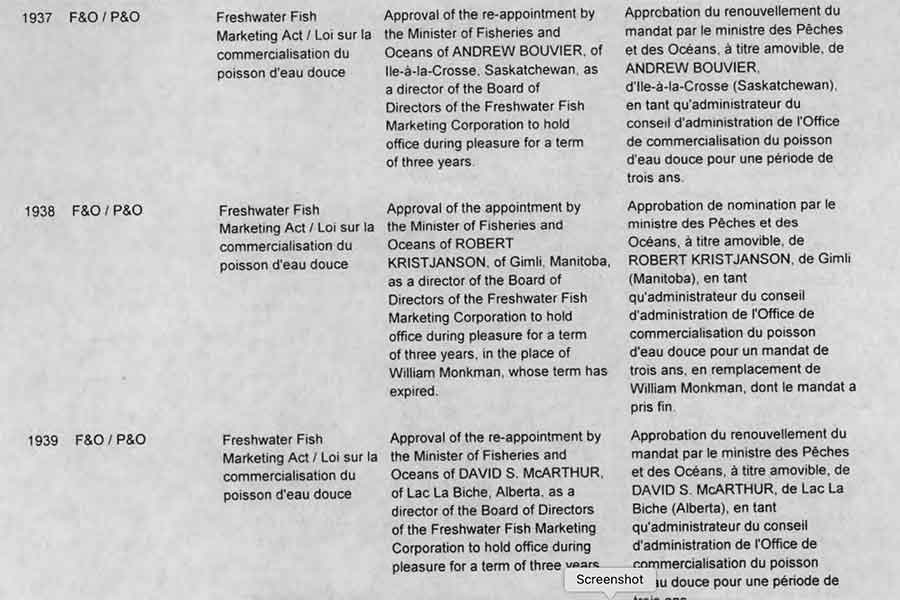
The text of Robert T. Kristjanson’s appointment as director of the Freshwater Fish Marketing Corporation’s board of directors is shown. Kristjanson is noted as serving a three-year term. His appointment was extended by about two years and was acknowledged upon his retirement as having served five years by minister Robert Thibault
And that mistake has re-opened a disturbing chapter in the federal government’s historical data migration, in which federal records with inaccurate dates are still out there on the web and can pop up when journalists and other researchers go looking for facts.
In the Express’s story “DFO unable at this time to reveal its preferred bidder for Freshwater Fish Marketing Corporation” in the April 2, 2026, edition, we wrote that Kristjanson stepped down from FFMC’s board in 2016 after serving five years.
After publication, we learned that Kristjanson actually retired from the Crown corporation’s board in 2003.
The Express attributes its mistake to a 2016 date stamp on a 2003 federal government news release pertaining to Kristjanson’s tenure on the board.
While writing its story on the sale of FFMC, the Express found a federal government news release online titled “Thibault appoints representatives of the Freshwater Fish Marketing Corporation” (noting Kristjanson’s retirement from the FFMC board) with a date stamp of Dec. 15, 2016, and no indication that it was from 13 years earlier.
The Express trusted the integrity of that news release because it had, after all, been issued by the Government of Canada.
Kristjanson, who lives in Gimli, was appointed to serve on the FFMC board in 1998 for a three-year term, which the Express confirmed by searching the online indices of the Canada Gazette.
Kristjanson’s term was extended by about two years until the government appointed Edward Isfeld from Winnipeg Beach to serve in his place.
After an investigation in conjunction with Lake Winnipeg commercial fisher and systems analyst Bill Buckels, we determined that the federal government in 2013 had launched an updated design of the Canada.ca portal and embarked on the migration of documents to that portal, a one-stop shop for government departments and information. Subsequently, misleading dates were applied to historical documents.
“Because the government migrated many of its news archives to the Canada.ca platform, older press releases, like the 2003 FFMC appointment/retirement, were often re-dated or surfaced in search results with 2016 time stamps,” said Buckels. “This led to public confusion in which it appeared the government was reporting Kristjanson’s retirement as a current event in 2016, rather than a historical one from over a decade prior.”
Buckels said government records became a “major casualty” in the 2010s with the digitization and migration initiative. When old documents were uploaded to the Canada.ca server, the system defaulted to an “upload date” rather than to a document’s “original publication date.” And this, in effect, “rewrote history.”
Google, he added, doesn’t know the “truth” about when documents were originally created as it simply indexes what exists on the web.
In addition to misrepresented dates, thousands of historical government documents such as news releases, technical reports and board appointments that the public, journalists and other researchers depend on for contextual information or to hold the government to account “simply disappeared from public view,” added Buckels.
Records from the department of fisheries and oceans, for instance, were gutted during the 2010s, with the government saying it was digitizing those records to save about $430,000.
“Photos emerged of world-class scientific research and historical records being thrown into dumpsters. Only a tiny fraction of that data was ever digitized,” said Buckels. “For a commercial fisher, this wasn’t just a file transfer: it was the literal destruction of decades of data on lake health, fish stocks and water safety.”
The misrepresentation of Kristjanson’s retirement date from the FFMC board raises a broader question about public faith in government information, he added, as the government of that particular time period had failed its duty of “archival integrity” and keeping the record straight.
“As a systems analyst, I know that data integrity is the first commandment of migration. To launch a 10-million-page migration without verifying historical time stamps is either gross professional negligence or a deliberate attempt to sanitize the record,” said Buckels.