A new docuseries is taking viewers deep into the Interlake and beyond, following one family’s quest to uncover answers about Viking ancestry in Canada — and the journey may change how Canadians see their own history.
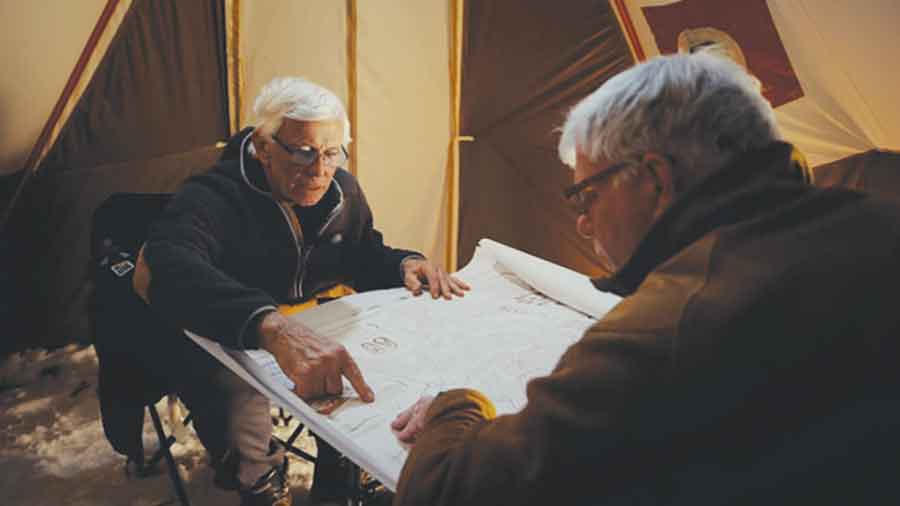
Johann Sigurdson (left) and David Collette plotting their route
Quest for the Lost Vikings, now streaming on Super Channel Quest, explores Icelandic history in Canada through the lens of people, geography and wildlife, revealing stories rarely told.
“It’s a point of Canadian history no one has really looked at before,” said David Collette, lead explorer with Fara Heim.
Fara Heim — Icelandic for “going home” — is a team of four explorers who began their ambitious journey 18 months ago after receiving approval to produce the series. Following 15 months of filming, the eight-episode docuseries is now airing weekly.
Collette and Johann Straumfjord Sigurdson serve as the senior leads of Fara Heim. Both grew up in the Interlake and have spent decades researching Icelandic heritage in Canada. They are joined by junior explorers Mackenzie Collette and Johann Straumfjord Sigurdson Jr., as the team sets out to uncover pieces of Viking history dating back more than 1,000 years.
For Collette and Sigurdson, the project grew out of years of unanswered questions.
“We know Norse arrived in Canadian territory around 1000 C.E., but there isn’t much publicly available information,” Collette said. “We wanted to find our own answers.”
Their curiosity led them to think differently about familiar waterways.
“In northern Manitoba, through Hudson Bay, you can sail anywhere in the world,” Collette said. “We started asking, what if people came the other way? If Vikings sailed from Iceland, what signs would point to life in North America?”
That question inspired their expeditions along routes Vikings may have travelled, including Hudson Bay waterways that connect as far south as Minnesota. While the crew has not yet completed a sail from Iceland, they hope one day to journey from Iceland to Greenland and into Hudson Bay — an expedition that could take weeks or even months, depending on where they stop to explore.
Quest for the Lost Vikings takes viewers from Nunavut to the Kensington Runestone in Minnesota — a journey Collette describes as “a trip across Canada you can do sitting in your own chair.”
“We’re going places most people will never see,” he said.
While many filming locations will feel familiar to Manitobans, the series also explores remote communities accessible only by boat. Along the way, the team uncovers unexpected stories, often through conversations with local residents and oral histories passed down through generations.
“We’re trying to peel back the layers of stories that haven’t been told,” Sigurdson said.
“Our direct ancestors were here 1,000 years ago,” he added. “They were explorers and businesspeople who built relationships with Indigenous communities. Now we’re trying to understand what they saw, what they experienced, and why they came.”
All members of Fara Heim belong to both the Explorers Club and the Royal Canadian Geographical Society, bringing professional expertise to their passion for history. Sigurdson previously worked as an environmental impact biologist designing specialized Arctic products, while Collette holds a mechanical engineering degree and served in the Royal Canadian Air Force.
Viewers can also expect revelations surrounding the Kensington Runestone, the discovery of the oldest English silver penny in North America dating back to 1320, and firsthand accounts shared through oral storytelling.
“It’s more than just old guys on a trip,” Collette said. “It’s a journey across Canada to understand how people first began settling here.”
The team credits famed Arctic explorer Vilhjalmur Stefansson — who grew up in Arnes in the late 1800s — as a major inspiration. Stefansson lived among the Inuit and helped advance archaeological and anthropological research in the North.
Exploring by water was essential to the crew, allowing them to experience the land the way Vikings once did. By travelling aboard whaling ships through historic routes like the Nelson River, York Factory and the Red River, they uncovered stories embedded in the landscape itself.
In one episode, the crew reflects on a trip to Port Nelson 15 years ago, sharing photos from a night spent camping on an island — unknowingly near a polar bear.
“That’s the kind of adventure we bring viewers along for,” Collette said. “Land, people, wildlife — it’s all incredible.”
While the team is still searching for answers, the first season reveals a wealth of information. If renewed, Fara Heim hopes to produce two or three additional seasons, expanding their search across other regions of North America.
“There’s only so much one season can share,” Collette said. “We want to keep this journey educational, entertaining and accessible.”
The first half of Quest for the Lost Vikings is now streaming on Super Channel Quest, with new episodes airing Sundays at 8 p.m.
For more information, visit www.faraheim.com or www.questforthelostvikings.com.


