A landowner in the Municipality of Bifrost-Riverton said she felt as though she had stepped into an old western movie last fall when she saw kochia tumbleweeds rolling across her property and filling drainage ditches.
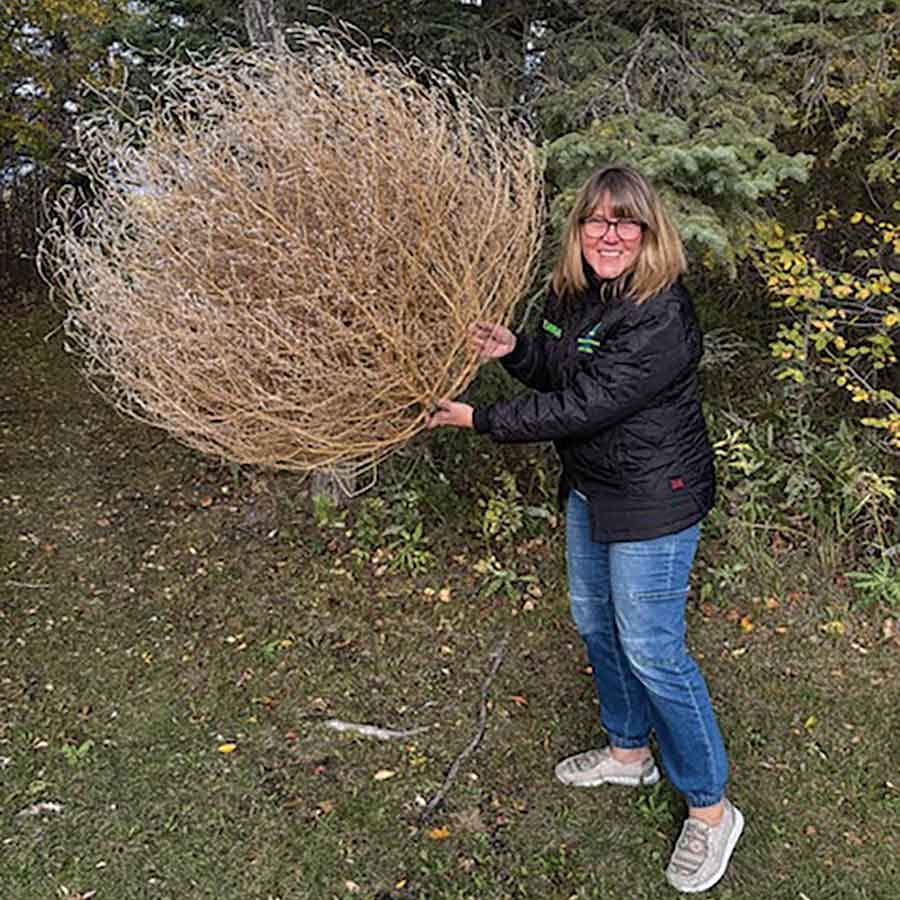
Bifrost-Riverton landowner Deanna Fridfinnson said she felt she had stepped into a western last year when she saw kochia tumbleweeds rolling across her property and filling ditches
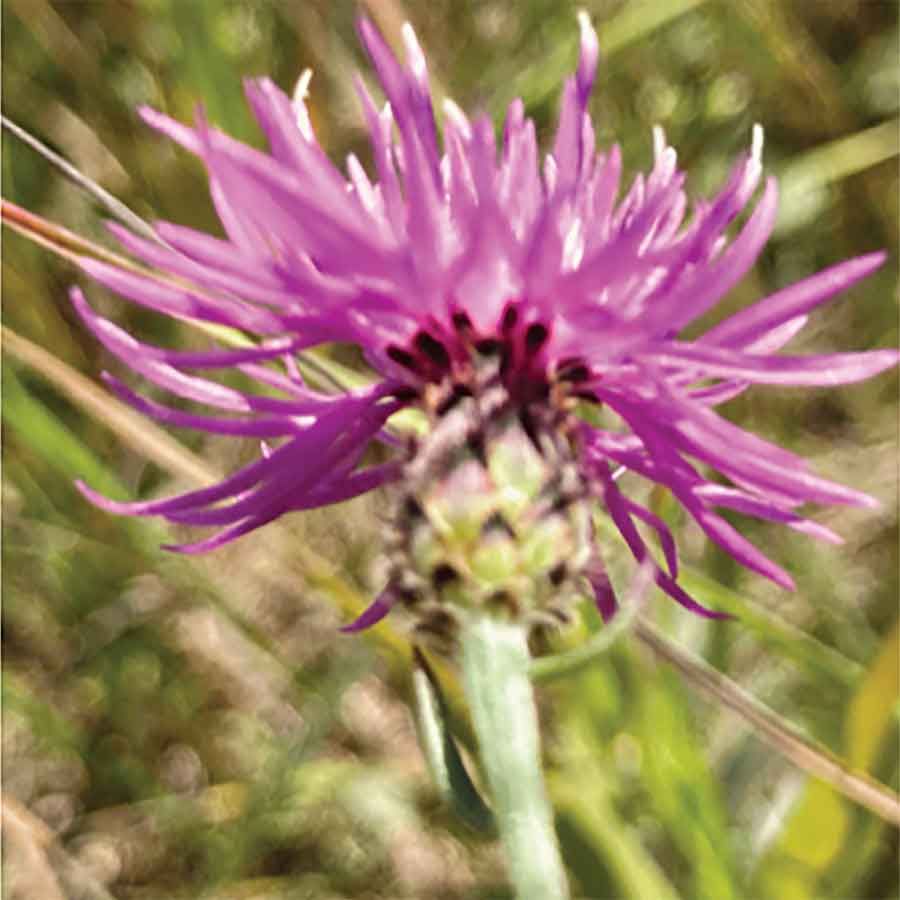
Spotted knapweed reached the Interlake Weed District boundary near Ashern in 2024 and is being monitored; it is identified by black-tipped bracts at the base of the flower
Deanna Fridfinnson said she’s quite worried about kochia’s potential to spread farther afield, affect agricultural land, interfere with drainage and even become a fire hazard.
“It’s got about a bazillion seeds on it. It was incredible to see it. It was like we fell back into a western with tumbleweeds blowing across a desert,” said Fridfinnson a few weeks ago. “That was the first year we saw the plant around.”
She’s concerned by its ability to fill ditches, which could potentially create a flooding hazard to agricultural land and rural homes.
“My ditch my was full. There were probably 50 or 60 tumbleweeds in the ditch, piled up five to six feet high. I picked one up and it was ginormous,” said Fridfinnson. “My concern is that because it was filling the ditches, the drains would be plugged when the snow melts this year.”
Kochia is an invasive weed. It emerges in the spring with hairy, pale green leaves and matures in the fall. A single plant can produce 15,000 to 25,000 seeds, according a factsheet from the province. It can grow to six feet high in favourable conditions and doesn’t mind saline soil and drought. It dries up and breaks free of its base in the fall and rolls across the landscape with the wind, spreading its seeds.
It’s a threat to agricultural land, with an ability to cause crop failure.
It’s considered among the “most troublesome” agricultural weed species in Canada, according to a 2025 Agriculture and Agri-Food Canada study titled “Baseline survey of protoporphyrinogen oxidase inhibitor-resistant kochi (Bassia scoria) in western Canada” in the Canadian Journal of Plant Science.
“This weed can cause high crop yield losses and occasionally near-complete crop failure. Recent (2019–2023) surveys of uncontrolled weeds in a combined 4,077 annual-cropped fields identified kochia as the sixth most-abundant weed species in the Canadian Prairies,” state the researchers.
Citing other studies, the researchers say kochia’s abundance comes down to the plant’s ability to thrive under abiotic stress combined with early-season emergence, prolonged emergence periodicity, genetic diversity, competitiveness, high fecundity, efficient dispersal and low seedbank persistence.
These traits lead to “rapid evolution and spread of herbicide resistance,” they wrote. In Saskatchewan, herbicide-resistant kochia occupied an estimated 39 per cent of annual-cropped fields in 2019-2020, the equivalent of 6.5 million hectares.
Fridfinnson said that in addition to concerns about drainage and farmers being affected by it, she’s concerned about kochia creating a possible fire hazard during dry years. She carried out some research and found that the tumbleweeds “actually cover homes” in some areas of the United States where its prevalent.
“I was thinking, ‘What do I do about this?’ I don’t know who you’re supposed to contact,” said Fridfinnson. “So I called Fred.”
Fred is Fred Paulson, weed district supervisor with the Arborg-based Interlake Weed District. Paulson works under the authority of the provincial government’s Noxious Weeds Act to restrict the spread of invasive plants in the district’s catchment area, which comprises the municipalities of Bifrost-Riverton, Gimli, Armstrong, Fisher and the Town of Arborg.
Paulson, who’s in his 34th season as weed supervisor, says kochia loves dry conditions, shows herbicide resistance and will “aggressively” grow in places where “nature has left a vacuum.” That includes areas around elevators where’s there’s little competition from other plants.
When Bifrost-Riverton farmers were harvesting last fall, he started getting calls about kochia.
“Kochia has always been in waste areas and around the elevators, but it’s never spread into the grasses,” said Paulson. “It’s always been here, but now it’s showing more resistance to herbicide. With a dry season like last year, that’s when we’ll see it. If we get back into a wet cycle, it will fade into the background.”
Paulson identifies and treats invasive weeds growing along roadsides and in public areas as part of his job — he’s not responsible for private land — and said kochia has, so far, not been a problem on roadsides because grass is a well established competitor there.
However, if drought conditions stress other plants — including crops — kochia will get a foothold.
“If we get good moisture this year, kochia will be less of a concern,” he said. “But if we go into this spring with a fast melt and the snow burns off the ditches and we don’t get the rain, then it will be a problem again.”
Kochia becomes a major problem when it matures and turns into a tumbleweed. At that point, there’s really not a lot that landowners or farmers can do to stop it from infesting land.
“Once it breaks off and becomes tumbleweed, it rolls along and spreads its seeds, and there’s nothing we can do at that point,” said Paulson. “The only thing you can do is mow it before it starts tumbling. If you can cut and bale it before it turns into tumbleweeds then burn the bales, that will help prevent seed spread. But burning when it’s dry is kind of dicey.”
Paulson said invasive weeds can spread from “roadsides into fields and out of fields onto the roadsides.” They can also be easily transported by offroad vehicles, on people’s footwear or clothing, on farm equipment and by animals. Sometimes people will see a pretty flower in a ditch, dig it up and take it home to plant it, finding out later on that it’s becomes quite aggressive and invasive.
“The roadsides are the biggest spreaders of invasive weeds. If one field has leafy spurge, for example, and it gets into a ditch, the [grass] mowers and the water will spread it. Graders can spread weeds,” he said. “Leafy sprurge is a huge problem in the south. We have small pockets of it in our weed district, but we hit those areas twice a year to make sure it doesn’t spread. Our biggest issue here is red bartsia. That’s a big one, it’s very invasive.”
Another invasive weed that’s worked its way to the borders of the Interlake Weed District is spotted knapweed. Paulson said a person near Ashern — which has a contract for weed control with the IWD but is not part of the district — reported the invasive plant to him last year.
“Spotted knapweed is on our borders and we’re watching out for it now. It’s similar to red bartsia in that it doesn’t go into annual crops. It’s more a pasture, hayland and roadside weed,” he said. “But it’s a Tier 1 weed.”
Manitoba’s Noxious Weeds Act sorts invasive plants into tiers based on their threat level. Some weeds can significantly reduce crop yields and threaten native species.
Spotted knapweed is “extremely competitive,” displacing most other plants by forming dense clusters, according to a district factsheet Paulson wrote. It’s a prolific seed producer, with 1,000 or more seeds per plant. It can “devastate” pastures, hayland and native habitats. A sharp-eyed landowner had spotted the pretty purple flower along PR 325 east of Ashern and contacted him. Paulson found the knapweed along an eight-mile stretch of road straddling the West Interlake–Grahamdale border and destroyed it.
Paulson said other problematic weeds in the Interlake district include common tansy, which typically grows around cemeteries, and purple loosestrife.
With or without a changing climate, invasive weeds will always be an issue, he said.
“But I think if the climate does change, it will change what weeds will become an issue,” he said. “When it’s hot and dry, certain populations of weeds will excel. When it’s cold and wet, other populations will thrive. But there’ll always be something to fill in nature’s blank spaces.”
Bifrost-Riverton grain farmer Gordon Klym found kochia growing among his crops in a few of his fields last year.
He said there needs to be more awareness raised about kochia because it’s hard to kill.
It can get into crops and pastureland and establish itself. Farmers and landowners need to take action as soon as they find it — before it matures and becomes a tumbleweed.
“There are certain weeds that come up during a dry year and one of them is kochia. During a normal or wet year, you’re not going to see it,” said Klym who farms near Ledwyn. “But kochia has really raised its head. There are not many chemicals that will kill it. It has lots of seeds and it spreads quickly. It’s a very problematic weed, and people really need to take it seriously.”
He tried to get rid of the kochia hiding among his crop last year, but said it was “very difficult to kill” and it ended up becoming a problem.
“There were some spots in my field that were pretty thick, but it wasn’t a bad year as far as affecting yield,” he said. “But if we get another dry year, it’s going to be a real problem.”
When harvesting, farmers can pick up tumbleweed with equipment and drag it with its thousands of seeds across a field without even realizing it, he said. That’s why kochia needs to be put in the spotlight; farmers have to know what to look for in the spring time and kill it before it gets going. If it gets out control, it can potentially “take over” a farm.
“We have to go into this year recognizing the fact that kochia can be a real problem. When the plant comes up in the spring time and there are a few leaves, you can treat it with chemical. Then you’ve got to keep an eye on it all summer long. If you see more pop up during the summer, you’ll have to go at it again to try to control it,” said Klym. “If you wait until kochia is really big, it’s too late because it has become a hardy weed and it fights off a lot of chemicals.”
A spokesperson for the province said weeds are “very adaptable” and different species will fill different niches. And they’re getting better at resisting herbicides.
In addition to kochia, other resistant weed species in the Interlake region include wild oats, waterhemp and Palmer amaranth.
“Weed resistance is steadily increasing,” said the spokesperson, “with weeds becoming newly resistant, and resistant weeds becoming resistant to more herbicides.”
Changing climate and weather patterns can change the “distribution and population” of weeds.
To help combat or control weeds, farmers can grow cover crops. They can also employ crop rotation.
“Diversity is key in crop rotation, farming practices and weed-control methods,” said the spokesperson.