Mill rate to increase to 12.24 to balance the budget
The Interlake School Division will increase its mill rate for the 2026-27 school year to account for costs that continue to rise.


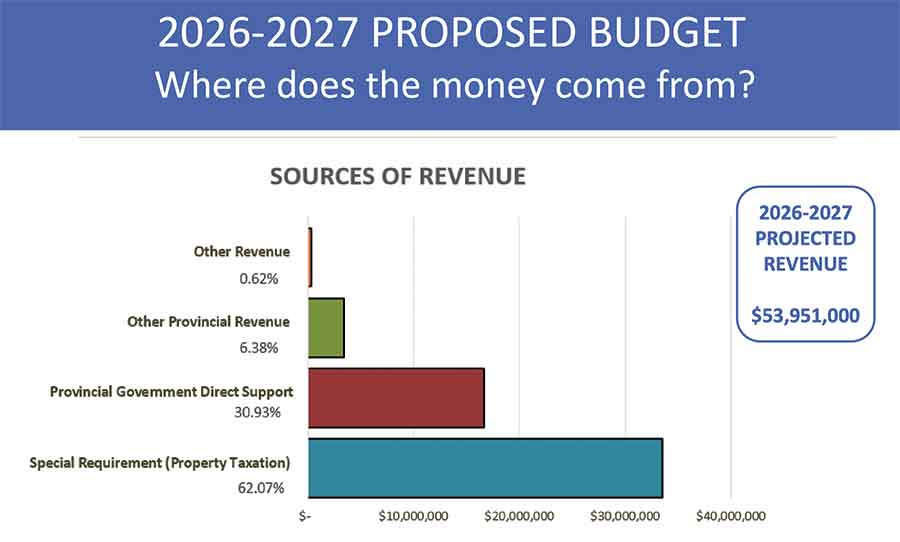
The mill rate will increase to 12.24 for 2026-27 to balance a nearly $54-million budget, up from 11.067 last year to balance a $51-million budget. Provincial funding also increased by about one per cent. A decade ago, 48.4 per cent of ISD’s budget came from provincial revenue, which has dropped to 37.3 per cent currently.
There’s a $2,910,000 overall increase from last year’s budget. At the same time, there’s a $2,938,422 overall increase to salaries and benefits compared to last year.
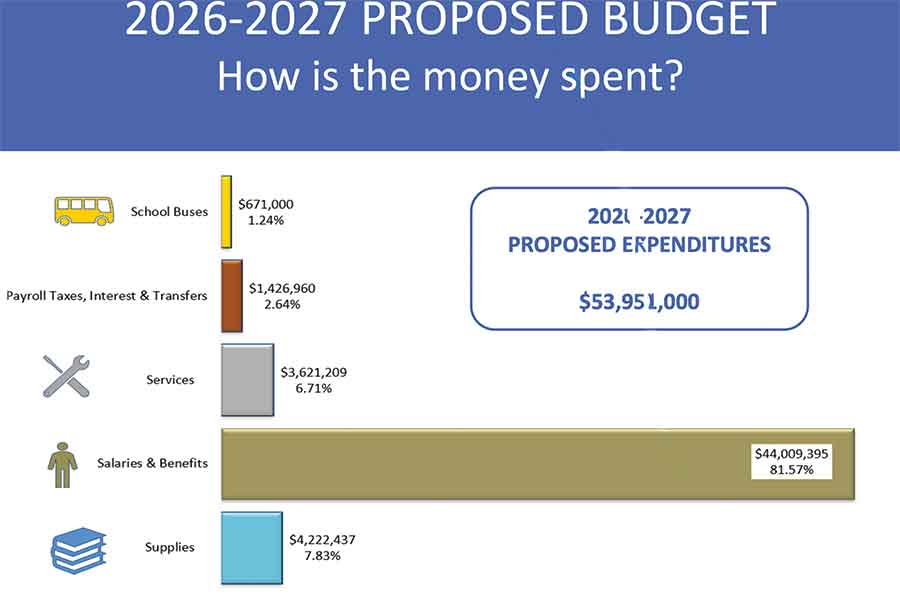
Of this year’s $53,951,000 budget, the majority will go toward salary and benefits, ringing in at $44,009,395 (81.57%). Another $4,222,437 (7.83%) will go to supplies and $3,621,209 (6.71%) will go to services. Payroll taxes, interest and transfers will cost another $1,426,960 (2.64%), while $671,000 (1.24%) will go to school buses.
Supt. Margaret Ward noted that ISD’s mill rate is consistently under the provincial average.
Primary residences qualify for a $1,600 Homeowners Affordability Tax Credit. For homes valued at $290,486 with 45 per cent portioned assessment, there will be no net increase to education tax. However, homes valued at $300,000 will face an overall tax increase of $52, For a $400,000 home, the net education tax increase will be $603. For a $500,000 home, the increase jumps to $1,154.
Ward also gave a breakdown of the impact on business property owners.
“Businesses feel tax and assessment increases the most,” she said. “Why is that? They are portioned at the highest rate coupled with no provincial rebate.”
With a 65 per cent portioned assessment and no provincial rebate, a $172,100 business property will face a net education tax increase of $1,369. For a $376,200 business property, the increase will be $2,993. And for a $551,900 business, the increase will be $4,391.
For farm property owners with a 26 per cent portioned assessment on a $410,600 property, the net education tax increase will be $784. For a $757,300 farm property, the net increase will be $1,446. And for a $1,410,300 farm property, the net increase will be $2,693.
“We know that somebody might actually fall in all three of these categories at once,” Ward said. “You might own farmland. You have a primary residence, and you may own rental property as a secondary residence. And you might be a business owner. You might be all of those things.”
Board chair Alan Campbell noted that the funding increase from the provincial government doesn’t line up with continually increasing costs.
“In the grand scheme of things on a $54-million budget, it’s a negligible increase when you consider the increases that are being experienced in staffing, in salary increases from a provincially negotiated contract for our teachers and for the pre-negotiated increases for our non-teaching staff,” he said. “When you look at the impact of inflation, when you look at the ongoing increases in utility costs, overall a one per cent increase from the provincial government does not keep pace.”
This budget will allow the school division to maintain current class sizes and clinical services, while also increasing the allocation of teachers and support staff including educational assistants, youth support workers and administrative assistants. Teaching staff — which could also include school counsellors, learning support teachers, administrators, divisional curriculum support and divisional support services — will increase by two full-time equivalents.
This school year, the division will also add four new buses to the fleet, along with one new bus route and one additional spare bus driver. In total, 1,868 students are transported by bus in the school division. Interlake School Division buses travel more than 900,000 kilometres in total each year.
The division’s school supply support will also continue for families.
“We are in the first year of the program by which Interlake School Division families do not have to purchase any school supplies in order for their students to come to school and participate fully,” Campbell said. “Schools have been empowered to purchase and provide all necessary school supplies for all students from kindergarten to Grade 12. We intend to maintain that program with some focused discussion once the fiscal year is complete.”
For the first time, the school board will consider providing divisional support through school-based budgets for grad ceremony fees.
“Our three high schools in the division have grad ceremony fees that are separate and apart from what we would call safe-grad fees. The safe-grad fees — the cost for families to participate in the dinner and the dance — is separate from this,” Campbell said.
“This is a fee that has been charged by the high schools for years for families to participate in the ceremony itself to cover things like equipment rentals for sound and lighting, for facility rentals in cases where they’re going out of the school, to allow the school to maintain caps and gowns and any of the things that you can think of that make sure that our graduation ceremonies are the very best that they can be. The division has increased grad ceremony fees from the division direct as part of this budget for Grad 2027.”
More funds will also be in place for maintaining buildings and grounds, with additional support to address safety needs.
“For the grounds improvement grant, we announced for the current fiscal year that we are going to offer $250,000 a year as part of our annual budget that would be split between two schools. The board is considering an increase to this amount in order to offer more money to each of the two schools and where possible to consider a third school as part of that rotation. This is something that we heard from in terms of communities that don’t have the capacity to fundraise the hundreds and hundreds of thousands of dollars that are required for full-scale playground improvements,” Campbell said.
“It aligns with our division’s continuous improvement plan as it pertains to equitable access to public education, knowing that our communities all have very different capacities when it comes to fundraising to replace playground equipment, which should otherwise be funded by the public institution where the playground sits, which is in the playground of the public school. So we’re looking at increases to that grounds improvement grant.”
Enrolment in 2025-26 was 2,982 students. For 2026-27, it’s expected to decrease slightly to 2,958 students. For the 2026-27 school year, the projected pupil-to-teacher ratio for kindergarten to Grade 8 is 19.01 while the projected ratio for grades 9 to 12 is 19.41. The pupil-to-teacher ratio is calculated by the number of students divided by the number of classroom teachers in each building.
Currently, the school division employs 235 professional staff members, which includes teachers, administrators, program support workers and clinicians. Clinician services available to students include physiotherapy, occupational therapy, speech and language services, psychology, mental health and social work. This year, ISD plans to increase the professional staff team to 237 professional staff members for the next school year.
Interlake School Division operates 13 public schools, eight colony schools and two divisional buildings.
“This budget is holding the line on what we believe are very good services and supports that we offer for students and families,” Campbell said. “There are no frivolous increases to any staffing levels or to any programs and supports.”
At the March 9 board meeting, the school board approved the 2026-27 final budget.
A link to a recording of the proposed budget presentation meeting is posted on the Interlake School Division website at www.interlakesd.ca.


