The Marquette Curling Club strives to make its rink a safe, welcoming and accessible place for all — including youth program participant Mackenzie Gaudrault, 13, who has a vision impairment.
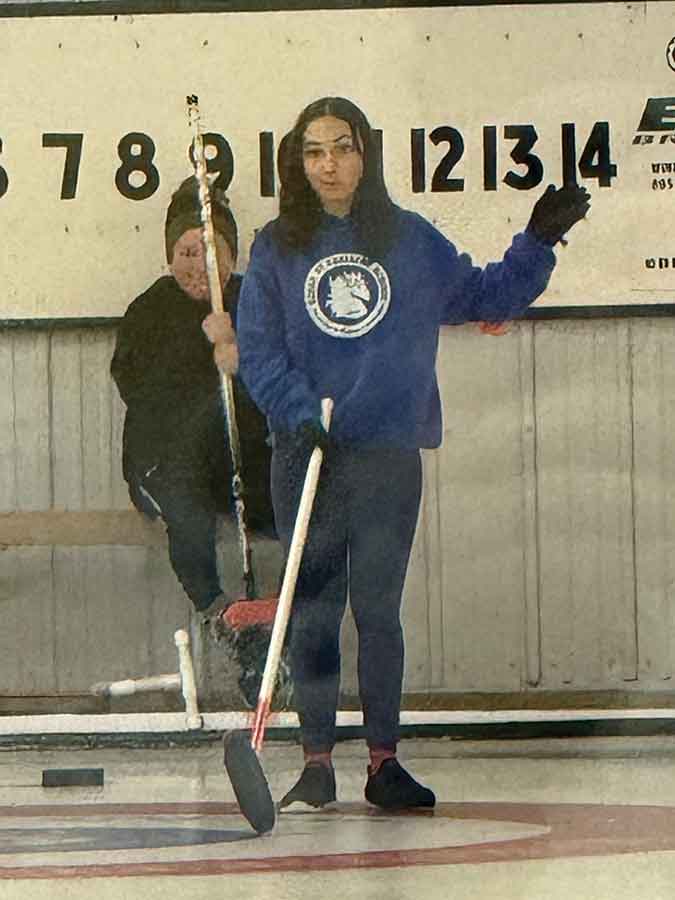
Mackenzie Gaudrault, 13, curls with the Marquette Curling Club. One of her coaches, Ed Campbell, added a flashlight to a curling stick to help her see the end of the rink
Mackenzie was born with low vision and is both near- and far-sighted. Her mother, Amanda, explained that while Mackenzie’s eyes can see, her brain struggles to process what they’re looking at. Some days she sees very little; other times, her vision is blurry or doubled. To make out objects clearly, she has to be very close — otherwise, everything appears as shadows. Even when her brain forms an image, it’s often incomplete.
Because of these challenges, Mackenzie found it difficult to participate in extracurricular activities.
“Her needs weren’t met and she was pushed aside,” Amanda said. “The moral of the story is it has always been a struggle. She was unable to do the same things as everyone else. There was always the worry of her getting hurt, and some places wouldn’t even take her, which is absolutely horrible.”
That changed when Mackenzie found a home at the Marquette Curling Club. The low-cost, small-group Learn to Curl program appealed to the family, and Amanda said organizers welcomed Mackenzie with open arms.
“They were so welcoming and made the step into curling easy for everybody,” she said. Not only have they accepted Mackenzie, they’ve gone “above and beyond” to make her experience the best it can be, her mother added.
Ed Campbell, one of the coaches, was inspired to create a simple but effective tool to help Mackenzie better navigate the ice. After noticing a similar concept on television, he attached a flashlight to a curling stick. Since Mackenzie has some light perception, she now aims for the light instead of a standard target.
Amanda said the impact has been transformative.
“She went from just pushing the rock and hoping for the best to actually participating and knowing what she is doing,” she said. “She can go out and be successful. Nothing will beat that smile on her face the first time she saw the light — it was like Christmas morning.”
As for Mackenzie, her experience has been worthwhile.
“My favourite thing about curling is that everyone there is supporting me and helping me with a sport that I love,” she said, adding it feels nice to have a supportive team.
“It felt like they actually cared about me and my success and the enjoyment of the game — I felt seen with my disability.”
Campbell said the adaptation was easy to implement and has made a meaningful difference.
“She absolutely loves it and wants to improve,” he said. “It’s a goal for all of us at the club to enjoy the game and make it fun for everyone. We have a bunch of kids coming out, and it wouldn’t make sense to turn anyone away. Mackenzie loves to curl, and this is a simple solution to make her feel like she belongs.”
For Amanda, the experience has been invaluable. Mackenzie has grown more confident, built friendships and found a true sense of belonging.
“Every kid deserves a place where they feel safe and seen. We have to see the kids’ abilities and meet them where they are,” she said. “To Mackenzie, that is the curling rink. I wish every kid would have this experience.”
Both Amanda and Mackenzie are thankful for the efforts made by the Marquette Curling Club.
For now, Amanda’s hopes for her daughter are simple: that she continues to grow, thrive and embrace everything that makes her unique.
As for Mackenzie, she wants to stay in sports, continue advocating for herself, assist in coaching younger athletes and become a teacher. She also hopes to encourage other sports to become more accessible.
“Please don’t assume that we can’t do something. Instead, ask us how you can help us,” she said. “It is important to be physically active, so help us meet and rise to the challenge.”