A set of retired Stonewall Blues hockey jerseys has found a powerful second life thousands of kilometres away — on the backs of young players in war-torn Ukraine.
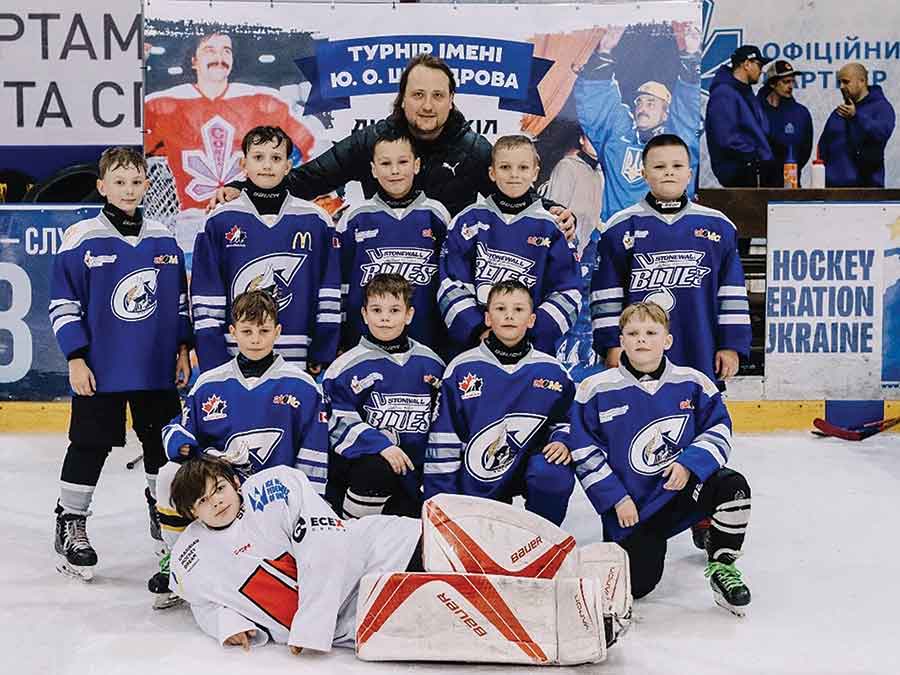
Young hockey players in Ukraine proudly wear donated Stonewall Blues jerseys after receiving equipment through Canadian Friends of Hockey in Ukraine. The jerseys, provided by the Stonewall Minor Hockey Association, give young athletes a chance to stay connected to the game despite the challenges of war
The jerseys were donated through Canadian Friends of Hockey in Ukraine (CFHU), an organization that collects and ships hockey equipment to youth programs struggling to keep the sport alive during the ongoing conflict.
The connection between CFHU and the Stonewall Minor Hockey Association came through Wayne Babych, a longtime CFHU volunteer and St. Louis Blues Hall of Fame inductee.
Babych, who has deep connections across the hockey world, works with CFHU to secure donated equipment for Ukrainian teams.
“When the Stonewall Minor Hockey Association deemed this set of hockey jerseys for replacement, Wayne was able to secure them for CFHU with the assurance that the jerseys would find a new home in Ukraine,” said Lloyd Ballard and Vernon Zatwarnicki of CFHU.
For young players in Ukraine, receiving hockey gear from Canada carries meaning far beyond the game.
In a message sent to the organization, members of the children’s hockey team Odeshchyna in Odesa expressed their gratitude.
“Dear Canadian friends,” the team wrote. “On behalf of the children’s hockey team, we sincerely thank you for the received parcels, attention and support, which are extremely important for our young athletes.
“Together, we are doing a great thing for the future of our children.”
Another youth team in Kremenchuk also shared its appreciation.
“We sincerely thank you for your humanitarian aid and for the hockey gear for young children,” the team wrote. “Your help is immensely significant and gives children the opportunity to get acquainted with hockey and feel the support of the international community.”
Getting that equipment into the country, however, is a complex process.
Teams requesting equipment must submit an application to CFHU, which verifies the request through its international contacts. Once approved, the gear is collected, packaged and shipped overseas — usually by cargo ship — with shipments taking at least six weeks to reach Ukraine.
Recently, additional challenges have emerged at customs.
“According to Ukrainian customs, we can only send one box per address,” Ballard and Zatwarnicki explained. “If we are sending 12 boxes of hockey equipment to a team, 12 shipping addresses must be acquired and vetted for the shipping process.”
Even after clearing customs, shipments may arrive at different times without explanation.
Despite the logistical hurdles, the need for support remains significant as the war continues to disrupt everyday life in Ukraine.
Many hockey arenas near the front lines have been destroyed by bombing, and numerous families now function as single-parent households while fathers serve in the military.
Recruiting young players has also become increasingly difficult.
“Many children start playing sports at the age of five or six and more often choose soccer or other sports that involve less financial burden for their parents,” one Ukrainian team explained in a message to CFHU.
“The lack of basic necessities for everyday living prevents people from thinking about the development and the provision of children’s hockey.”
Still, hockey continues to offer something invaluable.
“We believe that through joint efforts we can significantly increase children’s involvement in hockey,” the message continued. “We hope that this, at least for a while, will distract them from the horrors of war.”
Ballard and Zatwarnicki said the impact of donated equipment can be seen immediately when it arrives.
“The smiles on the faces of the children, parents and coaches — who are dealing with far greater issues — when they receive their hockey equipment says it all,” they said.
“They are grateful not only for the gear, but also in the knowledge that there are people out there who care about them in their time of need.”
The war’s human cost continues to touch the hockey community as well. CFHU representatives noted that last week a nine-year-old hockey player and his mother were killed by a Russian missile. The child played for a team that had previously received equipment through the organization.
For CFHU volunteers, moments like that reinforce the importance of continuing their work.
“Hockey, in its simplest form, is a game of competition, sportsmanship and camaraderie,” Ballard and Zatwarnicki said. “For the children of Ukraine it is all of this, plus the chance to be a child for just a short time and to dream of a better life.”
Community members who wish to donate hockey equipment to support the initiative can contact Canadian Friends of Hockey in Ukraine at ukrcanhockey@gmail.com.


