Private well owners across the West Interlake region will have an opportunity to test their drinking water at a reduced cost on June 29 through the West Interlake Watershed District’s annual Water Testing Days program.
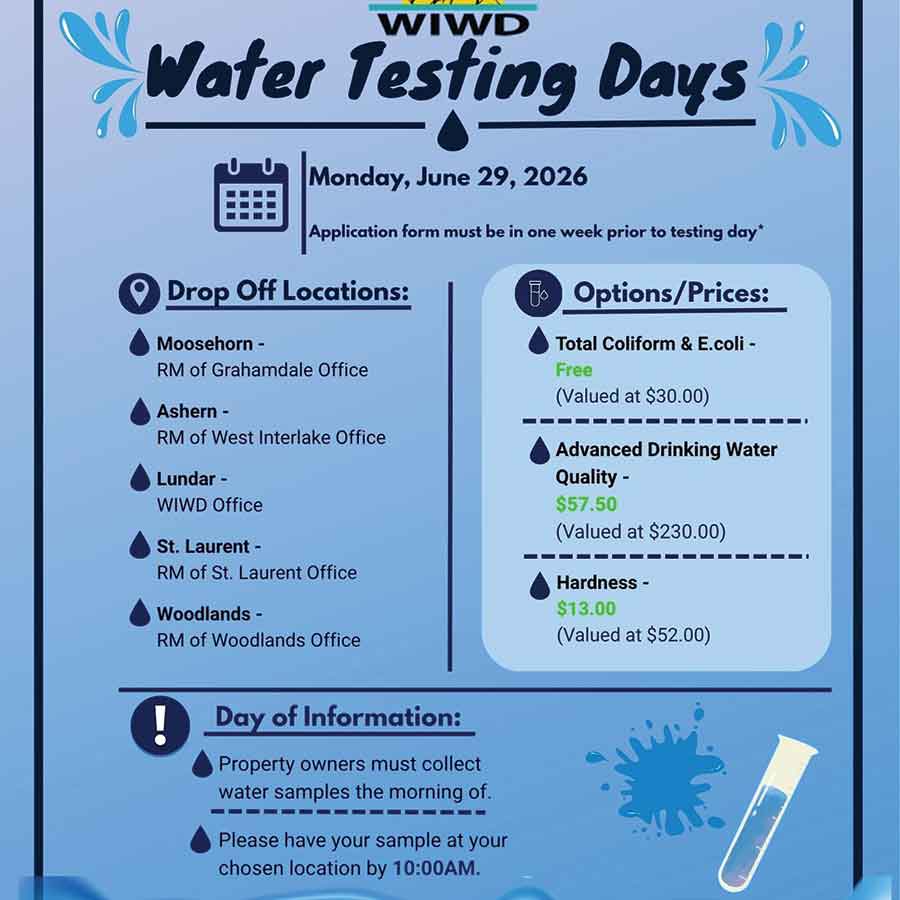
The West Interlake Watershed District is offering subsidized well-water testing for private landowners in Moosehorn, Ashern, Woodlands, St. Laurent and Lundar on June 29. Applications must be received by June 22, and water samples must be dropped off by 10 a.m. on testing day
The initiative is designed to make water testing more accessible for private well owners who may otherwise delay testing because of the cost.
Danya Chartrand, administrative and outreach co-ordinator with the West Interlake Watershed District, said the purpose of the program is to offer subsidized water testing for those who may be holding back due to financial constraints.
Water samples will be collected June 29 at designated drop-off locations in Moosehorn, Ashern, Lundar, St. Laurent and Woodlands. All samples must be dropped off by 10 a.m. to receive results. Application forms must be completed and submitted by June 22, one week before testing day.
The program is open to private well owners within the West Interlake Watershed District. Businesses are not eligible to participate.
Chartrand said the district has already received approximately 190 applications across its two scheduled testing days this year, with registrations continuing to arrive.
Regular testing is important because many contaminants cannot be detected without laboratory analysis.
“Private well owners are responsible for monitoring and maintaining their own water,” Chartrand said. “Contaminants like harmful bacteria, toxic trace elements and nitrates are invisible and cannot be detected by taste, smell or sight. Testing is the only reliable way to ensure your water is safe.”
The district particularly recommends testing wells that may be vulnerable to contamination, including those with wellhead extensions, properties affected by overland flooding, locations where livestock are near water sources, or wells that share a water source with livestock.
Residents can access free testing for total coliform and E. coli bacteria, which serve as indicators of the sanitary quality and safety of drinking water.
Additional testing options are available for a reduced fee, including an advanced drinking water quality analysis that screens for a range of minerals, nutrients and trace elements, including arsenic, lead, uranium, nitrates, fluoride and other substances. Hardness testing, which measures the concentration of dissolved minerals, primarily calcium and magnesium, is also available.
Contaminated drinking water can pose significant health risks, Chartrand said, ranging from gastrointestinal illnesses such as diarrhea, nausea and vomiting to more serious concerns involving viruses, parasites and long-term exposure to heavy metals or chemical contaminants.
If testing reveals a problem, she advises residents to stop drinking the water immediately and investigate potential sources of contamination.
This may include inspecting the well cap and casing for damage, checking for surface water pooling near the wellhead, ensuring contaminants such as animal waste or fertilizer are kept away from the well, and having septic systems inspected for leaks. Wells affected by bacterial contamination may also require shock chlorination.
The watershed district offers support programs to help landowners address water quality concerns.
Through its Wellhead Protection Program, property owners may qualify for assistance through an abandoned well-sealing program that provides up to $1,500 toward eligible costs. Funding is also available through a well chlorination program, offering up to $250 for partial chlorination and up to $500 for full chlorination.
Chartrand reminded residents planning to participate to submit their applications by June 22 and ensure payment is made before June 29 if they are requesting hardness or advanced drinking water quality testing.
She emphasized that appearances can be deceiving when it comes to drinking water safety.
“Harmful contaminants are invisible and cannot be detected by taste, smell or sight,” she said. “Testing is the only reliable way to ensure your water is safe.”