After about six years of residents raising concerns about possible environmental contamination to Lake Winnipeg from a Hutterite colony’s proposed sewage lagoon, a provincial advisory body recommended that the lagoon be approved.
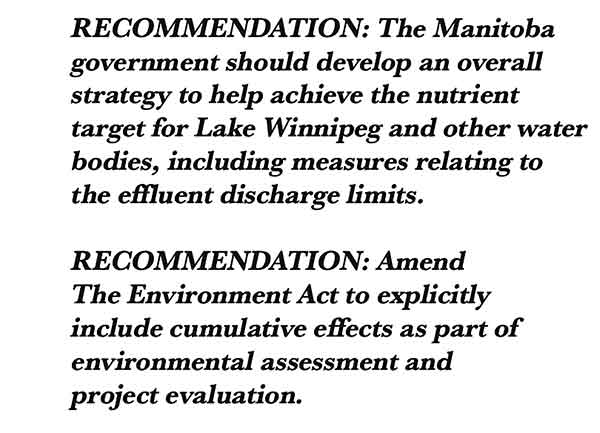
Two of 15 recommendations from the CEC’s report titled “Clean Environment Commission Report on the Harbour Colony Wastewater Lagoon Project.”
The Manitoba Clean Environment Commission (CEC) was tasked last year by the province’s environment minister to review and make recommendations regarding the proposed lagoon.
The CEC posted its report online last week, recommending the lagoon go forward.
The Harbour Hutterite colony (formerly called Crystal Spring) asked the province for approval to operate a wastewater lagoon on its new colony in the RM of Armstrong. The lagoon is situated on the RM of Gimli border, and the colony will be discharging lagoon effluent into a drain linking to Willow Creek, which flows through residential subdivisions into Lake Winnipeg.
Opponents of the lagoon, which include Lake Winnipeg commercial fishers, environmental groups and the RM of Gimli, have said in letters to the province and to the CEC, as well as during a CEC public hearing in April, that Lake Winnipeg already receives excessive amounts nutrients such as phosphorus, and that more wastewater will only contribute to the ongoing eutrophication of the lake and potentially cause damage to Willow Creek.
Phosphorus accelerates the formation of algal blooms, which deplete oxygen, create dead zones in the lake and kill fish and other aquatic organisms.
All wastewater treatment facilities, including lagoons, must meet a phosphorus limit of 1 mg/L or have a demonstrated nutrient-reduction strategy under provincial legislation. Harbour colony’s submission to the province and the CEC show it’s compliant under provincial law.
However, that discharge limit of 1 mg/L is higher than Lake Winnipeg’s .05 mg/L target under the Water Protection Act, something the panel considered.
“The panel … heard evidence that the Nutrient Target Regulation under The Water Protection Act gives Lake Winnipeg a target phosphorus level of 0.05 mg/L and that a discharge standard of 1 mg/L is incompatible with those goals,” states the panel in its report (page 16). “In the RM of Gimli’s expert report and in testimony, they spoke of Ontario which has established a phosphorus limit for wastewater discharges of 0.5 mg/L to address cumulative loading goals in Lake Erie.”
The CEC noted in the forward of its report that lake’s nutrient target is an “overall goal and is not the same as the wastewater treatment limits.”
The panel said it can’t hold Harbour colony to a higher standard than others because that would be “fundamentally unfair.”
“This is why we have recommended that the licence be issued to the proponent, with conditions, and that the [environment] department undertake steps to monitor impacts on the waterway and make adjustments as necessary to help ensure the ongoing health of the Willow Creek Watershed and Lake Winnipeg,” states the panel.
In addition to incompatibility, the CEC also considered a number of other issues, including emergency discharges of the lagoon, drainage and overland flooding in the immediate area of the colony’s lagoon, air quality and odours, the lagoon’s impact on groundwater, lack of public reporting of discharge dates and testing results, “effluent dominance” whereby Willow Creek would flow with effluent rather than water from upstream at times, and damage to fish habitat.
Despite approving the colony’s lagoon, the CEC said it has commented in the past on lagoons and thinks they should be phased out as many of them — as well as other systems such as septic fields and holding tanks — are contributing nutrients and contaminants to the watershed.
Citing provincial data, the CEC says Manitoba has nearly 350 licensed wastewater treatment lagoons. Since about 2009, the province has issued 130 licences for lagoons with roughly half of them discharging into the Red River or Lake Winnipeg watersheds.
“Lagoons have not been phased out but rather continue to be a common means of wastewater treatment, and a regularly licensed activity in Manitoba,” states the panel.
Although there’s strong public contention that the provincial government’s regulations for wastewater are not strong enough to protect the environment, the CEC said it cannot comment on that.
“The panel cannot make comment if current wastewater treatment standards would allow Manitoba to reach the nutrient targets established for Lake Winnipeg, but this is an appropriate consideration that the government must monitor and make regulatory and/or policy changes if required,” states the panel. “We recommend that this process takes place publicly. The cumulative effects and dynamics of nutrients on Lake Winnipeg are an important public concern, and Manitoba must act diligently to ensure accountability on this important issue.”
Harbour colony’s lagoon will discharge into the Malonton Drain, which runs along Road 15E. It will then flow into Willow Creek and eastwards to Lake Winnipeg.
The CEC provides advice and recommendations to the provincial environment minister. Regarding Harbour colony’s lagoon, the CEC made 15 recommendations for the government to consider.
They include a method of limiting or controlling maximum flow rate of discharge, emergency plans to address non-compliant effluent discharges, communicating when the licence is implemented, not permitting commercial wastewater, and that the government develop and implement a monitoring program for Willow Creek to assess effluent impacts.
“Standard lagoon discharge limits should apply. However, some additional monitoring should be required for the project to proceed,” states the panel. “Our reasoning is that the potential impacts to the receiving watercourse, Willow Creek, are not well understood. A straightforward monitoring program implemented by the department can quantify these impacts and identify required changes, should they warrant additional conditions or limits.”
The CEC also recommends that the government achieve the nutrient target for Lake Winnipeg.
“The Manitoba government should develop an overall strategy to help achieve the nutrient target for Lake Winnipeg and other water bodies, including measures relating to the effluent discharge limits,” it said.
The CEC’s recommendations have no force; they are simply suggestions for the province to either implement or disregard.
The RM of Gimli had presented its opposition to the lagoon at the CEC’s public hearing in April. It issued a response last week to the CEC’s decision, saying it had advocated for stronger protections for Willow Creek and Lake Winnipeg.
“The commission’s report recognizes that uncertainty remains regarding the potential effects of lagoon discharges on Willow Creek and downstream waters. In response, the commission recommended ongoing upstream and downstream monitoring of Willow Creek, together with the ability for regulators to require operational changes if adverse impacts are identified,” states the RM in its June 16 post. “This is a significant recommendation that, if adopted by the provincial regulators, will assist in safeguarding the health of both Willow Creek and the downstream watershed, including Lake Winnipeg.”
The RM added that it “remains committed” to protecting the lake and local waterways.
Although Harbour colony has met all the provincial regulations, that doesn’t mean the province’s environmental laws are effective at protecting watersheds and Lake Winnipeg, says RM of Gimli resident Andy Damm.
He wasn’t surprised by the CEC’s report as its mandate was “quite narrow” even though it made comments on items outside its scope, he said.
Manitoba’s weak environmental laws are the real issue, he said, and that’s what the opponents of wastewater lagoons should have focused on.
“From the onset, it was apparent the target should have been the provincial government’s environmental laws, regulations and compliance monitoring,” said Damm. “Targeting the Crystal Spring/Harbour colony was at best a shot in the dark as [the colony] built to today’s environmental standards.”
Damm attended the CEC’s hearings on the colony’s proposed wastewater lagoon in April. He said he thinks Gimli council — which had a consultant — could have made better use of taxpayer resources by targeting and challenging the phosphorus-loading limits under the current government.
“Total accumulated nutrient-loading to our watersheds is what needs to be reduced,” said Damm.
Although the recommendation that the lagoon proceed is a setback to those who oppose it, Damm said there was one good thing that emerged from the CEC’s hearing: the 15 recommendations as those will hopefully apply some pressure on the provincial government to address phosphorus targets.
“Hopefully, on a go-forward basis, this will be the foundation to challenge the province for the protection of our aquifers, tributaries and, ultimately, Lake Winnipeg which we all depend upon,” said Damm. “We should not have to wait until our lake is dead [similarly to] Lake Erie before we respond. A phosphorus-loading target of 0.5 mg/L is achievable today. Water is life, and our life in Gimli revolves around water.”