The STARS Mobile Education Unit visited Carman Memorial Hospital on April 20, providing hands-on emergency training designed to help rural health-care providers manage critically ill patients while awaiting air ambulance transport.
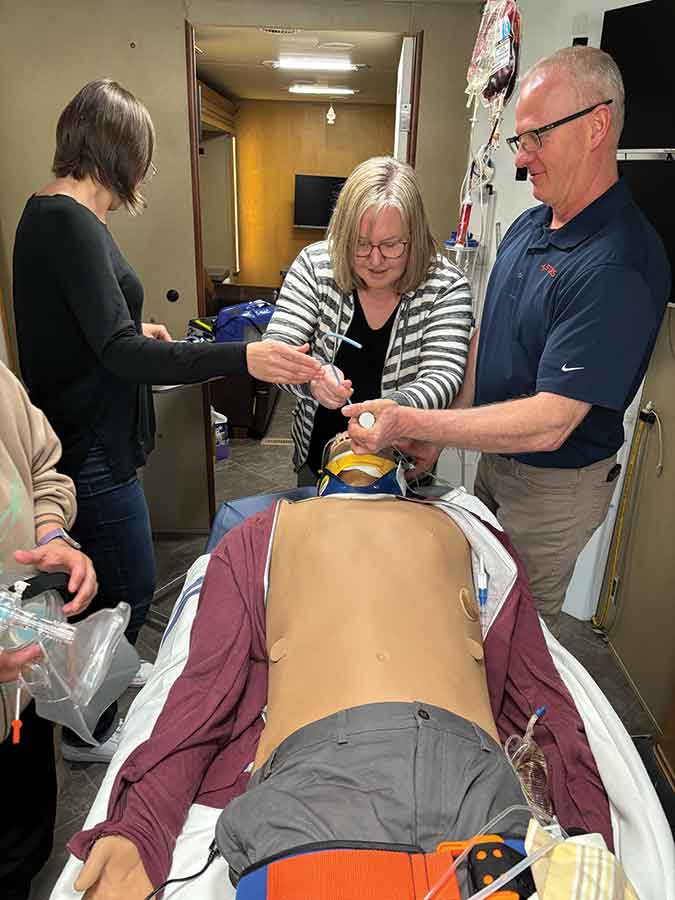
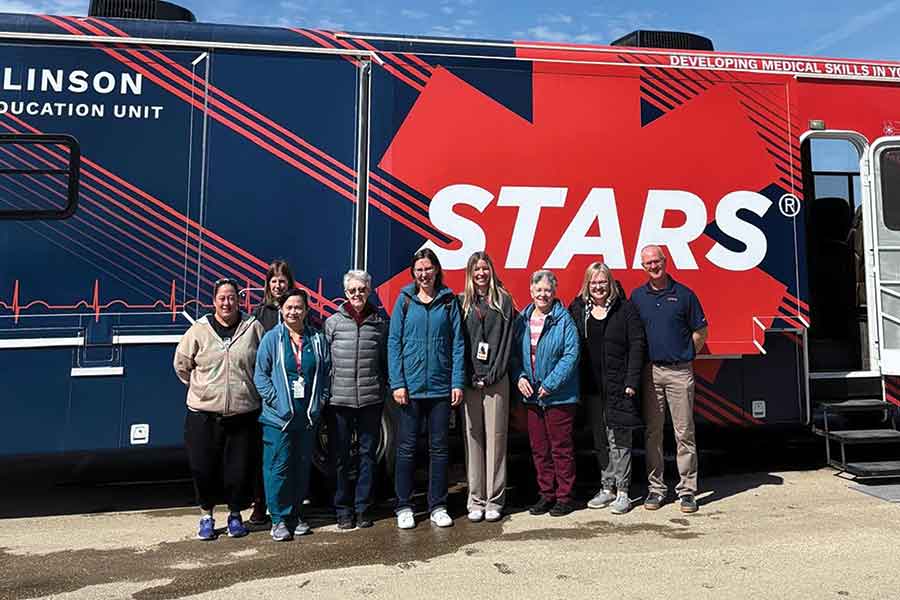
Carman Memorial Hospital staff stand in front with the STARS Mobile Education Unit during its visit on April 20. The specialized training unit travels across Manitoba to provide hands-on emergency simulations for rural health-care providers
The training focused on procedures that can be performed inside the hospital before a STARS helicopter arrives, with participants working through realistic emergency scenarios using specialized simulation equipment.
The mobile unit, staffed by three instructors, travels throughout Manitoba delivering practical training to nurses, physicians, paramedics and fire department personnel involved in emergency response. It is fully equipped with a stretcher, mannikin, IV solutions, simulated blood, airway devices, monitors, syringes and medications, allowing teams to practise high-pressure situations in a controlled environment.
Head nurse Maddie Gylywoychuk-Winkler, who organized the sessions for Carman Memorial Hospital staff, said one of the most important skills emphasized during the training was airway management in deteriorating patients.
“The most critical skill learned or reviewed during this simulation was airway management of a deteriorating patient,” she said.
Gylywoychuk-Winkler said bringing the training to a rural hospital setting is essential to ensuring staff are prepared to respond confidently during emergencies.
“It was important for us to bring this training to Carman so that the staff at our rural hospital feel comfortable and competent to provide this critical care to patients that present to our hospital,” she said.
“This will impact our community in a great way as it provides safety and trust, knowing that our staff can provide this care to them or their loved ones.”
Two training sessions were held during the day, each accommodating six participants. The Carman Health Auxiliary provided $1,500 in funding, which covered the cost of bringing in two STARS educators along with the mobile simulation unit.
Gylywoychuk-Winkler noted that response times for STARS can vary widely depending on factors such as the severity of the patient’s condition, weather conditions and whether the aircraft is already responding to another call elsewhere in the province.
Because of those variables, she said, early intervention at the local level plays a critical role in patient outcomes.
Currently, STARS air ambulances land at the Carman-Dufferin Airport, with patients transported between the hospital and landing site by ground ambulance.
STARS officials say community support remains vital to maintaining the service, noting that while the organization’s head office is based in Calgary, all donations made in Manitoba stay within the province.