Lake Winnipeg has been caught in the crossfire between commercial fishers and farmers and the municipalities of Gimli and Armstrong over a proposed chicken farm.
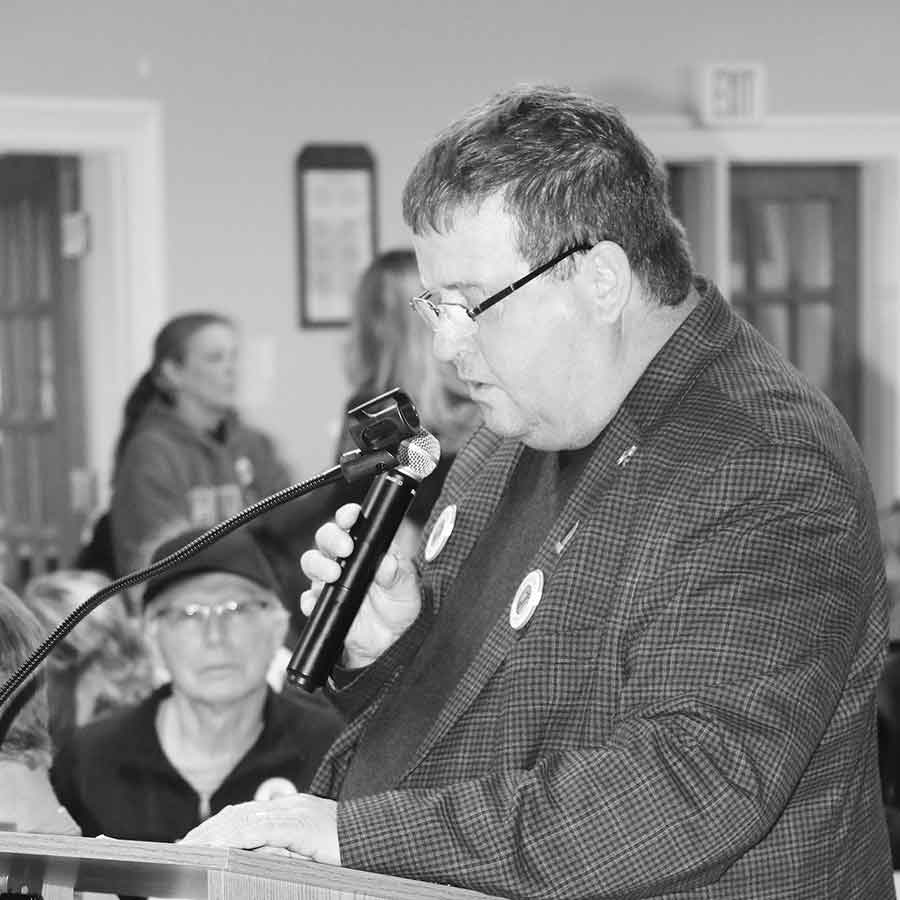
Chad Johnson, a farmer in the RM of Bifrost-Riverton, spoke during an RM of Armstrong public hearing to consider Harbour colony’s proposal to raise 140,000 chickens. Johnson supports the colony’s chicken operation
With the lake already in a precarious state from nutrient overloading from agricultural runoff, wastewater effluent and raw sewage spills, strong opposition has arisen within the fishers’ ranks and the RM of Gimli with regard to farming practices in the RM of Armstrong, which is primarily an agricultural municipality.
Harbour Colony Farms, a satellite colony of the Crystal Spring colony in Ste. Agathe, wants to build a 140,000-strong chicken operation in Armstrong on the shared municipal border with Gimli, and spread chicken manure on fields the colony owns in the RM of Gimli.
Armstrong council held a public hearing for the proposed operation on May 14 at the Fraserwood Hall. About 130 attended to hear presenters speak in favour or against it. Written submissions were also forwarded to council.
The colony is asking Armstrong council to approve a conditional use application that will allow it to construct a new poultry operation consisting of 40,000 layers, 40,000 pullets and 60,000 broilers, which is said to represent 764 animal units.
An animal unit is a measurement that provides an indicator of the environmental impact of livestock and informs land use to ensure that animal density doesn’t negatively affect soil and water.
Victor Kleinsasser, who represents Crystal Spring and Harbour colonies, explained what the proposed chicken operation will entail and provided schematics and photos of the chicken barns.
One barn will co-house the layers and the pullets. It will be a European-style aviary barn or free-run barn where layers aren’t confined to cages but are free to perch, lay an egg and “spend the rest of the day roaming about.”
The pullets, the chicks, will be housed on the other side of the barn where they’ll be “on the ground” but able to hop in and out of a cage system as they mature.
As for manure handling, Kleinsasser said the back of the barn will house dry manure that’s delivered via a belt system. The manure will then be loaded onto a truck and taken to fields.
The colony owns several parcels of land in the RM of Gimli and intends to spread some of its chicken manure there, according to technical documents posted on the province’s website.
“The whole point of this barn is to produce eggs,” said Kleinsasser. “We own quota; it’s all above board, just like fishermen who have quota for the amount of fish they can catch. We have quota in the amount of eggs we can produce.”
The colony hired engineer Peter Grieger from South-Man Design Group to prepare a technical review, which assesses the impact of the operation on the environment and surrounding community, and ensures “compliance” with provincial manure-management regulations, municipal zoning bylaws and long-term sustainability.
“By way of this process, it was established that the colony has a usable land base for manure application that is almost three times the minimum requirement. These excess acres provide the ability to select spread fields that are least likely to impact residents and surface and groundwater resources in the area,” said Grieger. “Preference will be given to fields most secluded from residential development and major surface water tributaries. Incorporation of the manure within the soil as soon as practical after application will minimize the runoff potential.”
Grieger added that the colony will take “all reasonable measures” to protect the environment and minimize impacts on surrounding communities. Like other residents, the colony wants to enjoy Lake Winnipeg’s recreational opportunities and has “no intention of harming this valuable resource.”
About seven staff from various provincial departments attended the hearing.
Holly Ervick-Knote, coordinator for the provincial livestock technical review process, provided an overview of what the province’s review entailed. It included 64 public comments “expressing concerns” over the impact of manure and dead chickens on the aquifer, Willow Creek and Lake Winnipeg, nutrient overloading from manure spreading, odour and air quality, proximity to local dwellings, increased traffic and impact on Manitoba’s fisheries and tourism sectors.
The provincial review process found no issues as the colony meets all requirements.
“The technical review committee concluded that the proposed operation is able to meet provincial requirements and standards,” said Ervick-Knote.
She asked that council state in their resolution — which will either approve or deny the chicken farm — that the colony has a right to appeal to the provincial Municipal Board should council reject their proposal or impose a condition of approval.
Twenty-five people registered to speak at the hearing. Most were residents from the RM of Armstrong but people from other municipalities such as the RM of Gimli and the Municipality of Bifrost-Riverton — as well as representatives from organizations such as Manitoba Egg Farmers, the Gimli Environmental Advisory Committee and the Silver Harbour Environment Committee — also spoke.
A number of speakers were in favour of the colony’s proposed farm, citing the colony’s having met provincial requirements, the colony’s state-of-the-art chicken barns, the removal of manure off-site and economic stimulus for Armstrong.
Chad Johnson, who farms in Bifrost-Riverton, spoke in favour of the colony’s operation.
He supports sustainable farming, environmental stewardship, public health, job creation and the economic viability of food-producing communities, he said. And poultry manure can be a valuable natural fertilizer when managed properly.
“Properly applied, chicken manure enriches the soil, improves crop yields and reduces the needs for synthetic inputs [chemicals] — it’s win for farmers and nature alike,” said Johnson.
The province has environment officers whose monitoring will ensure that the poultry operation would meet all environmental guidelines, including controlling odours, runoff and waste management.
“This is not about unchecked expansion,” said Johnson. “It’s about responsible growth under expert supervision.”
Johnson later showed the Express a soil-testing digital tool that calculates how much phosphorus, nitrogen, potassium and other nutrients are in soil so that farmers know how much manure to apply to land.
Melvin Toews from Sunrise Poultry Processors said Sunrise has been the Crystal Spring Colony’s sole processor since 2008 and the colony upholds high standards.
“As the processors for Crystal Springs Colony, we can confirm that they are indeed exemplary stewards of poultry farming and they strive in all areas to uphold the highest of standards,” said Toews. “In fact, they continue to be some of our top producers and are considered by other producers to be leaders in the industry.”
Dmitry Profopopov from Loveday Mushroom Farms said Loveday uses manure as a “key ingredient” to grow mushrooms for its markets in Canada and the U.S.
Profopopov noted that Loveday has had a long relationship with the Hutterite colony and the “reputation has always been there.”
Loveday takes manure from “many, many farms,” about 160-170 metric tonnes of manure weekly, he said.
Kleinsasser clarified that Loveday takes a proportion of its chicken manure: “All our broiler manure [from Crystal Spring] goes to Loveday where it is [used to] grow mushrooms.”
It’s unclear how much manure Loveday would be taking from the new colony in Armstrong should its chicken operation be approved by council.
RM of Gimli resident Hilmar Johnson, who lives in the Husavik area, said the colony has land on both sides of him, and he’s not worried about its proposed operation.
“I’m here to support them, their right to build the lagoon and apply poultry manure to the land in the RM of Gimli,” he said. “They are taxpayers and they should have the right. … They’re terrific farmers. I work with them, checking their fields, and they do an incredible job.”
He added the colony will have to follow a detailed manure-management plan that includes taking samples of the manure to determine nitrogen and phosphorus content. And they’d be subject to a fine if they apply more manure than what a crop can take up.
Referring to the RM of Gimli’s multi-million-dollar plan to convert an old sewage lagoon into a wetland, Johnson indicated there’s a double standard at play.
“I get mixed messages here from council of the RM of Gimli. Two years ago they applied human sludge just south of Aspen Park. I didn’t see any hearings or any notices. They went ahead and put it [on the land] in the fall, right where there’s 200-300 residents and … I’m surprised they expect extreme rules to the [colony] here, but they seem to do what they want to do when it comes to … human sludge,” said Johnson. “The other thing … they allow is solid waste from their sewage plant to their Gimli dump to dry it out. I don’t know how much they haul … and their effluent goes all the way from the plant to the lake.”
In regard to Lake Winnipeg’s decline, Johnson said “zebra mussels are killing the lake, not what farms are doing.”
RM of Armstrong resident Ken Rebizant, who owns land across from the Harbour colony, expressed many concerns about the chicken operation including the “nearly tenfold” increase in the number of chickens the colony recently stated it intends to raise.
It will be an “industrial-scale” chicken operation, “one of the largest in the province” and it doesn’t represent “regular country farming,” he said.
“The proposed industrial agricultural operation will generate large amounts of fecal matter that would need to be disposed of properly. This expansion would bring a persistent foul odour that would be highly disruptive to neighbouring residents,” said Rebizant.
He asked what proportion of Harbour’s chicken manure will be sent to Loveday Mushroom Farms as opposed to being spread on fields.
Kleinsasser said Loveday doesn’t want manure from the [80,000] layers and pullets they’ll have: it wants only broiler manure.
“At the moment, they’ve got all our manure” and “if we need to, we can put it on the land,” said Kleinsasser.
RM of Armstrong resident Steve Falcon said he’s in favour of the chicken farm and would purchase chickens and eggs from the colony if available.
“I’ve been hearing nothing but fear-mongering about these people, fear-mongering about the operation. We’ve got to go by facts. … This is all going to be regulated,” said Falcon. “If there is any issues, shut them down or resolve them. We can all work together on this.”
Falcon said he understands the issues on Lake Winnipeg but said people are “again fear-mongering.”
That comment caused a bit of commotion in the audience and had Armstrong Reeve Garry Wasylowski calling for order.
“As for the pollution that’s going into the lake, which has been affected for the last 40 years from the City of Shitpeg, by dumping billions of gallons [of waste] into this lake with no opposition from anyone, and it’s continuing to this very day,” said Falcon.
Lake Winnipeg commercial fishers know firsthand what’s out there in the water and killing fish and spawning habitat.
Gimli resident Bill Buckels has been covered head-to-toe in feces at times in the Hecla-Grindstone region, as well as in algae, while retrieving his catch.
As a long-standing advocate for the health of Lake Winnipeg — which he said is “already gasping” — the last thing the lake needs is more manure, which contains phosphorus and nitrogen that spur on toxic fish-killing algal blooms.
Buckels raised concern about the “massive scale” of the operation’s nutrient load. His calculation of animal units and manure impacts are far higher than what the proposal indicates.
“At the proposed capacity of 140,000 chickens, this operation represents approximately 1,400 animal units. This scale will produce an estimated 9,000 tonnes of manure annually,” said Buckels. “We’re talking about a concentrated chemical footprint of roughly 17 tonnes of nitrogen and 17 tonnes of phosphorus being introduced into our watershed every single year.”
He said the manure will likely be applied to fields “as is” and that’s a “hazardous practice” as poultry manure is extremely phosphorus dense. Because crops require significantly more nitrogen than phosphorus, applying chicken manure to meet nitrogen needs results in over-applying phosphorus.
“This isn’t farming: it’s nutrient dumping,” said Buckels.
In terms of soil saturation and runoff risks, Buckels said phosphorus binds to soil up to a point. After it reaches saturation, excess phosphorus “becomes mobile” and poses a “direct threat” to the aquifer, and will wash into ditches and waterways.
Citing innovation, he said that if the colony’s industrial-scale operation is to be considered at all, “it must be mandated to move beyond 19th-century disposal methods” with technologies that can mitigate risk.
Technology exists that can extract phosphorus from chicken waste and make it a safer fertilizer for fields.
“The commercial fishery cannot survive more broken promises regarding nutrient management,” said Buckels. “We cannot allow an industrial operation of this magnitude to establish itself using primitive disposal methods that treat our lake as a secondary consideration.”
After the hearing, Buckels said he’s in the process of engaging with the federal department of fisheries and oceans regarding fisheries habitat as there’s “provincial political inertia” when it comes to protecting water and fish.
Gimli Mayor Kevin Chudd told the audience there was a lack of consultation and collaborative planning on the proposed chicken farms. As well, there have been no “meaningful discussions” with Armstrong around road upgrades, maintenance obligations, drainage infrastructure, and liquid and solid waste.
“Gimli requested a pause and an opportunity to review and understand the proposal,” said Chudd. “The RM of Armstrong initially agreed and later withdrew that position. We are asking that the signed MOU [memorandum of understanding] related to that request be made publicly available.”
The mayor said the colony’s proposal can be viewed as an “industrial farm operation” sitting at the boundary of two municipalities with “two different planning priorities.”
As the RM of Armstrong would be receiving taxation revenue from the colony’s operation and from its buildings, Chudd said Armstrong should bear infrastructure and servicing costs.
“The approximately $60,000 in annual taxation generated from [colony] lands owned in [RM of] Gimli does not begin to offset the anticipated servicing and maintenance burden,” said Chudd. “Road improvements alone are estimated to exceed $1 million.”
Chudd warned Armstrong council that Gimli council is considering revoking an agreement it currently has with Armstrong to treat some of Armstrong residents’ waste at the Gimli Wastewater Treatment Plant (WWTP).
“Council is considering providing the required 90-day notice to terminate that agreement pending broader discussions toward a modern shared services framework,” said Chudd.
When asked later about Chudd’s warning and how many Armstrong residents rely on the WWTP, Armstrong CAO Colleen Mayer told the Express that there are 277 households, or 542 residents, who have their waste trucked to the Gimli treatment plant.
“The RM of Armstrong has an agreement until December 31, 2028, and we have not been notified of any potential cancelling of the agreement,” said Mayer by email. “If this matter does come forward, council will address it at that time.”
Reeve Wasylowski said Armstrong council will be reviewing the evidence presented and expects to make a decision about the proposed chicken operation at council’s next meeting.
Commercial fisher Robert T. Kristjanson, who brought the issue of algal blooms on Lake Winnipeg to the public and the federal and provincial governments in the 1990s, said despite provincial regulations on manure management, manure and its nutrients are destined for one place: “It’s all going to Lake Winnipeg. Everything runs into the lake.”