Residents affected by recent flooding may qualify for broader disaster assistance than ever before under Manitoba’s expanded Disaster Financial Assistance (DFA) program, provincial officials say.
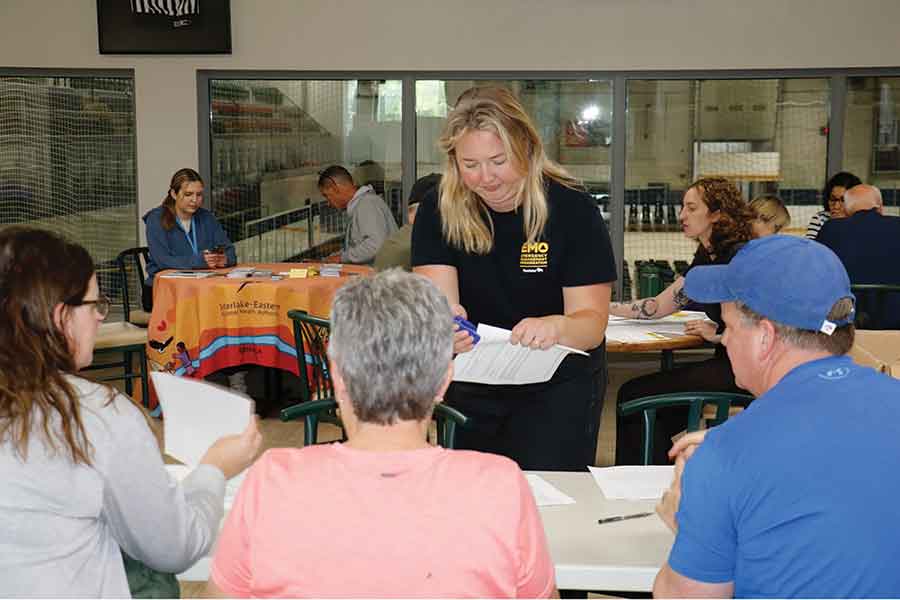
A Manitoba EMO official assists residents applying for Disaster Financial Assistance during a Stonewall DFA session
Representatives from Manitoba’s Emergency Management Organization (EMO) have been holding information and application sessions across flood-affected communities, including stops in Stonewall and Grosse Isle. Officials returned to Stonewall’s Veterans Memorial Sports Complex on June 19 and 20 to help residents navigate the application process and learn more about the updated program.
The sessions are the first to be held since Manitoba updated its DFA program in 2025. People who experienced damage from the June 6-10 heavy rains are eligible to apply for disaster assistance.
In a break from previous DFA rules, Premier Wab Kinew said residents who could have purchased flood insurance but did not may still qualify for disaster financial assistance.
“If homeowners do not have flood insurance or are underinsured, there may be assistance, though they should contact their insurance providers first to know what may be covered,” said Daniel Phalen of Manitoba EMO.
The sessions are intended to help residents understand what DFA can and cannot cover while also providing assistance with applications.
“Come in, talk to us, we’ll do our best to help,” said Phalen.
The invitation extends to homeowners, renters, farmers and business owners. While paper applications are available at the sessions, officials encourage residents to use the online system when possible. Applicants attending an in-person session should bring a copy of their most recent property tax bill.
Stonewall resident Grace Schedler attended the June 20 session after approximately 16 inches of water flooded her cellar. She said she only considered applying for DFA after learning her insurance policy would not cover the damage.
Schedler described the information session as “big-time helpful” and said the application process was straightforward and informative.
Although she was already familiar with the basics of DFA, she said residents who know little about the program would still find the sessions “very easy” and “very helpful.”
Phalen noted that approved claims help cover basic and essential repairs needed to return homes to a functional condition.
Repairs completed before an inspection will not affect eligibility, officials said. However, applicants should photograph all damaged property, document repairs and cleanup activities, and keep receipts, invoices and proof of payment.
Officials advised applicants to photograph all damaged rooms and, if possible, capture images showing how high the water reached. If homeowners have clear photos documenting the damage and water levels, an inspection may not be required.
Successful applicants are responsible for either $2,500 or 20 per cent of eligible costs, whichever is higher, under the cost-sharing program. For example, a resident with $10,000 in eligible DFA costs could receive $7,500 in assistance.
Officials stressed that residents should contact their insurance providers before applying for DFA. While uninsured residents may still apply, any expenses not approved for assistance would remain their responsibility.
Applicants who are denied assistance may appeal the decision within 60 days of receiving notice. The deadline to apply for the June Heavy Rains DFA program is Sept. 11, 2026.
Recognizing the emotional toll flooding can take, representatives from the Interlake-Eastern Regional Health Authority were also present during the sessions.
Mobile Crisis Services staff were available to connect residents with mental health resources and support.
“We’re available if they need to talk,” said Cam Freeborn of Mobile Crisis Services.
Freeborn noted that residents can access support in person or through online resources if they are uncomfortable seeking help face to face.
“It’s a community where everyone knows everyone,” he said.
Residents experiencing stress, anxiety or emotional difficulties related to the flooding can access the region’s 24-hour crisis line and additional mental health resources through the Interlake-Eastern Regional Health Authority.
While the DFA program is focused on helping residents recover financially, Phalen said the emotional impacts of the disaster should not be overlooked.
“I’ve seen people in a lot of pain, experiencing sadness and grief,” he said. “I really recommend reaching out to mental health supports.”
For more detailed information the government shared this website: www.gov.mb.ca