The high cost of mass-producing clothing in Winnipeg during the early 20th century led manufacturers to relocate factories to rural areas. The Winkler District Chamber of Commerce soon mobilized local businesses to invest in Winkler Apparel Ltd., which opened its factory in 1960. This provided 150 jobs — mainly for women — and quickly grew into a major employer with nearly 600 workers.

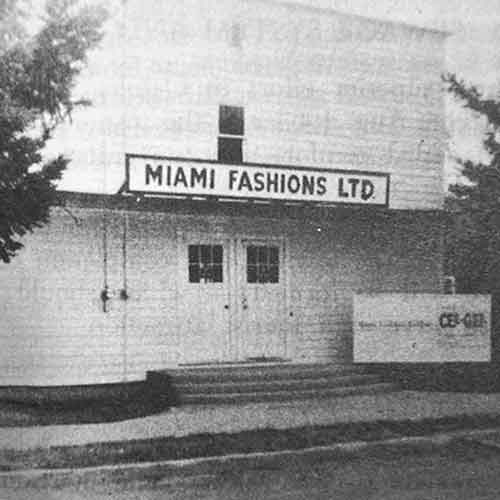
Sixty years ago, Miami entered the fashion business when Winkler Garments agreed to open a factory there in 1966
Ralph King, a New York-trained executive and general manager at Winkler Garments Limited, emphasized the need for the garment industry to revamp its public image through creative public relations programs. He shared these views at a government-sponsored seminar highlighting the public relations efforts that helped his company gain acceptance and respect in Winkler.
In 1965, Reeve Rudy Hink approached King to discuss opening a factory to employ people in Miami. With initial investors already committed, the Miami-Thompson Development Corp. sponsored the purchase of Ford Hall, which was renovated and outfitted as a factory. A training program began, and nine women — Mary Pearson, Annette Alexander, Margaret Smith, Isobel Angers, Anna Spenst, supervisor Marjorie Nordquist, Velma Hefford, Annie Ford and Esther Fry — were sent to Winkler from April 18 to July 22, 1966, to learn the trade.
Miami Fashions Ltd. officially opened Aug. 12, 1966, drawing hundreds to its ribbon-cutting ceremony, which featured Manitoba’s new minister of industry and commerce, Sidney Spivak. He commended Miami’s citizens for their entrepreneurial spirit and hoped this marked the beginning of rural diversification. Other garment plants sprang up in Altona, Winkler, Morden and Manitou.
King praised the Development Corp.’s essential role in making Miami Fashions possible. As the town’s first industry, it employed 30 people with an annual payroll of $60,000, and there was room for expansion as more workers were hired. Gemini products — primarily high-quality parkas and ladies’ sportswear — were shipped to stores in Eastern Canada and the northern United States.
By 1967, plans were finalized to expand the facility from 2,000 to 8,000 square feet and increase the staff from 35 to possibly 75. The Miami plant was expected to generate $750,000 by producing 100 per cent pile Eskimo parkas for Canadian Garments Ltd. of Winnipeg. King noted that Canadian manufacturers were now competitive with American companies in design, quality and price.
He opened a showroom in New York and soon announced an order for 6,000 garments from a major U.S. department store. Unfortunately, the operation in Miami closed in 1980 and moved to Morden. By 2008, Gemini ceased entirely due to competition from low-cost imports.
Doris Tosh: “I worked in Miami for five years, then two years in Morden before it closed. I was a garment checker for quality control, supervised by manager Herman Hyde. I don’t remember our wages — I’m 81 now — but I do recall that the faster you worked, the more money you made. Lol.”