Long before he was leaping from airplanes over Europe or racing camels across the Australian outback, Bob Smith was a Carman kid flying down a toboggan hill near the old oxbow of the Boyne River.
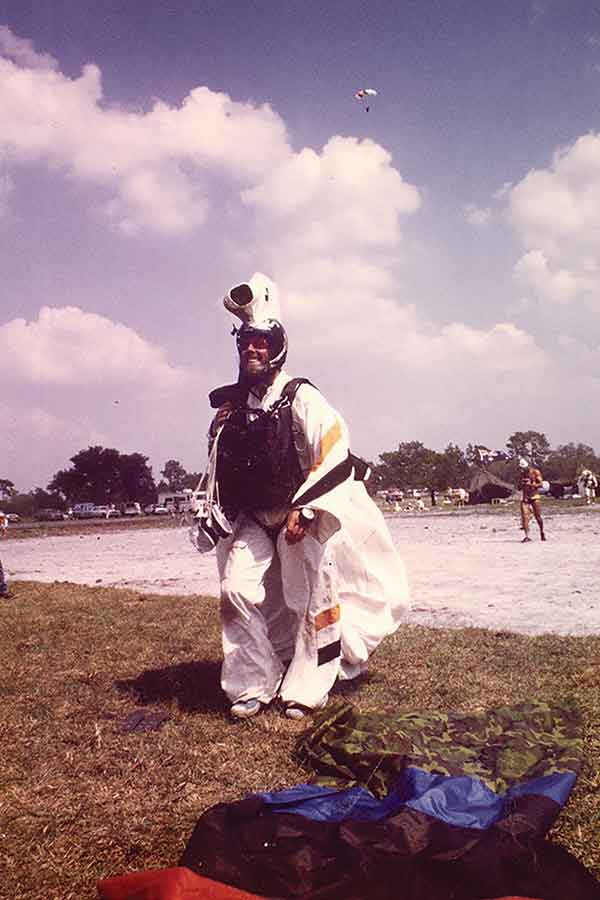
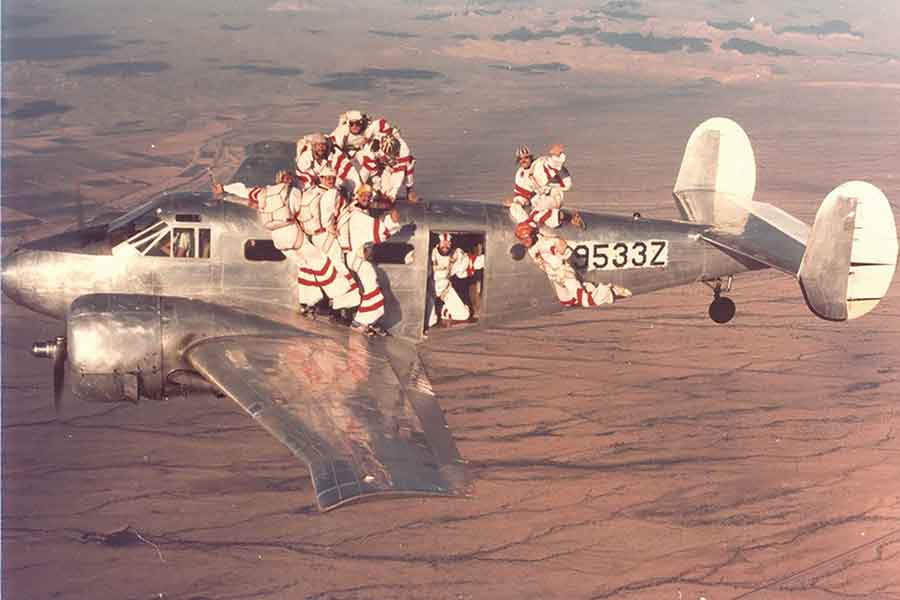
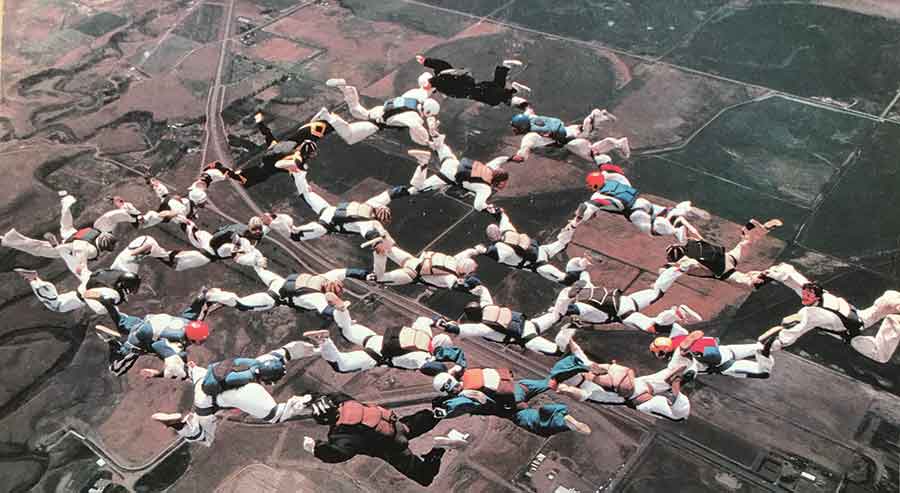
A 25-person diamond formation taken over Medicine Hat, Alta. in 1981. Smith is on the end o f the far left
Born at Carman General Hospital and raised on Fournier Avenue, Smith’s early world revolved around school sports, part-time work and the simple freedom of small-town life. Now retired in Victoria, B.C., he reflects on a journey that carried him far beyond the Manitoba prairie — though never far from its influence.
“Carman is the best place to grow up in the world,” Smith said. “Everyone knew everyone — it was the place to be, and you can’t ever take Carman out of my heart. It’s a part of me.”
His father, Willis, worked for Hank Churchill for years, while his mother, Jean, first worked at Harry Malcolmson’s store before moving to the post office. From them, Smith learned lessons that would guide him well beyond Carman’s borders.
“They showed me the right from wrong and the good from the bad,” he said. “I gained nothing but respect for them and others.”
After school, Smith stocked shelves, swept floors and helped with deliveries at Dorfman’s General Store. What he remembers most isn’t the tasks but the people. He enjoyed talking with customers and being part of the everyday rhythm of town life.
When he wasn’t working, he filled his days with baseball, football and curling. Winters meant toboggan runs down what he still calls the “best hill in the world,” before Highway 13 was straightened through town. Spring and summer brought rabbit hunting, endless bike rides and afternoons at the swimming hole. It was, he says, a childhood lived with “no regrets.”
That chapter shifted in the 1960s when his family moved to Prince George, B.C. The close friendships of Carman gradually stretched thin.
“Moving further and further apart,” he said, describing how distance slowly changed those relationships.
He still returns to Manitoba every few years to visit friends and family, but he admits the feeling has changed. New buildings have risen, new families have put down roots, and the rhythm of town life feels different. His visits have grown shorter and less frequent. Still, he credits Carman with making an “influential difference” in shaping who he became.
Ironically, it was Carman that first pointed him toward the sky.
Before leaving town, Smith met Bob Diemert, who had purchased the Boyne Theatre and was commuting from Winkler. Smith helped keep the furnace running during winter shutdowns — a small responsibility that opened unexpected doors. Through Diemert, he learned to ski and was introduced to aviation. One day, he watched three parachutists step into open sky.
“When I saw those three people make the jump, I just thought, ‘I would like to try that.’”
It would take five years after moving west before he figured out how to make it happen. A co-worker finally pointed him in the right direction, and Smith took his first leap.
That first year, he completed 13 jumps. By his third year, he had logged more than 100.
What began as curiosity quickly became commitment. He left steady mill work for construction, which offered the flexibility to train and compete. On a whim, he tried out for Team Canada — and made it.
The gamble paid off. Smith won medals at provincial and national competitions before representing Canada at three world championships: Warendorf, West Germany, in 1975; Gatton, Australia, in 1977, where his team secured gold; and Châteauroux, France, in 1979, earning silver.
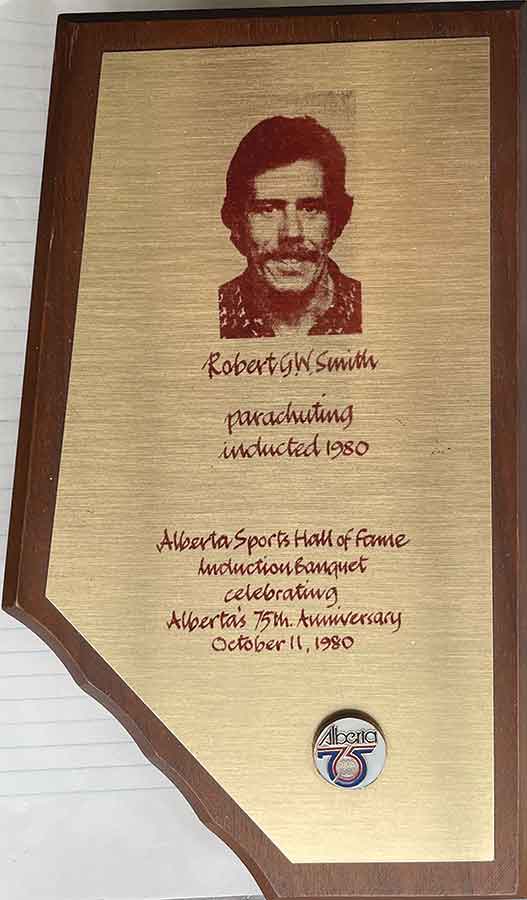
In 1979, his squad was named Team of the Year by the Sports Federation of Canada, and in 1980 he was inducted into the Alberta Sports Hall of Fame as a skydiving athlete with 1,700 jumps to his name and several international titles under his belt at the time. He lived in Alberta from January 1976 to November 1985, when he moved back to B.C.
Looking back, he describes his first jump as almost anticlimactic.
“It was rather forgettable. It just went so fast you can barely remember it.”
The second jump brought more fear, but over time the thrill consistently outweighed the nerves — even after breaking his foot five times.
More than medals, skydiving opened the world to him.
“It got me into exploring the world,” he said, noting his childhood self would never have imagined such a future.
In total, he represented Canada three times at world competitions. Practice typically consisted of two to three weeks of multiple jumps daily at parachute drop zones where teams could access an aircraft.
Smith competed in four-way, eight-way and 10-way maneuvers, making aerial formations with his teammates as they leapt from a plane together, falling at 120 miles per hour. When he competed, judging took place from the ground, with officials viewing teams through telemeters similar to large binoculars. Eventually, judges upgraded to using cameras, which provided better opportunities to observe each team.
After retiring from competition, he continued in the sport as a coach, working in Denmark, Sweden and Venezuela. He served as Sweden’s national coach at the 1981 world meet in Zephyrhills, Florida. A path that began with a furnace check in Carman had taken him across continents.
Construction work carried him even farther, across Canada and overseas into Southeast Asia, Africa, the jungles of Borneo and the Democratic Republic of Congo.
“Travelling opened my eyes to so many things,” he said. “Like camel racing.”
Through skydiving connections in Australia, Smith became involved in endurance camel racing in the outback. What began as supporting a friend honouring his late brother’s dream soon became a pursuit of its own. Smith helped catch and train wild camels, organized short-track races and competed in endurance events spanning 3,360 kilometres, 1,700 kilometres and 1,400 kilometres across some of the continent’s most remote terrain.
The sport brought him back to Australia dozens of times — for the races, the friendships and the warm climate.
“Life is an experience and it’s about chasing those opportunities,” he said.
Comparing skydiving and camel racing, he says, is nearly impossible. Each carried its own challenges and rewards. What stands out most, however, are the friendships formed along the way.
His one regret, he admits, is not having a family. Though he had meaningful relationships, constant travel and commitment to sport left little room for long-term stability. Now settled in Victoria, life is quieter.
“But I wouldn’t change one little thing about what I have done,” he said. “I’m still here and everything has worked out — most people can’t say they’ve ever lived a life close to mine.”
From the banks of the Boyne River to world championship podiums and the deserts of Australia, Smith’s story is proof that even the most extraordinary journeys can begin in the most ordinary places.
His advice remains simple.
“You only live once and you are only young once, so you should enjoy it,” he said. “Live life, have fun, don’t be too serious and take time to enjoy yourself.”