Manitoba students, international development leaders, and provincial and federal officials gathered at the Manitoba Legislature Monday to mark the launch of the 36th annual International Development Week (IDW), highlighting youth voices and global partnerships focused on building a more just and sustainable world.
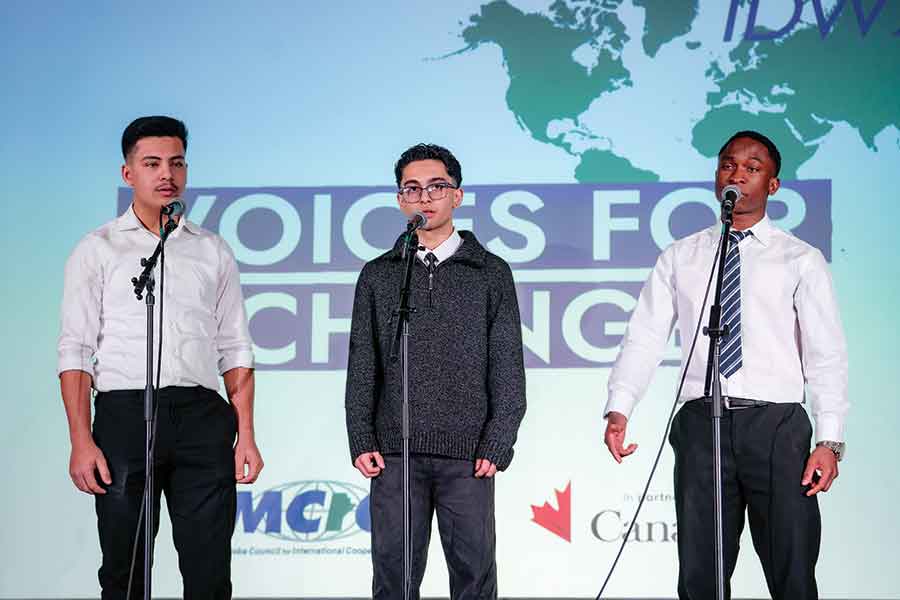
Fawwaz (Ali) Al Hassan, Sami Suliman and Tobilola (Tobi) Olorunsola perform a spoken-word piece during the Manitoba Council for International Cooperation’s launch of International Development Week at the Manitoba legislature
Hosted by Education and Early Childhood Learning Minister Tracy Schmidt, the event brought together youth advocates, global changemakers, elected officials and community leaders for the opening of the week-long initiative organized by the Manitoba Council for International Cooperation (MCIC).
Federal Secretary of State for International Development Randeep Sarai addressed attendees, speaking to this year’s theme, Prosperity Through Partnership, and emphasizing the importance of collaboration across borders to address global challenges.
A central feature of the launch was the debut performance of What We’re Meant to Be, a spoken-word poem created and performed by three Manitoba high school students — Tobilola (Tobi) Olorunsola of Brandon, and Fawwaz (Ali) Al Hassan and Sami Suliman of Winnipeg.
The students, all recent newcomers to Canada, explored themes of genocide, oppression and displacement, reflecting on injustice and resilience through personal and global perspectives.
“Stay home. Stay quiet. Stay invisible,” Al Hassan recited in the piece, reflecting on the experiences of girls denied access to education. Olorunsola evoked loss and longing, saying “Dust falls from them like small ghosts,” while Suliman delivered a message of hope, reminding audiences that “Even in broken places, love refuses to die.”
The performance was developed through MCIC’s annual Voices for Change program under the mentorship of Manitoba spoken-word artist Steve Locke and was released as a YouTube video to coincide with International Development Week.
While reciting at the Manitoba legislature, the students received a standing ovation and “moved guests to tears,” said MCIC public engagement specialist Grace Van Mil.
“Youth bring this new energy and passion into the work we do,” she said. “It’s an opportunity to help them understand their actions and advocacy matter while striving to make the world a better place.”
Van Mil — who currently lives near Gimli and formerly resided in Rosser and Selkirk — said it is MCIC’s and IDW’s mission to help Manitobans understand what it means to be a global citizen and recognize that local actions can have a global impact.
“Our main vision is a just world,” she said. “We work to create change locally by engaging Manitobans and encouraging the sustainable world we are striving for.”
“International Development Week reminds us that true prosperity is built through partnership, by working together across borders to create opportunity, resilience and a just world,” said MCIC executive director Janice Hamilton.
MCIC is a coalition of more than 40 Manitoba-based organizations that supports hundreds of international projects worldwide. Last year alone, through the Manitoba government matching grant program, the organization distributed $1.25 million to 57 projects focused on social justice, the environment, education and other global priorities. MCIC also offers learning opportunities, workshops and conferences throughout the year, including during IDW, which is celebrated annually during the first full week of February.
Since 1991, Global Affairs Canada has led International Development Week alongside provincial councils and organizations, recognizing contributions to international development and cooperation.
“It’s clear to Canadians that we are all in this together,” Van Mil added. “We are all part of a global community helping each other learn, grow, innovate and solve problems, giving us all a better chance to thrive.”
She noted that especially in small towns, residents understand the power of collective action, saying time and again, unity leads to progress.
MCIC also presented its 2026 Development Impact Award to World Vision Canada, in partnership with World Vision Sri Lanka, recognizing their Gender-Transformative Approach for Health, Food Security and Climate Resilience project in Sri Lanka. The initiative combined fuel-efficient cookstoves with women-led home and community gardens, while engaging men and boys as partners in advancing gender equality.
“This is just one example of the incredible work Manitobans have supported,” Van Mil said. “It truly shows we have the chance to make meaningful impacts.”
The project reached 274 participants, reduced household firewood use by 56 per cent, increased women’s participation in community leadership from zero to 69 per cent, and significantly improved food security through expanded local gardening.
“Now it’s different. It only takes a little wood to light the stove,” said Malani, a tea estate worker whose household became a model for community change. “I could even say it’s better than a gas stove. Now I get to spend more time with my family.”
Van Mil said the project addressed both immediate and long-term needs by combining practical solutions, such as fuel-efficient stoves, with lasting social transformation, including increased leadership opportunities for women.
“Once you improve life for your daughters — such as more time in school because less wood needs to be collected for stoves — they will be able to improve life for their future families and the community as a whole.”
To learn more about MCIC or get involved, visit www.mcic.ca.
“We are all global citizens. Our actions matter, and Manitobans can make a difference when we come together,” Van Mil added.