Farmers and municipal leaders in Manitoba’s south Interlake are calling on the provincial government to improve aging drainage infrastructure and provide clarity on disaster assistance after a massive rainstorm left thousands of acres under water and caused widespread damage across the region.
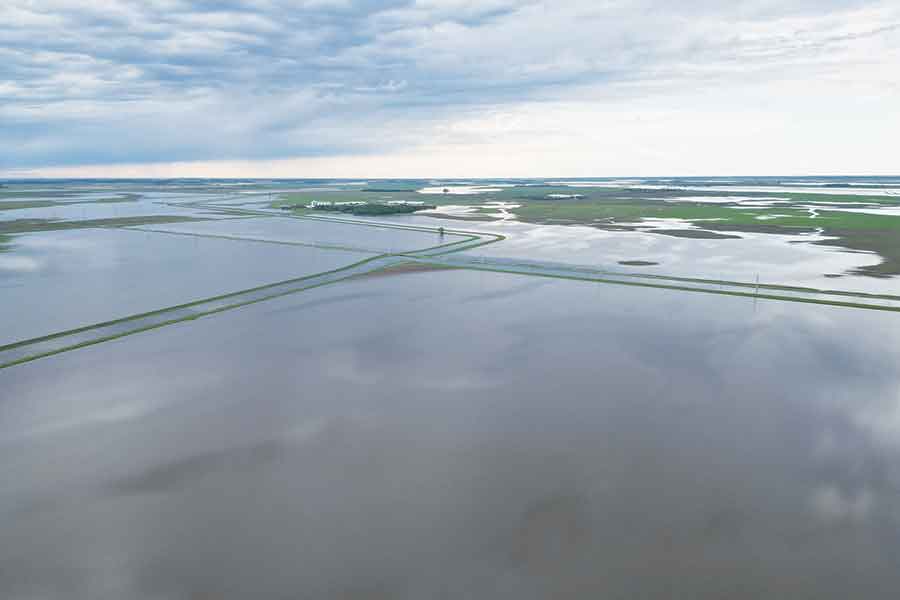
More than a week after an estimated 255 millimetres (10 inches) of rain fell in parts of the rural municipalities of Woodlands, Rockwood and Rosser on June 9, flooded fields, washed-out roads and overwhelmed drainage systems remain a reality for many residents and producers.
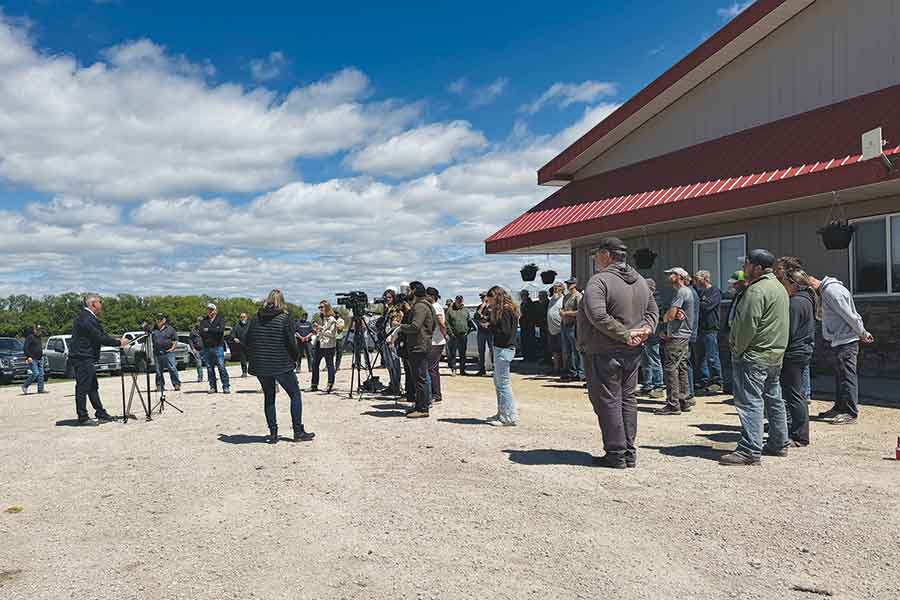
Dozens of agricultural producers joined Lakeside MLA Trevor King at Boonstra Farms, southwest of Warren, in the RM of Woodlands on June 18 to highlight the scale of the damage and push for both immediate support and long-term solutions.
“As of this morning, there’s still thousands of acres in this area underwater,” said King, who is the PC critic for Municipal and Northern Relations.
“Some producers are facing such a level of devastation that crop insurance alone will not make them financially whole,” he said. “These are farm families who need answers now, not months or years from now.”
The flooding has reignited concerns about drainage capacity throughout the Sturgeon Creek watershed.
Brian Boonstra, co-owner of Boonstra Farms, a third-generation dairy operation, said producers across the region have suffered significant losses.
“As individual farmers, we’ve all lost hundreds of thousands of dollars and some of us have most likely lost millions,” he said.
Boonstra estimated the economic impact of the storm could exceed $200 million in lost revenue from agricultural production.
“When you take these losses and we’re getting them every five or six years, it’s costing the province a lot of money,” he said. “We can’t fix it 100 per cent, but if we could fix it 40 or 50 per cent, the return on that investment is a huge number.”
He said producers are not asking for government handouts but rather investments in infrastructure that would help move water more efficiently through the watershed.
“Every farmer invests millions of dollars into land and buildings and equipment, and we would really like to see the province make a big investment into improving this drainage system,” Boonstra said. “Specifically, we’re talking about the Sturgeon Creek watershed to get this water into the Assiniboine faster.”
The flooding affects more than farmland, he added.
“Floodwater from the towns of Warren and Grosse Isle end up in the Sturgeon Creek watershed and something needs to be done to figure out a way to move this water faster.”
His brother, Rob Boonstra, said repeated flooding events threaten the long-term viability of farm operations.
“It’s devastating, and it’s happening too often,” he said. “Instead of just getting a big pocket full of cash from the government, I’d like to see infrastructure because this is going to happen again.”
He warned that without action, the region will face the same problems repeatedly.
“We need to take a look around and keep reminding ourselves why we’re here and what we’re trying to do and try and get the government on our side to help us build some infrastructure because otherwise the problem is just going to exist forever.”
Municipal leaders echoed those concerns, pointing to aging drainage systems and long-delayed projects.
Woodlands Reeve Doug Oliver said much of the infrastructure serving the watershed was designed in the 1960s and 1970s and no longer reflects current land-use patterns.
“Population has increased and water leaves developed areas faster,” Oliver said. “We’re back in a situation that needs to be remedied.”
He said water flowing through the watershed must eventually reach the Assiniboine River, but high water levels are slowing the process.
“Our flood event will eventually go down, but the RM of Rosser will continue for many days, and so will St. François Xavier, because the water can’t get into the river.”
St. François Xavier Reeve Delmer Nott called on the province to reconsider operating guidelines for the Portage Diversion, arguing that opening it sooner could help reduce pressure on downstream communities.
“We need to have solutions,” Nott said. “We talk about sustainability; we talk about resilience, we talk about cooperation, communication and coordination, those are all words until we put action in front of them. We can’t stop extreme weather, but we can learn how to be resilient to it.”
Rosser farmer Jim Beachell said local bottlenecks are worsening flooding in some areas.
“Our water started to recede yesterday, and we still have hundreds of acres underwater,” he said, adding that there is not enough culvert capacity in some locations to handle the amount of water.
RM of Rockwood farmer Kevin Molter, who farms near Stony Mountain, said recurring flooding issues highlight the need for long-promised drainage improvements.
Molter pointed to plans announced in 2011 for an $11-million upgrade to the Wavy Creek drainage system that was never completed.
“They walked away for another project and never came back,” said Molter. “What I want to know is if you had a problem on the books and you earmarked the money, where did it go? Because it didn’t get fixed.”
Molter said heavy rainfall and runoff from surrounding communities continue to overwhelm the area’s drainage infrastructure, leaving water stranded on agricultural land.
“We get a lot of water from the towns, which I understand — houses are important,” he said. “But at the same time, the water needs to leave. The water comes, so be it. Let’s make it leave.”
He said responsibility for drainage management is often passed between different levels of government and agencies while the underlying issues remain unresolved.
“We all need to start working together. Fix the infrastructure and you won’t hear from us,” said Molter. “Everybody will benefit. We need to start putting pressure on because this can’t continue.”
Rockwood producer Bruce Stewart echoed that drainage infrastructure has not kept pace with growth in surrounding communities.
“Everybody lives on infrastructure that’s 60 years old,” Stewart said. “Stonewall, Stony Mountain, Warren — all these small towns have expanded, and the water goes immediately into drains that have not been maintained and that can’t handle it.”
King said he recently wrote to Premier Wab Kinew and Infrastructure Minister Lisa Naylor requesting that the province consider using the Portage Diversion to help lower water levels downstream. The response he received stated the diversion is operated according to established guidelines, including river flow thresholds near Portage la Prairie.
“I think we need to take a good look at those guidelines and where it makes sense to utilize infrastructure that we have to alleviate problems downstream,” King said.
The Progressive Conservatives are also seeking details about disaster financial assistance announced by the province following the flooding.
Under current program rules, assistance generally covers uninsurable losses. Producers have raised concerns about what support may be available for losses not fully covered by crop insurance.
“The premier has said everybody will be taken care of,” King said. “But Manitobans need to know what that actually means, how the premier plans to modify or work around a federal program and whether producers will receive real support beyond crop insurance.”
Agriculture contributes between eight and 10 per cent of Manitoba’s gross domestic product and supports approximately 50,000 jobs, King noted.
“When producers are hit this hard, the impact is felt well beyond the farm gate,” he said. “The provincial government needs to respond with the urgency that this sector deserves.”
In a statement, Municipal and Northern Relations Minister Glen Simard said the province recognizes the challenges faced by producers, rural Manitobans and communities affected by this storm. The government is reviewing and strengthening disaster financial assistance to ensure it can better respond to the impacts of extreme weather events.
For producers such as the Boonstras, however, the focus remains on preventing a repeat of the disaster.
“We’re hoping the government will step in and help us,” Brian Boonstra said. “Nobody’s sitting here wanting big handouts. We want future infrastructure.”
He added that while major storms cannot be prevented, governments can reduce their impact through planning and investment.
“It’s a major rain event that nobody’s ever expecting,” he said. “But if there’s some way we can be proactive moving forward and take some pressure off these events, it’s worth bringing attention to.”