The provincial government launched an interactive CWD Dashboard to help hunters monitor chronic wasting disease (CWD) in the province.


Natural resources and Indigenous futures minister Ian Bushie said the online tool will help prevent the spread of the disease, which affects deer, elk, moose and caribou and was first detected in Manitoba in 2021.
“The CWD Dashboard is a first of its kind in Canada and showcases Manitoba’s commitment to leading the way in preventing the spread of CWD,” said Bushie in a Nov. 17 news release. “This tool, in partnership with hunters submitting biological samples and CWD testing, will help monitor and manage CWD in our province.”
Chronic wasting disease is a progressive and fatal neurological disease that affects cervids including deer, elk, caribou and moose. Proteins called prions build up in the brain and nervous tissues of infected animals and damage their nerve cells, according the province. The prions can also contaminate the environment and persist for years, infecting deer and other cervids in the area.
Meat from a CWD-infected animal should not be consumed.
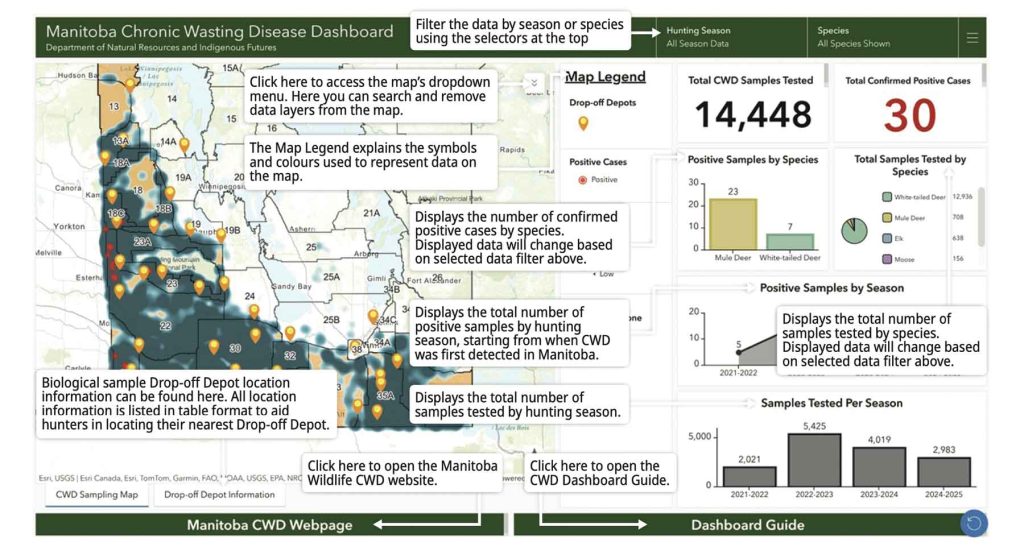
The CWD Dashboard is hosted on the provincial department of natural resources’ wildlife webpage. The dashboard shows detailed CWD data including locations where CWD has been detected, the total number of confirmed positive cases by species (indicated by a red circle), the total number of positive samples by hunting season, and the total number of samples tested by hunting season.
People can filter the map by hunting season, by species and also obtain directions to the nearest CWD sample drop-off location in their respective hunting areas.
The province’s 2024-2025 hunting season CWD Summary Report, released in September, says the Wildlife Health Program tested a total of 3,007 cervids, including deer, elk, moose and caribou.
Four samples – one mule deer and three white-tailed deer – tested positive for CWD (0.13 per cent positive rate). All four cases were identified through hunter participation.
The province has significantly improved turnaround times for CWD results from 77 days in 2022-2023 to 22 days this past hunting season.
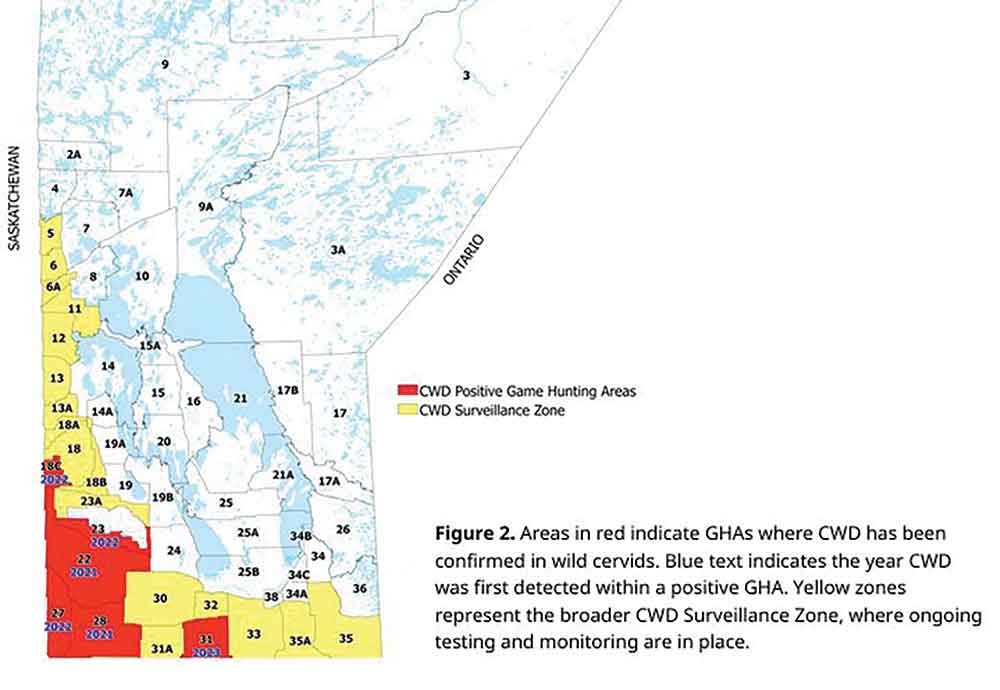
To date, 30 positive CWD cases have been identified in Manitoba since 2021 when the first case was confirmed. There were five CWD cases detected in the 2021-2022 hunting season, 17 cases in the 2022-2023 season, four cases in the 2023-2024 season and four in the 2024-2025 season. The positive cases were in mule and white-tailed deer.
“Since 1997, Manitoba has taken a proactive approach to preventing and detecting CWD in wild cervids. The comprehensive program includes targeted surveillance, import restrictions on potentially infected animals or materials, and regulations to reduce high-risk practices like feeding and baiting,” states the report. “Manitoba’s first confirmed case of CWD was identified in November 2021, a symptomatic male mule deer near Dropmore, a town in western Manitoba, within Game Hunting Area (GHA) 22. A second case was detected in December 2021 near Coulter (GHA 28). Since then, 28 additional cases have been confirmed, bringing the total to 30 across six GHAs (18C, 22, 23, 27, 28, and 31).”
Testing is critical to manage and prevent the spread of CWD in cervids.
Hunters should also practise safe-carcass-handling protocols and not eat any animal that has yet to be tested or has tested positive for CWD.
“Every hunter who submits a sample truly acts as a wildlife hero. In Manitoba, 83 per cent of all positive cases of CWD (25 out of 30) were identified through hunter participation …. Without hunter harvests, these infected animals might have gone undetected, potentially spreading disease throughout wild cervid herds. Hunters are not just harvesting game; they are harvesting hope for healthy wildlife cervid populations and saving the future of hunting,” states the report.
Visit www.manitoba.ca/cwd to access the province’s CWD Dashboard and the latest CWD summary report.