Educational talk open to all May 13
The Winkler Heritage Society is hosting an event next week to showcase one of the most unique artifacts in its collection.
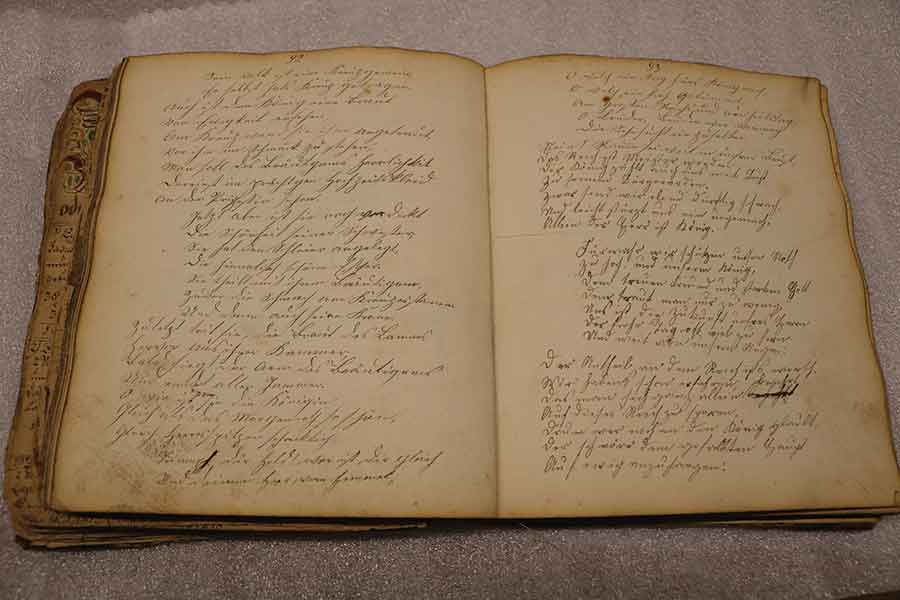
The Wiens Family Diary includes entries stretching back centuries. The Winkler Heritage Society is hosting an information night next week to share details about the artifact and its history
The Wiens Family Diary has been in the Winkler Archives’ possession for some time, but it’s about to go on a year-long loan to the Mennonite Heritage Village in Steinbach for a special exhibition.
Before it leaves, the society thought it would be fun night of education to invite people down to Winkler Arts and Culture (the new home of the archives and the future site of the new Winkler Heritage Museum) to learn more about the diary and the roots from which Winkler itself sprung.
“Personally, I believe this is the most important thing I’ve found in here,” shared archivist John Epp of the book and its handwritten entries. “200 years of history right here.”
The earliest entries in the journal come from Peter Wiens, who was born in Danzig in 1770. He included pages of arithmetic charts and problems, poems, riddles, and proverbs, and also painstakingly sketched and coloured in several examples of Gothic lettering.
His brother, Jacob Wiens (born 1767), then added several handwritten notes detailing his own birth and marriage, the birth of his children, and the death of his wife.
His son, Jacob Wiens, was born in Russia in 1816. As an adult, he continued adding to the family diary, detailing many recipes and cures for various maladies afflicting both man and beast, historical happenings in the village of Kronsthal in Russia, and his journey to Canada and eventual settlement in Hoffnungsfeld (just west of what would become Winkler) in the 1870s.
Wiens’ son was Isaac Wiens, the man who traded the quarter-section of land to Valentine Winkler in the 1890s on the advice of church leaders who didn’t want their members involved in the creation of a new town. Winkler went on to use that land to found the community that bore his name.
The diary was donated to the society by Grace Schellenberg, a descendant of the Wiens men who penned it.
Recently, the diary was thought to have been lost in the bustle of packing up the entire Winkler Archives for storage when they moved out of their longtime space in the Winkler library a couple of years ago. But Epp found it safe and sound a few weeks ago—just in time to grant the Steinbach museum’s request to showcase it as part of their upcoming display on Mennonite medicine, given the wealth of home remedies included in its pages.
Before it leaves the collection temporarily, anyone with an interest in local history is invited to the Park St. art gallery on Wednesday, May 13 at 7:30 p.m. for a presentation on its contents and a chance to see it up close.
“We’ll have it on display and we’ll also select some pages to highlight,” shared Epp. “And we’ll share a bit about the story of Winkler’s origins, the land transfer and all that, which a lot of people aren’t aware of.”
An artifact like this provides a compelling glimpse into the lives of past generations, Epp observed.
“Obviously, everything changes, and if you want to see what it was like then the only place you can get that sense is by talking to somebody who was there,” he said, noting that since those Mennonite settlers are long since passed, this is the next best thing—hearing their words written right as everyday history was happening around them.
Next week’s event is open to all. There is no admission fee, though donations towards the Winkler Heritage Society’s fundraising campaign for the heritage museum being built in undeveloped space in the art gallery building are most welcome.