What can businesses do to help prevent crime?
That was the topic of discussion at a recent Stonewall and District Chamber of Commerce lunch event featuring a presentation by Stonewall RCMP detachment commander Jason Vrooman.
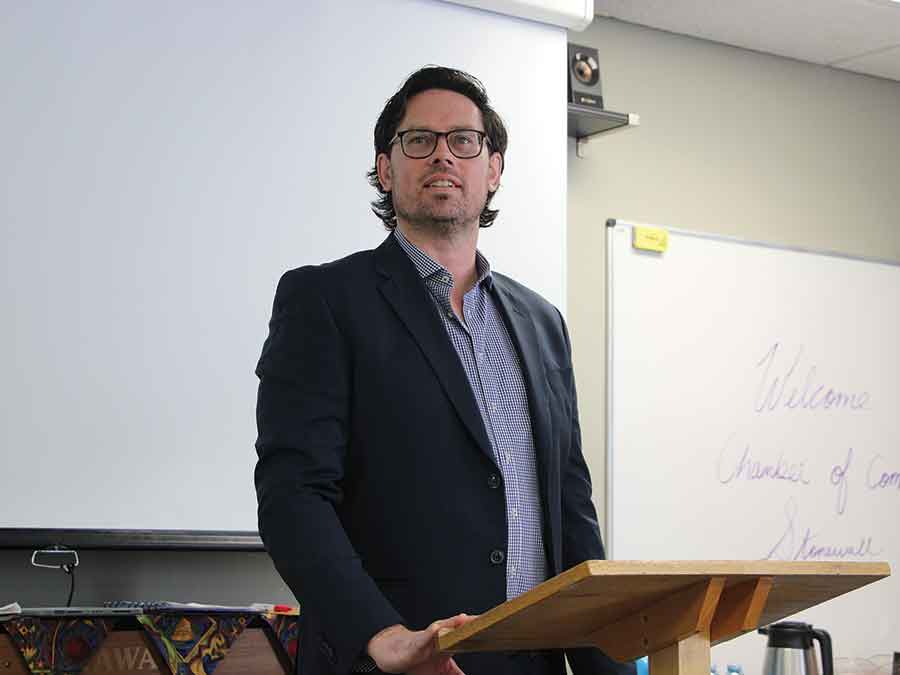
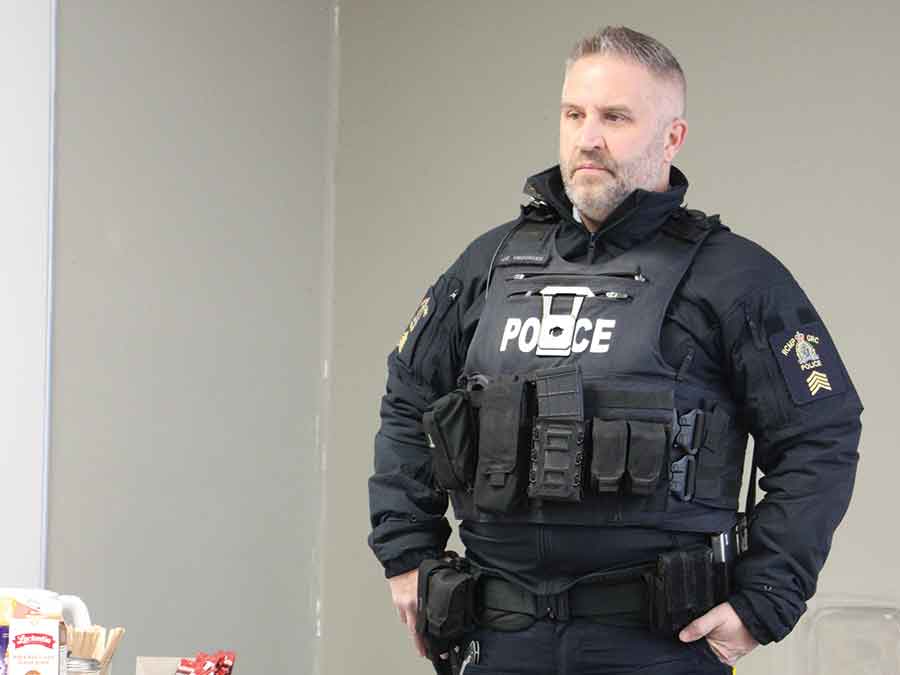
Stonewall RCMP detachment commander Jason Vrooman shared tips about how to help prevent crime
Vrooman offered security suggestions to the group that gathered at Stonewall New Life Church for the event on Thursday, March 12.
To start, he focused on how businesses can bolster their outdoor security. He suggested that business owners ensure there are no dark areas around the property, with bright lights illuminating outside doors and windows.
“We have a lot of criminals in this province — and a lot of them aren’t very smart, but they’re not in the business of getting caught,” he said. “They’re not going to come into that property that’s well lit.”
Another idea is to install security cameras and ensure that they’re working.
“It’s nice to embrace the technology we have these days. We have a lot of analysts at the district that love surveillance footage,” Vrooman said. “They love to compile all the footage of people stealing stuff and breaking into stuff. It allows us to connect various crimes throughout an evening or weekend.”
To reduce places for criminals to hide, business owners can trim shrubs and bushes. They can also put up signs indicating that there’s no cash or valuables on site.
“Our property crime is directly related to our meth problem,” he added. “People need to have their fix so they’ll steal property to sell it on Marketplace or Kijiji or wherever to get their money to go buy more drugs. There’s a direct correlation.”
Inside the business, Vrooman recommends security alarm systems with motion detectors and glass-break detectors. In addition, all safes and cash registers should be removed from the site after hours. If they’re kept on site, they should be left open and empty each night. At the end of the workday, it’s best to ensure there are no spare keys to offices, registers and safes on site. All valuables should be out of view after hours, and lights should be left on inside.
“We encourage lights to be left on inside,” he said. “If it’s backlit and someone’s walking around after hours, anybody driving by or us on patrol can see if there’s somebody in your business.”
Motion lights and CCTV cameras are also a good idea. As an added precaution, business owners can post the phone number for the local RCMP detachment for employees to access easily.
Doors and windows should all have working locks. Screens on windows should be in good condition without being able to be removed from the outside. Anti-smash security film can be added to windows as an additional safety measure. Sliding doors should have a pin or board to prevent them from opening, and doors and doorframes should be reinforced.
It’s also a good practice to record serial numbers for valuable items, including TVs, computers and equipment.
“If you write down the serial numbers for your valuables, it’s very easy for us to connect that it’s yours,” Vrooman said.
At the end of the workday, Vrooman recommends completing a safety check — and he even implements the same practice at home each evening. This safety check should include checking windows and doors while also ensuring that lights are on, CCTV is working and valuables are out of sight.
“Before you lock up and go home, make sure everything is secure,” he said. “I know it’s sometimes a daunting task because you have other things to do, but taking that extra four or five minutes to secure your business and make sure it’s locked up will go a long way.”
And what should business owners or employees do if they encounter a shoplifter? Absolutely nothing, Vrooman says.
“That’s when you have your really good security cameras and ways to identify people. We might not get them that day, but our job is to get them. We don’t want you to put yourself in any harm’s way or any threat to you or your employees so you get hurt as a result of someone taking $100 worth of groceries,” he said.
“It’s hard to say, but that’s the reality. You don’t know what kind of condition they’re operating under. You don’t know what they’re capable of. It’s not worth anybody getting hurt.”
Businesses also have the right to deny entrance on private property.
“You can ask them to leave — and if they don’t leave, we’ll come and help you. Through your approval, we’ll have them barred so they’re not allowed back in,” Vrooman said. “Once they come back, then we can arrest them. We just have to get them on the initial condition, but you can refuse service.”
The event wrapped up with a question-and-answer session followed by the regular meeting of the Stonewall and District Chamber of Commerce.