Spirits are soaring for Tribune reporter Jennifer McFee, who closely guessed the arrival of the first goose of the year at Oak Hammock Marsh.
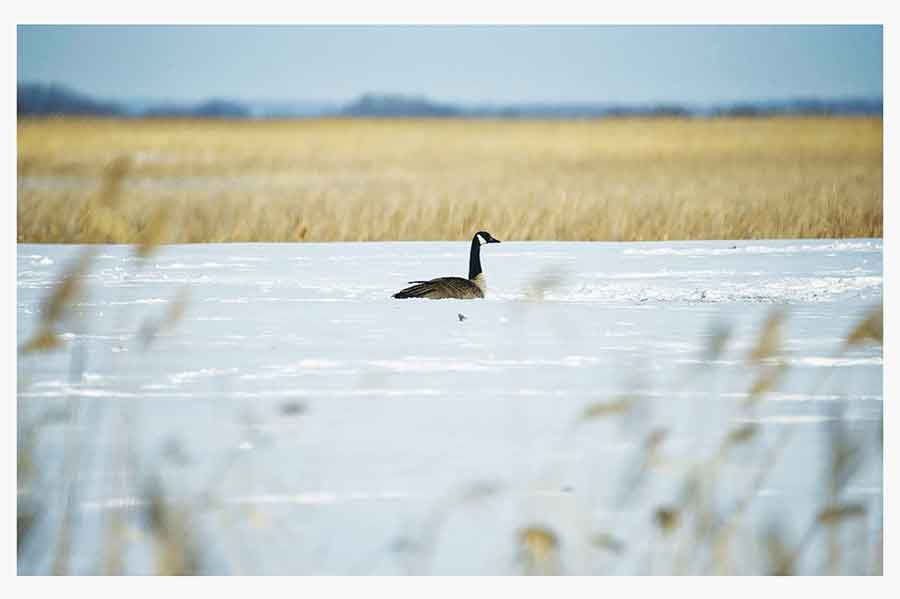
The first Canada Goose arrived at Oak Hammock Marsh on March 10
Each year, Oak Hammock Marsh organizes a contest asking participants to guess the date and time of the arrival of the first Canada goose on site. An employee of the Wetland Discovery Centre at Oak Hammock Marsh must see or verify the goose, which needs to be located within the physical limits of the site’s wildlife management area. The winner receives a one-year family membership to the Wetland Discovery Centre, along with a plush Canada goose.
Your local reporter guessed the first goose would arrive at 10:07 a.m. on March 10. Indeed, the first goose arrived that day — but two minutes earlier at 10:05 a.m. The next-nearest guess was 10 a.m.
In total, 170 people took a guess in this year’s contest, which has been running annually since it launched in 1993.
Besides being a fun tradition, the contest also serves several meaningful purposes tied to nature observation, community engagement and wetland conservation.
“The return of the Canada geese celebrates a change of season. It is one of the best signs that winter is ending on the Prairies. The contest builds excitement around this,” said Jacques Bourgeois of Oak Hammock Marsh.
“It gets visitors actively looking and listening for migrating birds, which leads to wanting to learn more about migration, wetlands and the importance of habitats like the marsh. As a major stopover along the Mississippi Flyway, the marsh plays a crucial role during migration. The contest highlights that fact in a fun way. Whether it’s families, birders or school groups — we had a few this year — entering their guesses, the contest creates a sense of connection and friendly competition.”
At the same time, the contest introduces the idea of tracking wildlife observations, which Bourgeois says is central to conservation.
“Noticing the ‘first sighting’ helps real scientific monitoring of migration patterns,” he said.
“As a matter of fact, we also keep track of every bird species’ first sightings of the year in a friendly staff competition. Our First Goose of the Year contest turns a natural event into an engaging experience that connects people with wetlands.”
During spring migration, tens of thousands of geese return to Oak Hammock Marsh as they head north to their nesting grounds. It starts in early to mid-March, when a few hundred geese arrive. The first goose of the year is usually spotted at Oak Hammock Marsh around mid-March. The earliest arrival was on Feb. 21 at 1:45 p.m. in 2017, while the latest arrival was on April 6 at 7 p.m. in 1996.
From mid- to late March, numbers quickly rise to 5,000 to 10,000 daily. Early to mid-April is the peak of spring migration, when up to 20,000 to 40,000 Canada geese can be seen daily.
By late April, numbers taper off as the flocks continue north, but several thousand geese might still stop over. Only a few hundred will remain and nest at Oak Hammock Marsh.
Bourgeois explains why the spring numbers are lower than the fall numbers.
“In spring, geese migrate in smaller groups and don’t linger as long. Finding good nesting sites drives them north quickly, whereas fall is about feeding heavily and resting, which is why hundreds of thousands build up then,” he said.
“Migration seasons, both spring and fall, are fantastic times to visit the marsh. While fall migration is truly a sight to behold, with hundreds of thousands of migrating waterfowl filling the sky and the marsh, spring migration can be just as exciting, with the arrival of each species inching us closer to warmer days.”