Property owners will be seeing a mill rate increase of 16.71 per cent on their property tax bills this year as Prairie Rose School Division (PRSD) combats at $500,000 deficit for the 2026-2027 school year.
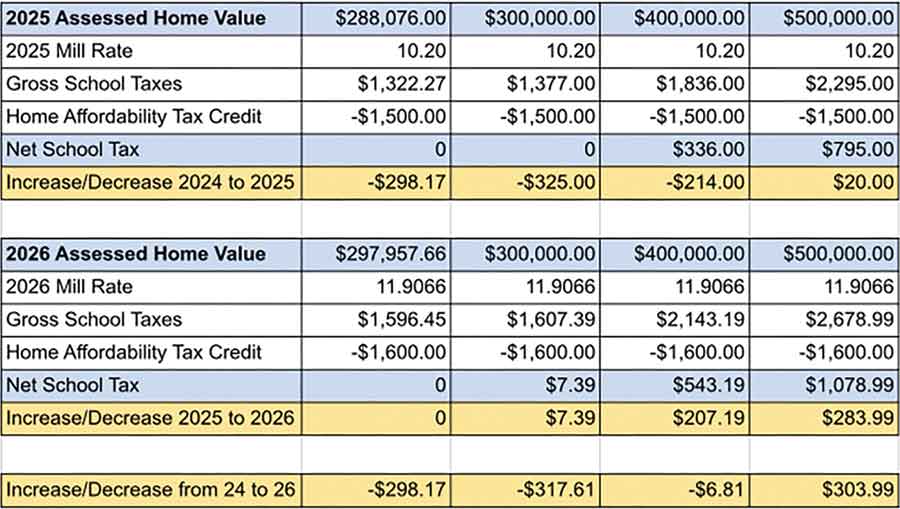
PRSD taxation changes for 2026
As announced at its public budget presentation on March 23, PRSD outlined their key priorities and financial pressures for the next school year.
With a planned $500,000 deficit, PRSD has implemented increased taxation rates to offset the decline of provincial funding.
The 2026 special levy will rise by 17.74 per cent compared to 2025, while the mill rate will increase by 16.71 per cent, this comes after 2025’s increase of only 2 per cent.
For farmland, a $100,000 quarter section will be taxed at $309.57, an increase of $44.32.
The Home Affordability Tax Credit (HATC) continues in 2026, with a maximum value of $1,600. Under the new rates, homes assessed at $300,000 are expected to pay $7.39 in net school taxes, while homes assessed at $400,000 will pay $543.19 and those assessed at $500,000 will pay $1,078.99. Homes assessed at or below $297,957.66 will not pay school taxes, as the full amount is covered by the HATC.
Present at the meeting were PRSD board members, trustees, administration, staff and community members.
PRSD serves approximately 2,300 students across nine community schools and 13 colony schools. The division offers both English and French programming, with French immersion accounting for about 15 per cent of total programming. It spans 3,500 square kilometres from Miami to St. Laurent and operates 38 daily bus routes, covering 3,800 kilometres each day.
The PRSD Board of Trustees engaged with community members, parents, advisory councils, Hutterian colonies, staff and students during budget consultations held between November 2025 and February 2026. These discussions focused on divisional priorities such as access to services, maintenance, class sizes, programming and transportation, with superintendent Kevin Clace describing stakeholder engagement as “critical.”
When setting the budget, the board considered several fixed and largely uncontrollable costs, including the harmonization of teacher salaries, salary accruals, insurance and liability increases, rising utility rates, higher transportation costs and growing maintenance and facility expenses.
The most significant impact comes from teacher salary harmonization. Beginning July 1, 2026, all teachers in Manitoba will be paid according to a single salary grid established by Manitoba Teachers’ Society guidelines.
“Although there are significant costs for the Prairie Rose School Division due to this compensation change, the province is only funding a portion of those costs through what is called the harmonization grant,” Clace explained. “The remaining costs are borne by the school division.”
In addition, divisions must account for potential increases tied to the provincial teachers’ collective agreement, which expires June 30, 2026, and may result in salary costs beyond harmonization.
“School divisions across Manitoba saw their insurance costs rise substantially over the past year,” Clace added, citing inflating construction costs and the provincial wildfire situation. Insurance and liability costs have increased by 30 per cent over the past 18 months.
Despite these pressures, the board remains committed to maintaining small class sizes from kindergarten to Grade 6, sustaining current full-time teaching staff and preserving educational assistant supports. Investments have also been made in technology and security upgrades, project-based learning for Grades 9 to 12, financial software replacement, and the purchase of two new buses and one fleet vehicle.
Regular instruction accounts for 57.8 per cent of the budget, or $25,673,307—an increase of nearly $4 million from the previous year. Other major expenditures include student support services ($7,095,172), operations and maintenance ($4,687,701), transportation ($3,131,555), divisional administration ($1,393,984), instructional and pupil support ($1,280,103), fiscal services ($791,300), capital transfers ($738,800), adult learning ($367,461) and community education and services ($30,511). All areas have increased compared to the 2025–2026 budget.
Total expenditures are projected at $45,189,894, covering salaries and benefits, services, supplies, materials, minor equipment and transfers.
On the revenue side, PRSD expects $16,401,903 from provincial funding, $27,770,521 from the special requirement—funds raised through municipal taxation—and $517,470 from other sources, for a total of $44,689,894. A transfer of $500,000 from surplus reserves will be used to balance the budget, along with property tax rate increasements.
Provincial funding has declined as a share of total revenue, now accounting for 36.1 per cent, down from 42.4 per cent in 2023–2024, 41.2 per cent in 2024–2025 and 36.6 per cent in 2025–2026.
“These additional costs of 5.7 per cent have been directly transferred to admissible taxpayers,” added PRSD secretary-treasurer and chief financial officer David Gudmundson.
Midland MLA Lauren Stone says these increases have “gone out of control” by the NDP government by removing all guardrails such us eliminating the 50 per cent education property tax rebate, removing the 2 per cent cap on education tax increases and providing insufficient funding to meet inflation rates.
“The government needs to stop putting the brunt on homeowners and develop a sustainable and long-term funding model at a provincial level for school divisions across Manitoba because the tax increases that families are seeing is not sustainable for the future,” Stone said. “When the NDP removes these guardrails it only creates a storm for homeowners and the rising property tax rates.”
Overall, the increases will be felt most by property owners above the HATC threshold, however, the budget reflects the importance of school programming, supports and maintenance.
PRSD board chair Ashley Lachance said trustees continue to advocate for capital improvements through long-term planning.
“The board’s ongoing advocacy with the province has successfully seen an additional $10,042,290 of capital investment into PRSD buildings that is outside of the provincial funding provided by the province,” she explained. “This is important work for the board as our ongoing advocacy ensures that your tax dollars are put to work, directly supporting PRSD students.”
Key projects for the coming year include roof repairs at Carman Collegiate, a boiler repair at St. Laurent School, an HVAC upgrade at St. François Xavier, a science lab upgrade in Elm Creek and a kitchen upgrade in St. Laurent.
Public feedback on the budget will be accepted until Thursday, April 2. Submissions can be made online at www.g.prsdmb.ca/board/financebudget, by email to prsd@g.prsdmb.ca, or by mail to the Prairie Rose School Division office in Carman. Budget presentation slides and a recording of the meeting are also available online.