Three young black bear cubs are now in care after their mother was illegally shot near their winter den site, prompting outrage from a local wildlife rescue and renewed calls for public education and responsible behaviour around wildlife.
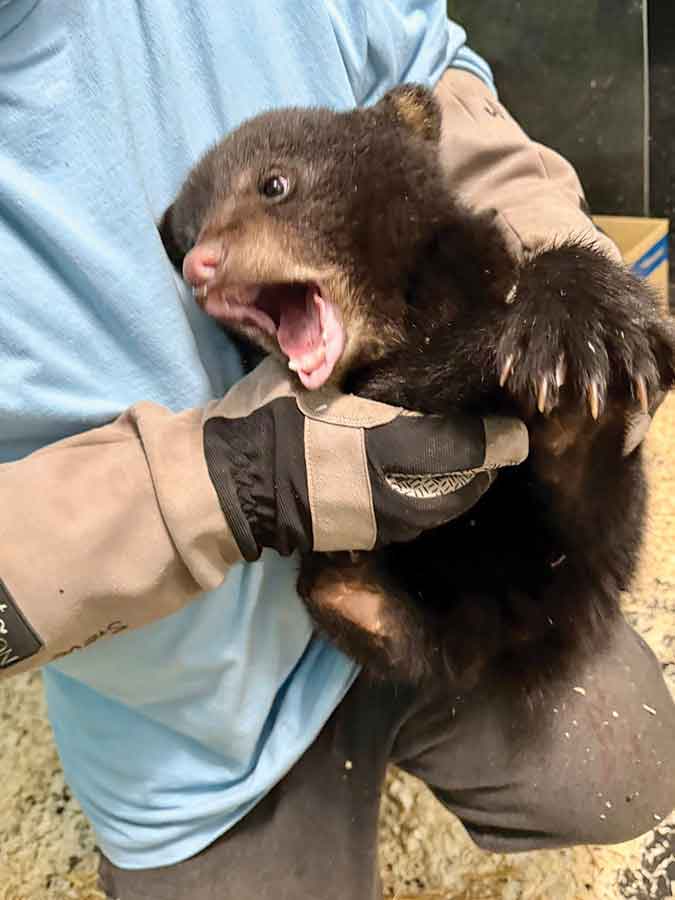
Two orphaned black bear cubs sit huddled together while a third cries out after their mother was illegally shot near Balmoral. The cubs are now in the care of Manitoba Black Bear Rescue
According to Manitoba Black Bear Rescue, the female bear — who was nursing three 10-week-old cubs — was killed near north of Balmoral in March. The loss left the cubs orphaned, distressed and entirely dependent on human intervention for survival.
“At this age, they would have no chance of surviving in the wild without their mother,” said Judy Stearns, owner of the rescue.
Cubs at just 10 weeks old rely completely on their mother for food, warmth and protection. They are still nursing and even require help to relieve themselves, making survival impossible without care.
Stearns said she first became aware of the situation through social media posts shared March 20 and 21, which included photos and the exact location of the den. The posts quickly spread, drawing increasing numbers of people to the site.
“That created a very dangerous situation,” she said.
According to the rescue, the den area saw a steady stream of vehicles, with people stopping to take photos, approaching the bears, making noise and even leaving food behind. Headlights were also reportedly shone on the animals at night.
Such activity can cause significant stress for wildlife and may lead to a mother bear abandoning her cubs, while also increasing the risk of bears becoming habituated to humans and vehicles.
“The biggest concern was that the location was shared publicly, including to anyone who might wish the bears harm — and, unfortunately, that’s what happened,” Stearns said.
The cubs arrived at the facility in otherwise good condition thanks to their mother’s care, although one had a laceration on a front leg that required sutures.
Since then, they have required intensive, around-the-clock care.
Feeding and toileting must be done every three hours, day and night. Because the cubs are still nursing, they must be fed using a syringe fitted with a special nipple — a process that can be difficult as the animals are frightened, disoriented and crying for their mother. Each feeding session can take up to an hour.
“The physical and mental exhaustion is one of the biggest challenges,” Stearns said, noting the constant concern for the cubs’ well-being.
Despite the demanding work, she said rehabilitation programs like theirs have proven successful. Manitoba Black Bear Rescue has rehabilitated and released more than 100 bears.
Cubs typically remain in care until the fall, when they are released back into the wild in time to den for the winter. Those that arrive later in the year may overwinter at the facility and be released the following summer as yearlings.
Stearns emphasized that incidents like this are preventable, pointing to the need for better public understanding of black bear behaviour.
“There are many misconceptions about the threat black bears pose,” she said.
Data from Manitoba’s Wildlife Damage Compensation Program shows black bears account for only a small fraction of livestock predation. Of roughly 1,900 annual claims, about 75 per cent are attributed to coyotes and 20 per cent to wolves, with black bears, cougars and foxes making up the remaining five per cent.
Research also shows that mother black bears are highly unlikely to attack humans in defence of their cubs. While they may bluff charge or vocalize, they typically retreat or encourage their cubs to climb trees rather than engage.
Still, Stearns said misinformation continues to fuel unnecessary fear and harmful actions.
“We’ve received cubs from at least six similar incidents where a female bear was illegally shot, leaving cubs orphaned,” she said.
In Manitoba, it is illegal to kill a female black bear with cubs. Violations can result in fines, equipment seizures and possible licence suspensions, with investigations handled by conservation officers.
In Manitoba, it is illegal to kill a female bear with cubs, though enforcement and broader protections fall under provincial authorities.
Stearns is urging the public to take simple precautions to coexist with wildlife, particularly in bear country.
Residents are encouraged to remove bird feeders from April through November, secure garbage and other food attractants, and consider electric fencing for gardens or fruit trees. When encountering a bear, people should calmly leave the area and avoid approaching dens, keeping pets away as well.
Her strongest message, however, is about responsibility in the digital age.
“Please do not share the location of vulnerable wildlife publicly,” she said. “Take the time to verify information before posting. Misinformation and exposure can have very real and harmful consequences.”
As the three cubs continue their recovery, Stearns hopes their story will serve as both a warning and a learning opportunity.
“This bear didn’t deserve to lose her life,” she said. “And her cubs deserved the chance to stay with their mother in the wild.”