The South Central Eco Institute has been recognized for its work in environmental education and water stewardship after receiving the Red River Basin Commission (RRBC) Endowment Grant, an award highlighting organizations making a meaningful impact across the Red River Basin.
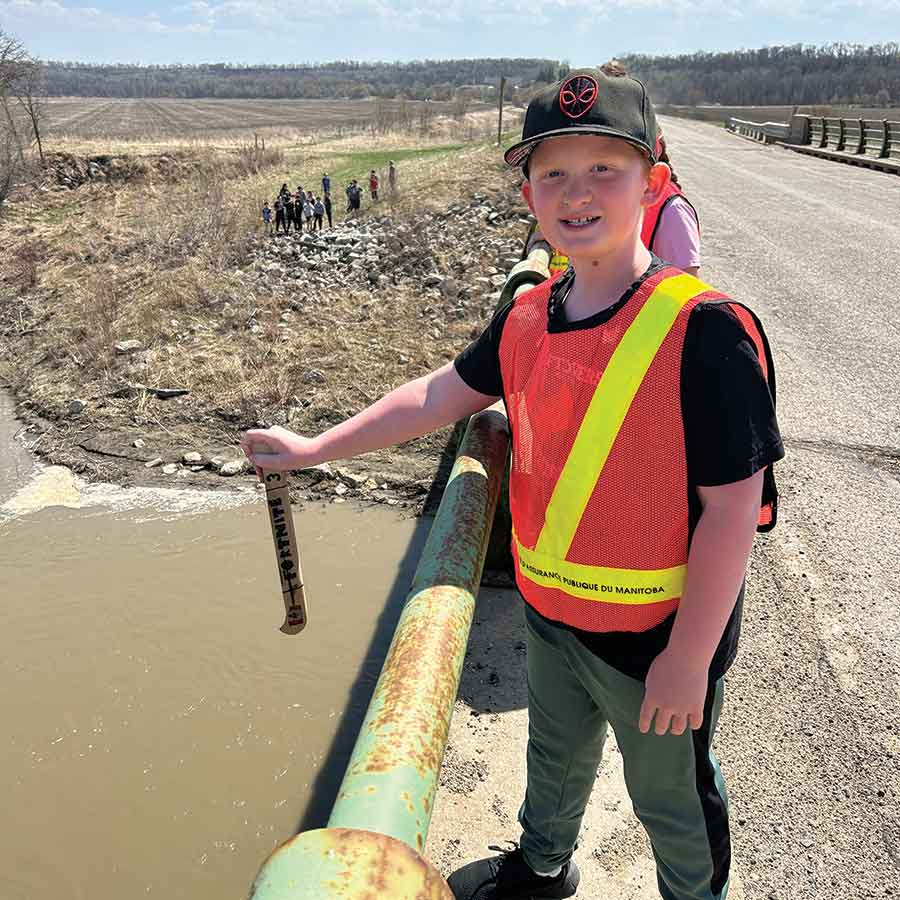
Two students from Treherne Elementary School drop their canoes, they helped decorate through the River of Dreams program, into the river
The grant, presented by the Red River Basin Commission’s executive committee during its 15th annual North Chapter Fish Dinner Fundraiser Gala on March 19, celebrates community-based initiatives that advance environmental awareness, innovation and stewardship.
For program coordinator and Prairie Spirit School Division educator Kent Lewarne, the recognition reflects years of work building collaborative, hands-on learning opportunities that connect students, educators and communities to local waterways.
“I was totally shocked when they called me up,” he said. “It is a nice influx that will promote the River of Dreams and the River Watch program this spring and next.”
At the heart of the institute’s work is a focus on water resource management and watershed education, bringing together academics, government representatives, environmental professionals and community members. Through these partnerships, the organization aims to strengthen understanding of how local waterways connect across the broader Red River Basin.
One of its longest-running initiatives is River Watch Manitoba, a student-driven monitoring program that has been operating for more than a decade. Students across Manitoba collect environmental data from local water bodies, which is then compiled and made publicly available online for both educational and research purposes.
“In Prairie Spirit, we were looking for a project to really sink our teeth into, and water quality is an issue a ton of schools and community members were interested in,” Lewarne said. “With immense support from surrounding watershed districts, we quickly realized this project was going to be something bigger than Prairie Spirit, and the South Central Eco Institute was born.”
The program has since expanded to schools across the province, with Lewarne bringing River Watch as far north as Norway House. Upward of 60 Grades 7 through 12 classes participate annually.
“Water is a resource we desperately need to look after,” he added. “And the future of our waters is in the hands of these students.”
More recently, Lewarne has helped introduce the River of Dreams program to Manitoba youth in Grades 4 to 6. Originally developed by the International Watershed Institute in the United States, the program uses a hands-on approach to teach students about watershed connectivity and river systems.
The initiative invites students to decorate and launch small cedar canoes — each approximately 14 inches in size — into local waterways. Each canoe carries a unique tracking number and a message encouraging anyone who finds it to log its journey online before returning it to the water. Over time, students are able to follow the path of their canoe as it travels through the watershed, potentially making its way toward Hudson Bay.
He added that, thanks to funding from the RRBC, every student across nine classrooms was able to decorate and launch their own canoe this year.
“The kids have had an absolute blast with the program, and the teachers absolutely love it,” he said. “We’ve been fortunate to put a canoe in the hands of every student. They can make it their own, and that’s what makes this unique — they are making a canoe of their dreams.”
He has run the program for two years, launching in three classrooms in the first year and nine classrooms in the second. So far, only one canoe has been spotted upstream, but Lewarne hopes more will be discovered as they travel.
“I want them to go wherever the waterways can take them,” he said. “We would love to see them make it out to the sea — that would be my dream for the River of Dreams.”
Lewarne said the program is designed to turn abstract environmental concepts into something tangible for students, allowing them to physically connect with the movement of water across regions and ecosystems.
In addition to program development, he is a regular presence in classrooms throughout the Red River Basin, where he leads discussions on water conservation and encourages students to think critically about their role in protecting local environments.
“Kids will only protect what they love, and they will only love what they understand,” Lewarne said. “In years from now, they will be the people making decisions about the future of our watersheds, and their knowledge is key — education is the infrastructure that will reach the most people.”
He added he hopes youth will share their knowledge with others and understand that their decisions, opinions and voices matter.
The RRBC Endowment Grant highlights growing recognition of community-driven environmental education efforts across the region. For the South Central Eco Institute, the focus remains on building long-term awareness and stewardship through education, collaboration and hands-on learning.
Looking ahead, Lewarne hopes to expand participation in both River Watch Manitoba and the canoe program, reaching more schools and strengthening connections between communities and the waterways that link them.
“It’s my goal to get these programs into the hands of as many students as possible,” he said. “Students will be fantastic decision-makers for our basins — they are the key to a healthy future.”
Registration for the River Watch program is accepted on an ongoing basis. Participation inquiries for River of Dreams will open in late fall 2026, with school presentations and canoe construction anticipated in early 2027 and launches in spring. All schools across the province will be considered for the spring 2027 launch, with final participation numbers dependent on funding.
For more information on South Central Eco Institute initiatives, contact klewarne@prspirit.org.