By Lana Meier with files from Corrine Einarsson
A routine calving season turned extraordinary for a long-time Interlake farm family after a Charolais cow delivered twin calves nearly a week apart — a rare occurrence that even a lifetime of farming experience could not prepare them for.
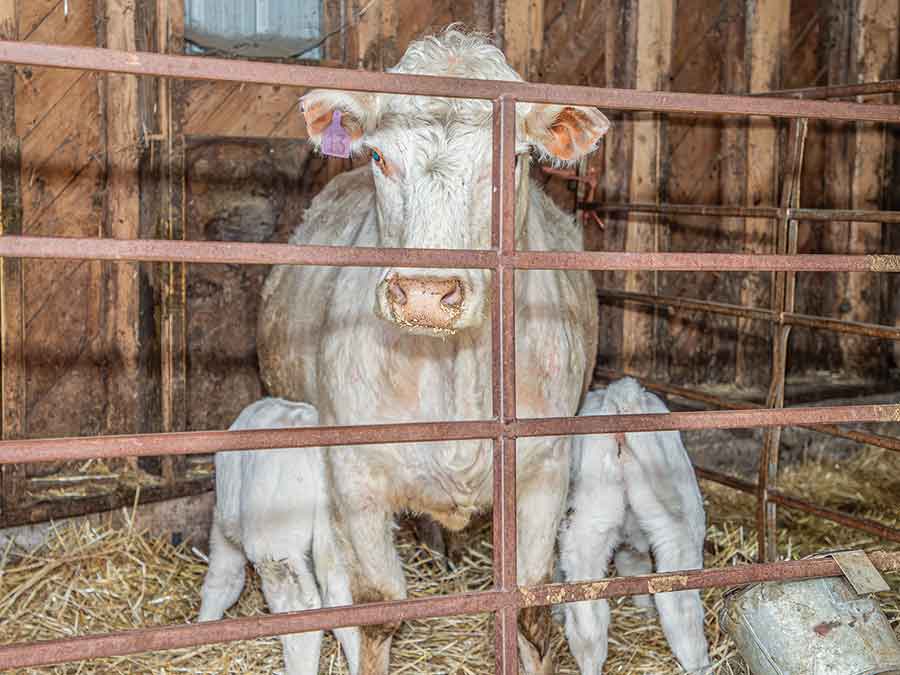
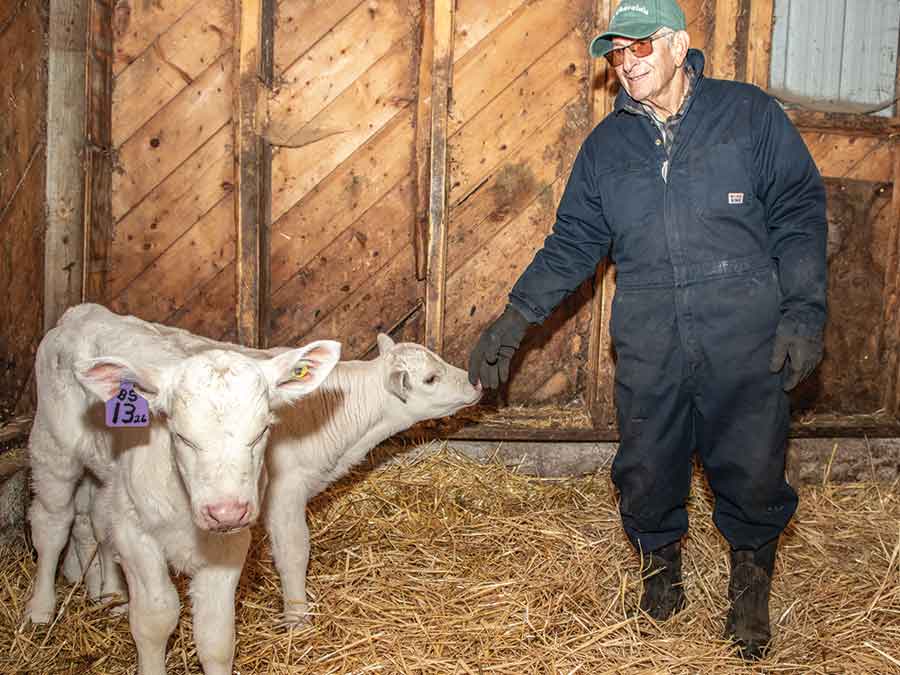
Ted Sumka poses with the twin calves born nearly a week apart on his family farm in Rembrandt, a rare occurrence he describes as “nothing short of a miracle” after more than 60 years in cattle farming
In early April, Ted Sumka of Rembrandt witnessed what he now calls nothing short of a miracle.
On April 3, one of their Charolais cows gave birth to a healthy heifer calf. Everything appeared normal. But six days later, on the morning of April 9, Ted returned to the barn and noticed something unusual.
“I saw the cow over there licking something,” he said. “When I walked over, I realized it was another calf. I just couldn’t believe my eyes.”
The second calf, a bull, had been born nearly a week after the first — an extremely rare phenomenon known as a delayed twin birth.
“I’ve checked a lot of cows over the years, but this was something else,” Sumka said. “You look once, then you look again just to make sure you’re seeing it right.”
He said instinct quickly took over.
“You don’t have much time to stand there thinking about it,” he said. “You make sure the cow is doing well and that the calf gets what it needs right away.”
Sumka immediately checked the animals before heading to the house for colostrum to support the newborn calf.
“I told Shirley (his wife), ‘We have a miracle farm — and a miracle calf,’” he said.
While twin calves themselves are not uncommon, the extended delay between births is exceptionally rare. In most cases, twins are delivered within hours of each other. Research suggests delayed twin births may occur as infrequently as one in 200,000 calvings.
The phenomenon is believed to happen when each calf develops in a separate uterine horn, allowing one to be born while the second remains inside the cow for several more days. The situation can be risky, but in this case, both calves and the mother came through in excellent condition.
Despite the unusual circumstances, Sumka said both calves were strong from the start.
“They were up and moving like any other calves,” he said. “That’s what really surprised me — how well they were both doing.”
Now affectionately referred to as “Miracle Baby No. 1” and “Miracle Baby No. 2,” the calves are thriving and behaving much like typical twins, feeding side by side and rarely straying far from one another.
The cow, a four-year-old in her second calving, has taken to both calves without issue.
“She took to both calves right away,” Sumka said. “That’s not always the case, but she’s done a real good job with them.”
For the Sumka family, the experience is especially meaningful given their own connection to twins. Ted has twin sisters, and their son Brad and his wife Holly welcomed twin boys, Hunter and Chase, in August 2024.
Longtime farmers in the Arborg area for more than 60 years, the Sumkas operate a cow-calf farm alongside Brad and Holly, who farm in nearby Poplarfield. Farming runs deep in the family’s roots — Ted grew up in Skye Lake and Shirley in Meleb — and the family has been working the land for more than a century.
Having family involved in the operation makes moments like this even more special, Sumka said.
“It’s nice to be able to share something like this with Brad,” he said. “You don’t see it very often, so it’s something we’ll remember.”
Now 82, Sumka remains actively involved in the day-to-day work of the farm, continuing a lifetime spent in agriculture. He also drove a school bus for 38 years and worked in Winnipeg as a young man before returning full-time to farming and raising his family.
“It gives me purpose. It keeps me young and active,” he said. “My goal is to keep farming all my living days.”
The spring calving season has kept the family busy, with approximately 89 to 90 calves expected this year. As of last week, about 50 calves had already been born, putting the operation on track to wrap up by the end of May.
After decades in the cattle business, Sumka said moments like this are a reminder that farming still holds surprises.
“You learn something new every year, no matter how long you’ve been at it,” he said. “That’s one of the things about farming — it keeps you on your toes.”
Even after more than 60 years on the land, this is one experience he won’t soon forget.
“You think you’ve seen it all,” he said. “Then something like this comes along and proves you haven’t.”